
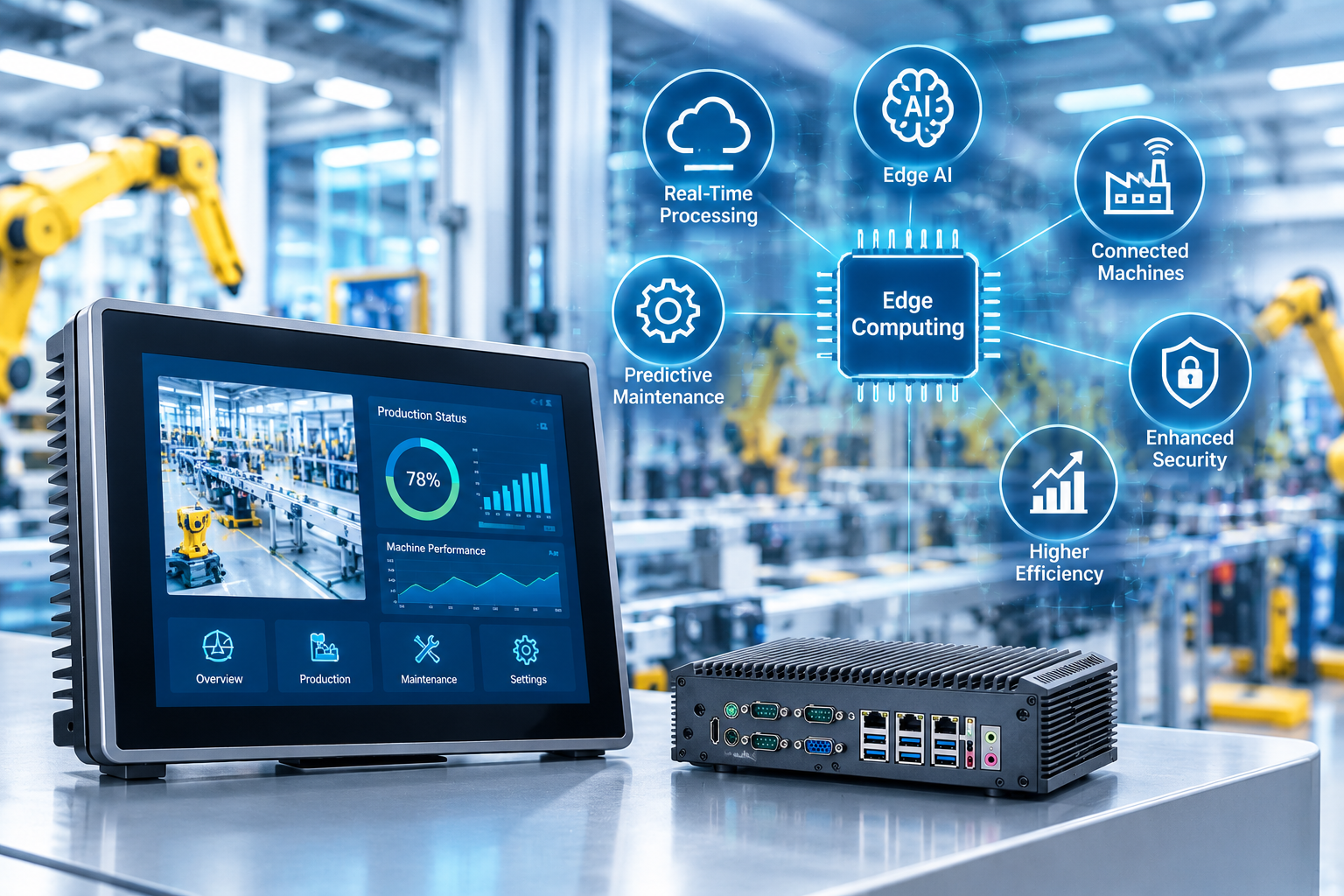
Industrial Edge Computers in 2026: What's Changing in Smart Manufacturing?

Manufacturing is moving towards smarter, more connected and data-driven production. Factories are no longer relying only on traditional automation systems. They are increasingly using real-time data, industrial connectivity, artificial intelligence (AI) and predictive analytics to improve production efficiency and reduce downtime.
At the centre of this transformation is the Industrial Edge Computer. By processing data closer to machines and production equipment, these systems help manufacturers make faster decisions without depending entirely on remote cloud infrastructure.
In 2026, industrial edge computing is becoming an important part of smart manufacturing strategies. But what is changing, which applications are driving adoption, and what should businesses consider when choosing an industrial edge computer?
1. From Traditional Automation to Connected Manufacturing
Traditional industrial automation often relies on individual machines and control systems operating within defined processes. While these systems remain essential, manufacturers increasingly need to connect production equipment with business applications, monitoring platforms and data analytics tools.
Industrial edge computers help bridge this gap between operational technology (OT) and information technology (IT).
They can collect and process information from connected equipment, communicate with other systems and provide a local computing platform for industrial applications.
This supports:
- Real-time machine and production monitoring
- Centralised equipment data collection
- Communication between industrial devices and IT systems
- Production performance analysis
- Remote monitoring and maintenance
The objective is not necessarily to replace existing automation infrastructure. It is to make existing machines and production processes more connected and easier to manage.
2. Edge AI Is Bringing Intelligence Closer to the Factory Floor
One of the important developments in 2026 is the growing use of AI in manufacturing. Applications such as quality inspection, predictive maintenance and production optimisation increasingly depend on timely access to machine data.
Cloud computing can support large-scale data storage and analysis, but sending every piece of production data to a remote server may introduce latency, connectivity requirements and additional data-transfer costs.
Edge computing offers another approach: process suitable workloads locally, close to the equipment generating the data.
Examples include:
Quality inspection: Industrial cameras and connected computing systems can support automated inspection workflows by analysing images and identifying potential defects.
Predictive maintenance: Machine data, including temperature, vibration and operating conditions, can be analysed to help identify unusual behaviour before equipment failure occurs.
Production monitoring: Local processing can help operators monitor machine status, production performance and process conditions.
Energy management: Industrial systems can collect and process energy-consumption data to help identify inefficient operating patterns.
An important consideration is that not every industrial computer can run every AI workload. Demanding machine-vision and AI inference applications may require dedicated GPU or NPU acceleration, depending on the software and model being used. Hardware should therefore be selected according to the actual computing requirements.
3. Real-Time Data Processing Is Becoming More Important
Manufacturing environments generate large amounts of data from PLCs, sensors, industrial networks, cameras and connected machines.
In many applications, waiting for information to travel to a remote cloud platform and return is not ideal. Local processing can reduce dependence on external connectivity and support faster responses.
For example, a production monitoring application may need to display machine status immediately. An industrial edge computer can receive information from connected equipment, process it locally and present relevant information to operators.
However, an industrial edge computer should not automatically be treated as a replacement for a PLC or a safety-critical control system. Time-sensitive control and safety functions must remain within appropriately designed and validated control architectures.
4. Industrial Connectivity and IT/OT Integration
Smart manufacturing requires different systems to exchange information reliably. Industrial edge computers can provide interfaces that connect machines, sensors, displays and network infrastructure.
When evaluating an industrial edge computer, check for:
- Gigabit Ethernet for industrial network communication
- Serial interfaces such as RS-232, RS-422 and RS-485
- USB ports for peripherals and service equipment
- Display interfaces where additional screens are required
- Compatibility with the required operating system and industrial software
Software compatibility is equally important. A computer may have sufficient processing power but still be unsuitable if it cannot support the required drivers, communication protocols or industrial applications.
For manufacturers using an established industrial edge ecosystem, platform compatibility and device certification should also be checked before purchasing.
5. Fanless Design and Long-Term Industrial Reliability
Industrial computers often operate in environments where dust, vibration, temperature changes and limited installation space can create challenges.
A fanless industrial computer reduces reliance on moving cooling components. This can be useful in installations where maintenance access is limited or where dust accumulation is a concern.
Other important factors include:
- Front-panel protection rating
- Operating temperature range
- Industrial-grade power input
- Housing material and mounting options
- Memory and storage requirements
- Availability of technical documentation and product support
For panel-mounted applications, the display size, resolution, touch technology and front-panel protection should also match the working environment.
6. How to Choose the Right Industrial Edge Computer in 2026
Before purchasing an industrial edge computer, manufacturers and machine builders should evaluate the complete application rather than selecting hardware based only on processor specifications.
Start with the workload. Determine whether the computer will be used for HMI visualisation, machine monitoring, data collection, industrial communication or more demanding analytics.
Select the processor according to performance requirements. A system designed for operator interaction and monitoring may not need the same processing capability as a machine-vision application.
Check memory and storage. Consider the operating system, industrial software, application size and expected data-storage requirements.
Review connectivity. Confirm that the computer has the Ethernet, serial, USB and display interfaces required by the existing equipment.
Consider the installation environment. Check cooling design, protection rating, power input, mounting and operating temperature.
Verify software and platform compatibility. Confirm that the required operating system, industrial runtime and application software are supported.
7. Pericom Industrial Edge Panel PCs: NPP-156P01 and NPP-156P02
For manufacturers looking for a Siemens-certified Industrial Edge Panel PC, Pericom offers two 15.6-inch models with different processor platforms.
NPP-156P01 – Intel Celeron J6412 Industrial Edge Panel PC
The NPP-156P01 is based on the Intel Celeron J6412 processor. It is designed for industrial panel computing applications where HMI visualisation, machine operation, equipment monitoring and industrial communication are important.
Its key hardware features include:
- Intel Celeron J6412 processor
- 15.6-inch Full HD display
- Fanless design
- DDR4 memory support
- IP66-rated front panel
- Multiple Ethernet, USB and serial interfaces
It is worth considering for machine builders and manufacturers who need a Siemens-certified industrial panel PC based on the J6412 platform.
NPP-156P02 – Intel N97 Industrial Edge Panel PC
The NPP-156P02 uses the Intel Alder Lake-N N97 processor, offering a different processor platform from the J6412-based NPP-156P01.
It supports DDR5 memory and is suited to industrial panel computing projects where the N97 platform is a preferred hardware option.
Potential applications include industrial HMI, machine monitoring, production visualisation and connected automation systems, subject to the performance and software requirements of the application.
The NPP-156P02 should be evaluated as an Intel N97-based solution rather than treated as another version of the J6412 model.
Which model should you choose?
Choose the NPP-156P01 when the Intel Celeron J6412 platform matches your application and existing hardware requirements. Consider the NPP-156P02 when you specifically require the Intel N97 platform and its DDR5 memory architecture.
The right choice depends on software compatibility, workload, memory requirements, interfaces and the expected service life of the installation.
Conclusion: Industrial Edge Computing Is Becoming a Manufacturing Essential
In 2026, industrial edge computers are helping manufacturers move towards connected, data-driven production. Real-time processing, Edge AI, predictive maintenance and improved IT/OT integration are creating new opportunities for factory automation.
However, successful implementation depends on selecting hardware that matches the actual application. Processor performance, connectivity, industrial protection, software compatibility and long-term support should all be considered before purchasing.
If you are planning to upgrade an existing machine, develop a new automation system or integrate industrial edge computing into your production environment, explore Pericom's NPP-156P01 and NPP-156P02 Industrial Edge Panel PCs.
Looking for the right Industrial Edge Computer for your application? Contact Pericom to discuss your industrial computing requirements.
Frequently Asked Questions
1. What is an Industrial Edge Computer?
An Industrial Edge Computer is a computing system designed to process and manage data close to industrial machines and equipment. It supports applications such as machine monitoring, industrial communication, HMI and local data processing.
2. Why is edge computing important in smart manufacturing?
It allows suitable data-processing tasks to take place closer to production equipment. This can reduce dependence on cloud connectivity, support faster local responses and improve access to machine data.
3. Can an Industrial Edge Computer run AI applications?
Yes, depending on its processor, memory, graphics or AI acceleration capabilities and software compatibility. More demanding AI and machine-vision workloads may require dedicated acceleration hardware.
4. What is the difference between NPP-156P01 and NPP-156P02?
The NPP-156P01 uses an Intel Celeron J6412 processor and DDR4 memory architecture. The NPP-156P02 uses an Intel N97 processor and supports DDR5 memory. The appropriate model depends on the application's hardware and software requirements.
5. What should I check before buying an Industrial Edge Computer?
Check processor performance, memory, storage, connectivity, operating system support, industrial protection, mounting options and compatibility with your automation software.
Read More: https://tecsysproductguides.blogspot.com/2026/10/industrial-edge-computers-in-2026-whats.html


