
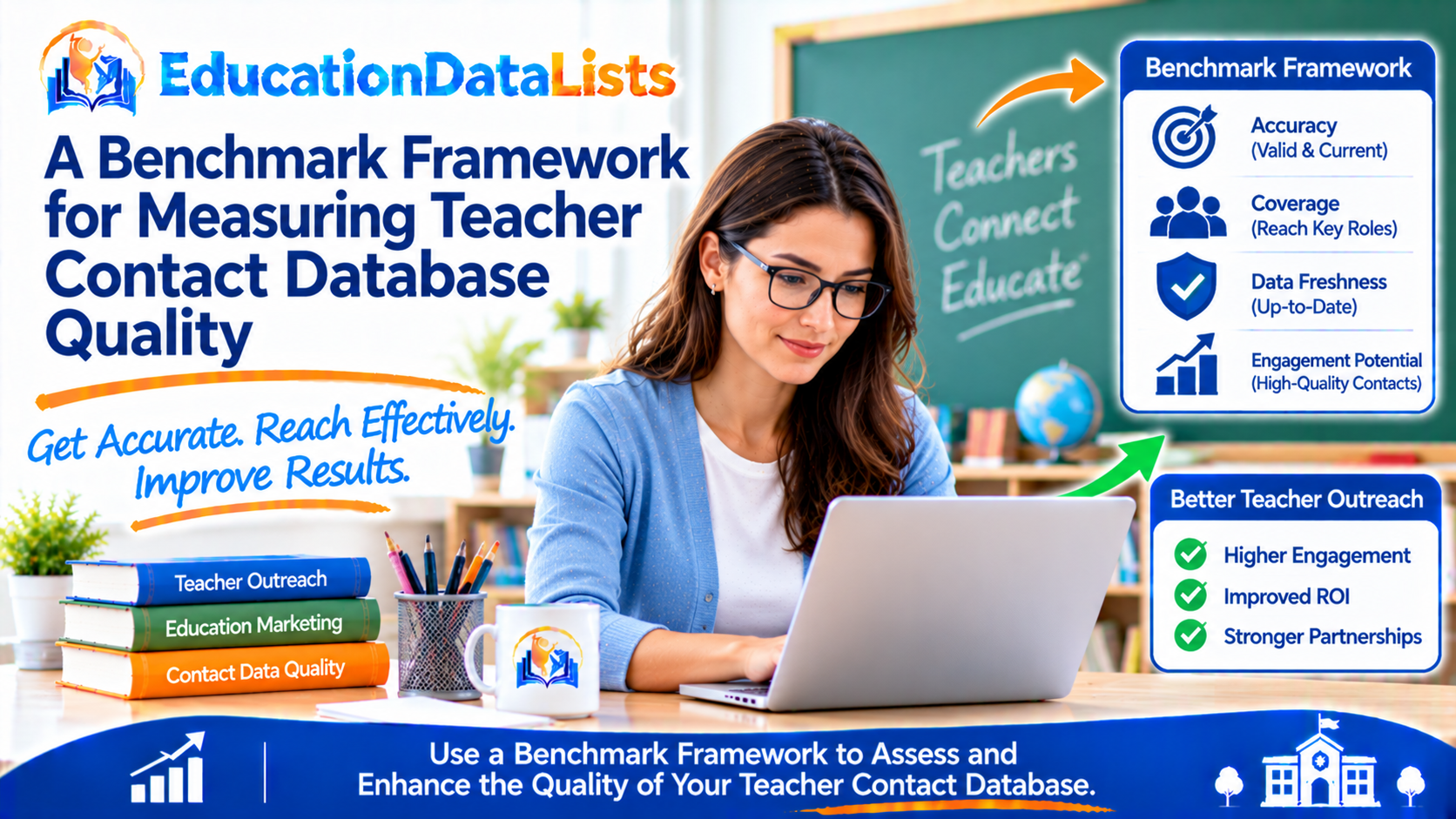
A Benchmark Framework for Measuring Teacher Contact Database Quality | EducationDataLists

1. Why Teacher Contact Database Quality Needs Measurable Standards
Education vendors often evaluate contact databases by their total number of records. However, a large database does not necessarily provide better prospecting opportunities. Outdated email addresses, incorrect school affiliations, duplicate contacts, and inaccurate job titles can reduce campaign effectiveness.
The scale of the U.S. education workforce makes data quality especially important. According to the National Education Association's Rankings of the States 2025 and Estimates of School Statistics 2026, U.S. public schools employed approximately 3,231,992 teachers during 2024–25. The same report estimated that the national teacher workforce would remain close to 3.23 million in 2025–26.
This creates a substantial potential audience for curriculum publishers, education technology companies, professional development providers, and classroom resource suppliers. A meaningful Teachers Email List benchmark should therefore measure record accuracy, contact relevance, institutional coverage, freshness, and usability rather than database size alone.
2. Measure Contact Accuracy and Email Validity
The first benchmark should establish whether each record contains accurate contact information. An incorrect email address or mismatched name can make an otherwise relevant prospect unusable.
A useful evaluation should examine:
-
Email accuracy: Whether the address is correctly formatted and associated with the intended contact.
-
Name accuracy: Whether the teacher's name matches available institutional information.
-
Domain consistency: Whether the email domain corresponds to the school's current official domain.
-
Contact status: Whether the address appears technically deliverable.
-
Source verification: Whether the record can be traced to a reliable source.
Validity's State of CRM Data Report 2026, based on a survey of 500 marketers worldwide, found that only 21.3% considered their CRM data very well prepared for AI. Additionally, 71.4% said poor CRM data had contributed to inaccurate or misleading AI results.
Although this research covers broader marketing databases rather than teacher contact records specifically, it demonstrates why businesses should not assume that existing CRM information is accurate simply because it has already been collected.
For education vendors, the same principle applies to a Teachers Mailing List. Technical email validation should be combined with institutional checks to establish whether the address belongs to the intended teacher and school.
3. Evaluate Employment and School Affiliation Accuracy
A teacher's email address may remain technically valid even after that individual changes schools or leaves the teaching profession. Consequently, email deliverability alone is not a sufficient quality indicator.
The National Center for Education Statistics (NCES) provides useful institutional reference information through its Common Core of Data (CCD). Its 2025–26 preliminary directory files include school and district identification numbers, locations, mailing addresses, operational status, and grade ranges. The information is based on an October 1, 2025 snapshot.
Education vendors can use these records to establish whether a teacher's listed institution exists and whether the school is classified correctly. However, NCES institutional directories do not independently verify every teacher's employment or email address.
A contact database should ideally distinguish between:
-
Teachers currently associated with the listed school.
-
Teachers whose employment status requires confirmation.
-
Former employees or contacts with outdated affiliations.
-
Records associated with closed, renamed, or reorganized institutions.
A practical quality measure is the school-affiliation accuracy rate:
School-affiliation accuracy = Correctly matched teacher records ÷ Records reviewed × 100.
This metric helps identify whether contact information is connected to the right institution, not simply whether an email address works.
4. Check Job Titles, Teaching Levels, and Subject Specializations
Not every teacher is an appropriate prospect for every education product. A supplier selling early-literacy resources may need elementary educators, while a company offering advanced science laboratory equipment may prioritize secondary science teachers.
The NEA's 2026 report provides a national workforce overview, but vendors need more detailed segmentation to identify relevant professional audiences.
Useful database fields include:
| Data field | Purpose |
|---|---|
| Current job title | Distinguishes teachers from administrators and other staff |
| Grade level | Separates elementary, middle, and high school audiences |
| Subject specialization | Identifies relevant curriculum or instructional interests |
| School type | Supports public, private, and charter school segmentation |
| School location | Enables geographic targeting |
| Institution name | Connects the contact to the correct school |
| Employment status | Helps identify outdated records |
These fields make a Teachers Email Database more useful for targeted campaigns.
For example, a mathematics education publisher could prioritize mathematics teachers by grade level, while a professional development provider might segment educators by subject, experience, and institutional type.
The objective is to establish audience relevance rather than assume that every person with a teacher-related job title is a suitable prospect.
5. Measure Database Freshness and Workforce Changes
Teacher employment information changes as educators move between schools, accept new positions, retire, or leave the profession. A database that was accurate when originally collected can gradually become outdated.
RAND's 2025 State of the American Teacher survey found that 16% of surveyed K–12 public school teachers intended to leave their jobs by the end of the 2024–25 school year, down from 22% in 2024. The report also found that 53% reported burnout, compared with 60% in the previous survey.
These figures measure intentions and reported experiences, not actual departures. Nevertheless, they illustrate why teacher employment information should be reviewed regularly.
A practical freshness framework should track:
-
The date each contact was originally collected.
-
The date the email address was last validated.
-
The date the school affiliation was last checked.
-
Any reported job-title or employment changes.
-
The date of the most recent database review.
A useful metric is the record freshness rate:
Record freshness = Records verified within the defined review period ÷ Total records × 100.
The review period should reflect campaign frequency, data source reliability, and the importance of the contact information. Vendors should not assume that a technically valid address automatically represents a current professional relationship.
6. Assess Duplicate Records and Institutional Coverage
Duplicate contacts can distort campaign reporting, increase unnecessary outreach, and create confusion within CRM systems. A teacher might appear multiple times because of different name formats, multiple school affiliations, or inconsistent email records.
Education vendors should compare records using email addresses, names, school identifiers, and other appropriate matching fields.
Database coverage is another important consideration. NCES reported 99,073 operating public elementary and secondary schools and 19,183 operating districts in 2024–25. These figures provide an institutional reference for understanding the scale of the public-school market.
However, a database should not be judged simply by how many schools it claims to cover. Vendors should examine whether records are distributed across states, school levels, subjects, and institution types relevant to their target audience.
Useful measures include:
-
Duplicate rate.
-
Percentage of records with complete institutional information.
-
Geographic coverage across target states.
-
Representation of relevant school levels.
-
Percentage of contacts with identifiable teaching specializations.
This helps businesses distinguish broad database coverage from meaningful coverage of their intended market.
7. Build a Practical Teacher Contact Database Quality Scorecard
Education vendors can combine these dimensions into a consistent evaluation framework.
The following scorecard is a proposed internal benchmark, not an industry-wide standard. Businesses can adjust the weights according to their products and target audiences.
| Quality dimension | Suggested weight |
|---|---|
| Email accuracy and deliverability | 25% |
| Employment and school affiliation | 25% |
| Job title and subject relevance | 20% |
| Data freshness | 15% |
| Duplicate management | 10% |
| Institutional and geographic coverage | 5% |
| Total | 100% |
Each category can be rated from 0 to 100 based on a representative sample of records.
For example, a database scoring well on email validity but poorly on employment accuracy may still generate irrelevant outreach. Similarly, strong institutional coverage does not compensate for missing subject specializations when a campaign targets a specific teaching audience.
A weighted score provides a more balanced assessment than relying on one metric.
8. Practical Steps for Improving Teacher Database Quality
Education vendors can apply five actions when evaluating or maintaining their contact records:
-
Validate email addresses: Identify formatting problems, invalid addresses, and potential delivery issues before launching campaigns.
-
Confirm institutional affiliation: Match contacts against current school information and reliable institutional sources.
-
Standardize segmentation: Organize records by grade level, subject, school type, and geography.
-
Remove duplicates and outdated records: Establish a consistent process for reviewing repeated or obsolete contacts.
-
Measure performance: Track delivery, bounce rates, replies, qualified inquiries, and conversion outcomes to identify weaknesses in audience selection.
EducationDataLists can be considered as a resource for businesses researching education-sector contact data. Vendors should evaluate available fields, sourcing information, verification practices, and suitability for their intended outreach before using any database.
Conclusion
A reliable teacher contact database should be measured through a combination of accuracy, relevance, freshness, institutional coverage, and duplicate management. National workforce figures demonstrate the scale of the U.S. teaching market, while recent CRM research highlights the business risks associated with inaccurate data. Education vendors should therefore move beyond record-count comparisons and adopt a structured quality scorecard. A well-maintained Teachers Email List can support more focused prospecting when contact information is connected to current school affiliations, relevant teaching roles, and appropriate audience segments. By measuring these factors consistently, businesses can make better database decisions, reduce unnecessary outreach, and develop more effective education marketing campaigns.
Frequently Asked Questions
1. What makes a Teachers Email List high quality?
A high-quality list contains accurate email addresses, current school affiliations, relevant job titles, useful teaching specializations, and minimal duplicate records. It should also provide information about data sources and verification dates.
2. How can businesses measure teacher contact database accuracy?
Businesses can review a representative sample and calculate the percentage of records with correctly matched names, email addresses, school affiliations, and job titles. Email validation should be combined with institutional verification.
3. How often should a Teachers Mailing List be updated?
There is no universal update frequency that guarantees accuracy. Vendors should establish a review schedule based on data freshness, campaign activity, source reliability, and observed changes in contact information.
4. Why is teacher job-title segmentation important?
Teachers work across different grade levels, subjects, and educational settings. Job-title and subject segmentation helps suppliers identify professionals whose responsibilities are relevant to a particular product or service.
5. What is a good benchmark for teacher email database quality?
There is no universally accepted industry benchmark specifically for teacher contact databases. Businesses can create an internal scorecard covering email validity, employment accuracy, relevance, freshness, duplicates, and institutional coverage.
6. How can vendors reduce duplicate teacher records?
They can compare email addresses, names, school identifiers, and institutional details using consistent matching rules. Records that appear similar should be reviewed before merging to avoid combining different educators with similar names.
7. Does a valid teacher email address guarantee accurate employment information?
No. An email address can remain technically deliverable even after a teacher changes schools or leaves the profession. Employment and institutional affiliation should be verified separately.
Research Sources
-
NEA — Rankings of the States 2025 and Estimates of School Statistics 2026
-
NCES — 2025–26 Common Core of Data Preliminary Directory Files
-
RAND — Teacher Well-Being, Pay, and Intentions to Leave in 2025
-
RAND — To Make Teaching Sustainable, Help Teachers Balance Work and Personal Demands
Research note: NEA workforce figures cover public-school teachers. NCES directory information identifies institutions but does not verify individual teacher email addresses. RAND survey findings describe reported intentions and experiences rather than confirmed employment departures. The proposed scorecard weights are suggested evaluation criteria, not published industry benchmarks.


