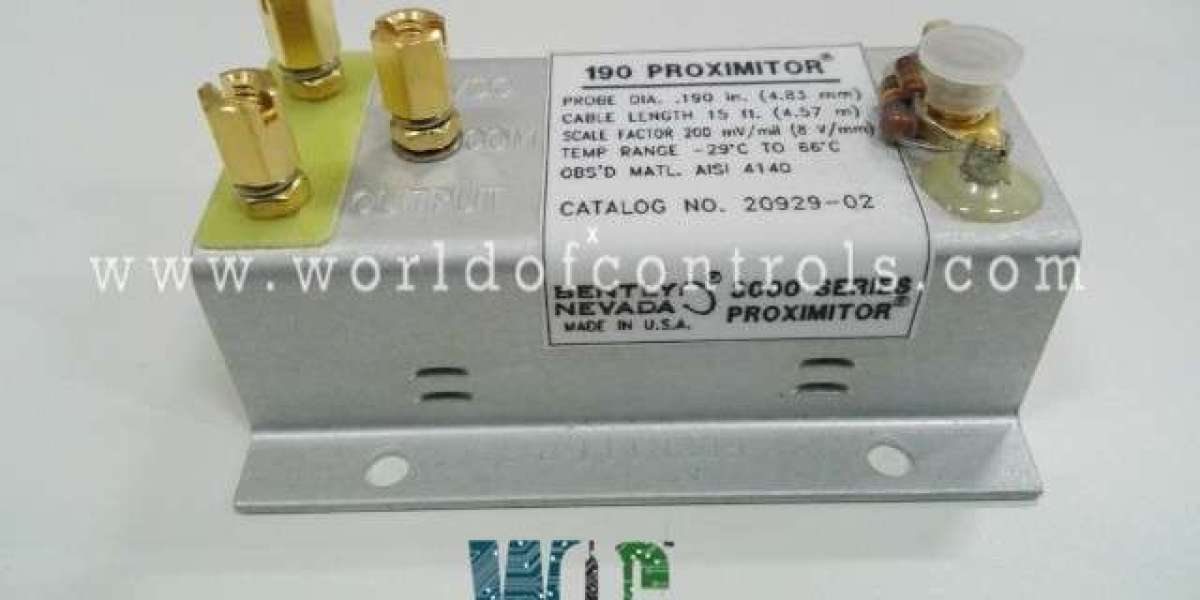
Proximitor transducers play a critical role in the accurate measurement of shaft vibration in high-speed rotating machinery. They enable precise, non-contact monitoring that directly improves equipment reliability and protects critical assets from damage.
Working principle basics
Proximitor transducers are part of a proximity measurement system that uses an eddy current probe, extension cable, and signal conditioning unit to measure the distance (gap) between a probe tip and a rotating shaft. The probe generates an electromagnetic field, and as the conductive shaft moves closer or farther from the probe, the system converts this change into a proportional electrical signal representing shaft displacement.
Shaft vibration measurement fundamentals
Shaft vibration measurement focuses on key parameters such as displacement, amplitude, frequency, and phase to understand how the rotor behaves during operation. Direct measurement of shaft vibration, rather than only monitoring bearing housing vibration, is vital for high-speed turbomachinery because it reveals dynamic behavior at the rotor level that might otherwise go undetected.
Advantages of Proximitor-based measurements
Proximitor-based systems use non-contact sensing, so they do not mechanically load or influence the shaft, which preserves true vibration characteristics even at very high speeds. Their calibrated linear range allows accurate measurement of shaft displacement and orbits, enabling detailed analysis of rotor dynamics, shaft runout, and overall machine health.
Improving reliability and early fault detection
By continuously tracking shaft movement, Proximitor transducers help detect early signs of faults such as unbalance, misalignment, rotor rubs, oil whirl/whip, and developing cracks. Identifying these issues at an early stage reduces the risk of catastrophic failures, supports better maintenance planning, and significantly cuts unplanned downtime for critical equipment.
Integration with condition monitoring systems
The electrical output from a Proximitor transducer is easily integrated into vibration monitoring instruments, protection relays, and control systems for alarms, trips, and long-term trending. When connected to online condition monitoring platforms, these signals allow continuous supervision of machine health rather than relying solely on periodic manual measurements.
Installation and best practices
To obtain accurate measurements, proper probe placement and orientation relative to the shaft are essential, typically using orthogonal probes to capture full rotor motion. Correct gap setting, high-quality cabling, good shielding and grounding practices, and proper calibration all help minimize electrical noise, signal degradation, and measurement errors.
Industry applications
Proximitor transducers are widely used in turbomachinery such as steam and gas turbines, compressors, turboexpanders, large motors, and generators in industries like power generation, oil and gas, and petrochemicals. In these environments, reliable shaft vibration measurement supports higher machine availability, safer operation, and adherence to demanding reliability and safety standards.
Common challenges and how to address them
Typical challenges include temperature variations affecting components, electromagnetic interference from nearby equipment, and poor target surface conditions on the shaft. These issues can be mitigated through proper probe mounting on suitable shaft surfaces, use of shielded cables, adherence to manufacturer installation guidelines, and periodic verification of gap and calibration settings.
Future trends in proximity-based vibration monitoring
Modern Proximitor systems continue to evolve with digital signal processing, enhanced diagnostics, and better integration with plant control and IIoT platforms. As predictive maintenance and advanced analytics become more common, high-quality shaft vibration data from Proximitor transducers will increasingly feed into algorithms that predict failures before they impact production.
Conclusion
Proximitor transducers significantly improve shaft vibration measurement by providing accurate, non-contact, real-time data on rotor behavior, which directly enhances machinery reliability and protection. The 20929-02 Proximitor Transducer is an example of a specialized device designed for demanding industrial applications, offering stable and precise measurements that support effective condition monitoring and trip protection strategies. World of Controls supplies such critical components, including the 20929-02 Proximitor Transducer, providing access to quality products and technical support that help operators maintain the performance and reliability of their most important rotating equipment.