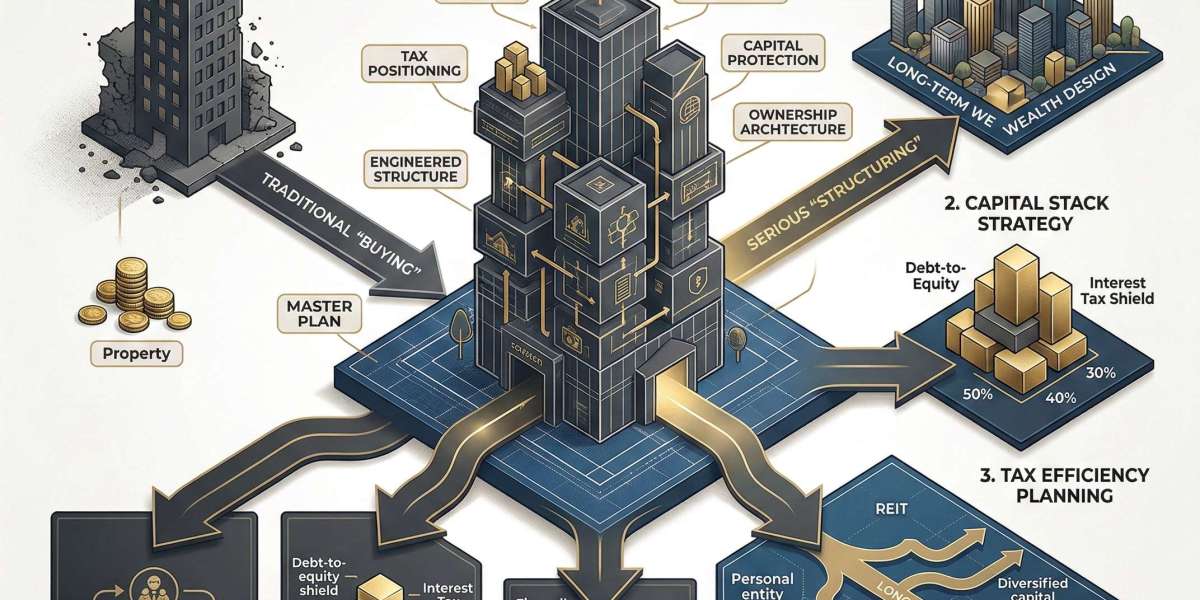
Most people “buy property.” Serious investors structure real estate. There’s a big difference. One approach focuses on ownership. The other focuses on strategy, tax efficiency, risk control, and long-term wealth design. If you’re thinking beyond one flat or one commercial unit, this article will change how you look at real estate.
Why Buying Property Isn’t Enough Anymore
In today’s market, property is no longer just about location and price. It’s about:
- Capital protection
- Cash flow optimization
- Tax positioning
- Exit strategy
- Portfolio balance
Without structure, even a good property can become a liability. With the right structure, an average property can become a powerful asset.
What “Structuring” a Property Really Means
Structuring means deciding:
- Who should own the asset? (Individual, LLP, Trust, Company?)
- How should it be financed?
- What is the tax impact over 10–20 years?
- What happens in succession?
- How does it fit within your total portfolio?
Most investors skip these questions. That’s where they lose money.
Example: Two Investors, Same Property
Investor A:
- Buys commercial property in personal name
- Takes a high-interest loan
- Pays maximum tax
- Has no defined exit plan
Investor B:
- Evaluates ownership structure
- Optimizes loan-to-equity ratio
- Plans depreciation benefits
- Aligns with long-term estate strategy
Ten years later, Investor B builds scalable wealth. Investor A owns “property.” That’s the difference.
Why Real Estate Structuring Matters More in 2026
The real estate landscape has changed:
- Compliance rules are tighter
- Tax regulations are evolving
- Commercial yields are under pressure
- Institutional participation is increasing
Smart investors are no longer operating casually.
They rely on professional real estate advisory services to:
- Reduce risk
- Improve ROI
- Build long-term portfolios
The 5 Pillars of Smart Property Structuring
1. Ownership Architecture
Should the property be held under:
- Individual ownership?
- Private Limited Company?
- LLP?
- Trust structure?
Each has different tax, liability, and succession implications. There is no universal best option. It depends on your goals.
2. Capital Stack Strategy
Serious investors think about:
- Debt-to-equity ratio
- Cost of capital
- Refinance strategy
- Interest tax shields
The wrong financing structure can wipe out profits.
3. Tax Efficiency Planning
Tax isn’t something to calculate after buying.
It must be planned before acquisition.
You need clarity on:
- Rental income tax
- Capital gains tax
- Depreciation benefits
- GST implications (for commercial assets)
Structured planning prevents future shocks.
4. Risk Management
Professional structuring separates:
- Personal liability
- Business exposure
- Asset-specific risk
This protects long-term wealth.
5. Exit Strategy Before Entry
- Most investors ask: “What’s the price today?”
- Serious investors ask: “What’s the exit plan?”
Is the strategy:
- Long-term rental yield?
- Capital appreciation?
- Portfolio diversification?
- REIT entry?
Entry without exit is speculation.
Real-World Scenario: Business Owner Expanding Wealth
A successful entrepreneur wants to diversify into commercial real estate.
Without advisory:
- He over-leverages
- Mixes personal and business risk
- Faces liquidity challenges
With structured real estate advisory:
- Asset is acquired under a strategic entity
- Loan terms align with cash flow
- Tax is optimized
- Succession is planned
The asset becomes a wealth engine, not a stress factor.
The Hidden Cost of Not Structuring
Many investors underestimate:
- Legal restructuring later
- Tax penalties
- Compliance complications
- Capital gains leakage
- Estate disputes
Correcting a poorly structured asset later can cost far more than structuring it correctly at the beginning.
Why Advisory Is Becoming Essential
As markets mature, investors move from reactive decisions to structured strategies. Professional firms specializing in asset strategy focus not just on buying property but on designing wealth frameworks around it. For instance, firms like Old Stone Asset Group approach real estate from a structured, portfolio-driven perspective rather than transactional brokerage. You can explore their investment philosophy and structured advisory framework at https://oldstoneassetgroup.com/ to understand how strategic positioning differs from simple property acquisition.
How to Start Structuring Like a Serious Investor
Here are actionable steps you can apply immediately:
1. Review Existing Holdings
Ask:
- Under whose name are assets held?
- What is the effective tax rate?
- Is liability separated?
2. Define 10-Year Objectives
Are you building:
- Passive income?
- Capital growth?
- Intergenerational wealth?
- Business expansion security?
Clarity drives structure.
3. Analyze Cash Flow, Not Just Price
Focus on:
- Net yield after tax
- Loan servicing ratio
- Vacancy buffer
4. Seek Strategic Advisory - Not Just Brokerage
Brokers sell property. Advisors structure portfolios. There is a difference.
Final Perspective: Wealth Is Designed, Not Purchased
Anyone can buy property. Few know how to structure it.
In modern markets, wealth is built through:
- Strategy
- Risk alignment
- Tax intelligence
- Long-term planning
If you’re serious about scaling your property investments and want a framework-driven approach rather than transactional buying, structured real estate advisory can make the difference between owning assets and building wealth. To explore a strategy-focused approach to property structuring and portfolio design, you may review insights from Old Stone Asset Group and evaluate how structured investing aligns with your long-term goals. Because serious investors don’t just buy property. They design it.