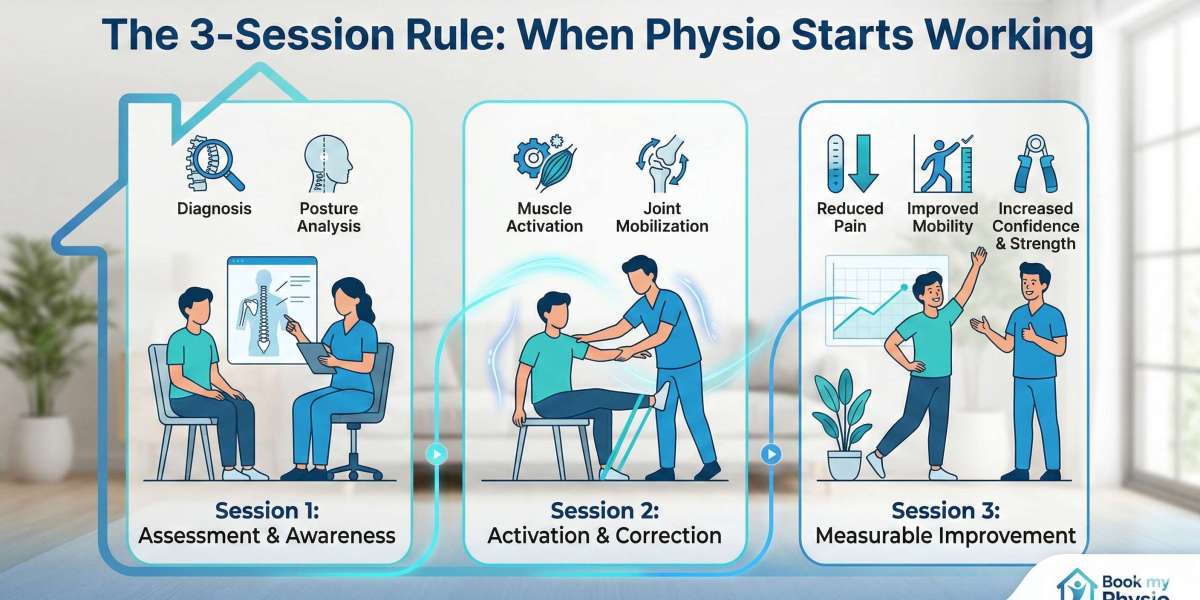
One of the most common questions patients ask is: How many sessions will it take before I feel better? While recovery depends on the condition, severity, and consistency, many physiotherapists follow an informal benchmark often called the 3-Session Rule.
- It’s not magic.
- It’s not a guarantee.
But it’s a practical way to measure whether treatment is moving in the right direction. If you’re considering or already doing home visit physiotherapy, understanding this rule can help you set realistic expectations and track progress the right way.
What Is the 3-Session Rule?
The 3-Session Rule simply means:
By the third physiotherapy session, you should notice at least one of these:
- Reduced pain intensity
- Improved mobility
- Better muscle activation
- Increased confidence in movement
If there’s absolutely no change, not even slight improvement, your treatment plan may need adjustment. This rule keeps both patient and therapist accountable.
Why the First Three Sessions Matter Most
Session 1: Assessment & Awareness
The first session is usually about:
- Understanding the root cause
- Posture and movement analysis
- Pain mapping
- Initial corrective exercises
Many patients expect immediate relief, but this session is about diagnosis and direction.
Real-world example: A 38-year-old IT professional with neck pain assumed it was “just stress.” After evaluation, the real issue was forward head posture and weak scapular muscles. Without proper assessment, exercises alone wouldn’t help.
Session 2: Activation & Correction
By the second session:
- Muscles begin activating correctly
- Stiff joints start mobilizing
- Pain patterns become clearer
This is when subtle improvements begin.
Patients may say:
- “It still hurts, but less sharp.”
- “I feel more flexible.”
- “It doesn’t lock up as often.”
That’s progress.
Session 3: Measurable Improvement
By the third session, there should be visible or felt improvement.
Examples:
- Knee bends 10° more than before
- Shoulder lifts higher
- Walking feels smoother
- Morning stiffness reduces
If nothing changes, it’s time to reassess:
- Is the diagnosis correct?
- Are exercises being done consistently?
- Is there an underlying issue needing imaging?
The 3-Session Rule is about responsiveness.
Why Home Visit Physiotherapy Accelerates Results
Many patients respond faster with home visit physiotherapy compared to clinic-only sessions.
Why?
Because recovery improves when:
- Exercises are done in your real environment
- Postural mistakes at home are corrected
- Daily movement habits are observed
- Consistency increases
For example, a therapist visiting your home can:
- Adjust your workstation setup
- Correct how you climb stairs
- Observe how you lift objects
This practical correction leads to faster functional recovery.
Platforms like Bookmphysioo make accessing structured home visit physiotherapy easier, especially for patients who struggle with mobility or time constraints.
Conditions Where the 3-Session Rule Applies Well
The rule works particularly well for:
- Neck and back pain
- Frozen shoulder (early stage)
- Post-surgery rehab
- Sports injuries
- Sciatica
- Knee osteoarthritis (mild to moderate)
However, chronic neurological conditions or long-standing degenerative issues may require longer timelines.
What If You Don’t Improve After 3 Sessions?
Don’t panic. Instead, check these:
1. Are You Doing the Exercises Daily?
Physiotherapy is not a once-a-week fix.
If prescribed exercises are ignored, progress slows.
2. Is Pain Being Managed Properly?
Sometimes inflammation needs short-term medical support alongside physiotherapy.
3. Is the Diagnosis Accurate?
Persistent non-response may require:
- X-ray
- MRI
- Orthopedic consultation
Good physiotherapy is adaptive.
Signs Physio Is Truly Working
Beyond pain reduction, look for:
- Improved posture awareness
- Better sleep
- Increased strength
- Reduced dependency on painkillers
- More confidence in movement
Healing isn’t just about pain disappearing. It’s about restoring function.
The Psychology of Early Wins
Small improvements early in therapy:
- Boost motivation
- Increase exercise compliance
- Reduce fear of movement
This is why the first three sessions matter psychologically too. When patients feel progress, they commit more seriously.
How to Maximize Results From Session One
If you’re starting home visit physiotherapy, follow these practical steps:
1. Be Honest About Pain
Don’t underplay symptoms.
2. Share Your Daily Routine
Your therapist needs context:
- Sitting hours
- Sleep position
- Activity level
3. Do Exercises Exactly as Prescribed
Wrong form slows recovery.
4. Track Changes Daily
Note:
- Pain score (1–10)
- Movement improvement
- Stiffness levels
Tracking creates measurable progress.
When More Than 3 Sessions Are Needed
Some cases require longer timelines:
- Severe ligament injuries
- Post-fracture rehab
- Chronic disc issues
- Advanced arthritis
In such situations, improvement may start after 4–6 sessions. The 3-Session Rule is a progress checkpoint, not a cure deadline.
Why Environment-Based Rehab Is the Future
In 2026, recovery is shifting toward patient-centered care.
People prefer:
- Comfort
- Personal attention
- Time efficiency
- Customized plans
Home visit physiotherapy aligns with modern lifestyles where:
- Traffic delays waste recovery time
- Busy schedules reduce clinic visits
- Elderly patients need assistance
Services like Bookmyphysioo simplify booking qualified therapists for home-based sessions, ensuring continuity and structured rehabilitation without unnecessary travel stress.
The Bottom Line
Physiotherapy doesn’t work overnight.
But it shouldn’t feel stagnant either.
By the third session, you should notice:
- Less pain
- Better movement
- Improved strength
- Or at least measurable change
If you don’t, reassess.
Recovery isn’t about counting sessions.
It’s about tracking progress. And when therapy is delivered consistently, especially through structured home visit physiotherapy, improvement becomes clearer, faster, and more sustainable. Because healing isn’t passive. It’s active, and it starts from session one.