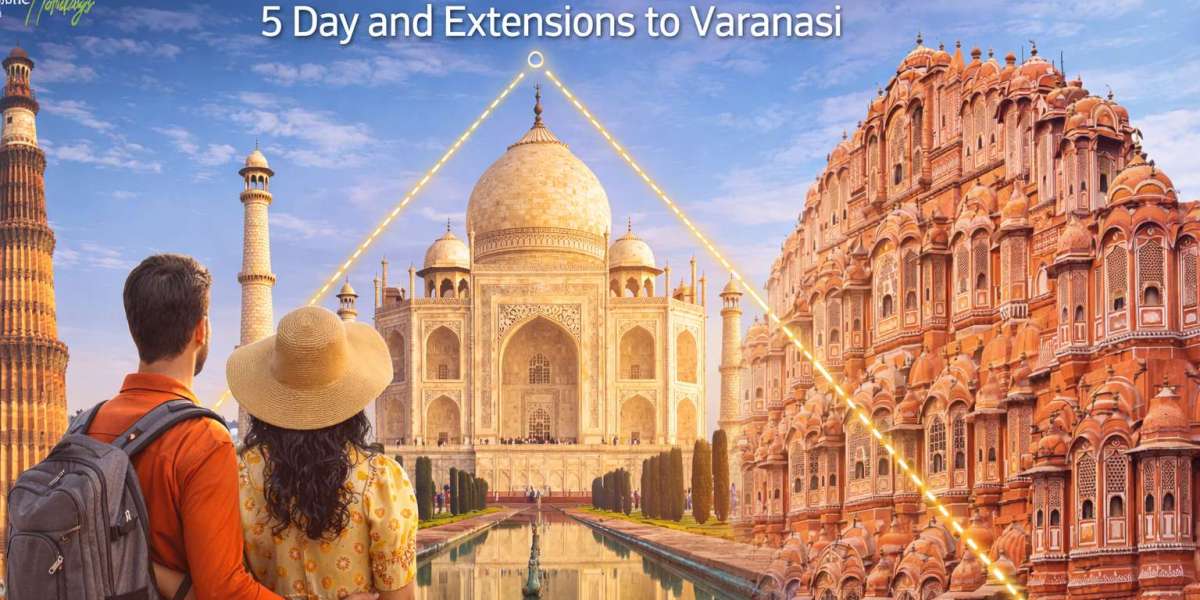
India is not a destination; it is an emotion. It is a kaleidoscopic shift of colors, sounds, and ancient echoes that stay with a traveler long after the dust of the road has settled. For those looking to capture the true essence of this subcontinental giant, the most prestigious route is the iconic "Triple Crown" of the North. For some, the journey is a focused, high-impact golden triangle tour 5 day experience. For others, the hunger for the soul of India leads them further East, into the literal "City of Light," through a Golden triangle tour with varanasi.
In this deep-dive exploration, we move past the surface-level brochures. We delve into the architecture of power, the geometry of love, and the metaphysics of the Ganges.
Part I: The Foundations of Empire (The Golden Triangle)
The Golden Triangle is the most traveled circuit in India for a reason. It represents the three pillars of Indian history: The Political Power (Delhi), the Architectural Romance (Agra), and the Royal Chivalry (Jaipur).
1. Delhi: The Eternal Survivor
Delhi is a city built on the ruins of itself. Historians say there have been at least seven "Delhis." To understand the city, one must look at its two faces:
The Mughal Grandeur: In Old Delhi, the Red Fort (Lal Qila) stands as a sandstone masterpiece. Built by Shah Jahan, it was the ceremonial heart of the Mughal Empire. Nearby, the Jama Masjid towers over the city. When you stand in its courtyard, you are surrounded by 25,000 worshippers and centuries of prayer.
The British Blueprint: New Delhi is the antithesis. Designed by Lutyens and Baker, it features wide boulevards and neoclassical architecture. The India Gate serves as a poignant memorial, while the Qutub Minar—the world's tallest brick minaret—reminds us of the 12th-century Sultanate that first established Delhi as a global capital.
2. Agra: Beyond the White Marble
While the world knows Agra for the Taj Mahal, the city is a living museum of the Mughal "Golden Age."
The Taj Mahal: It is often described as a "teardrop on the cheek of time." But to truly appreciate it, one must look at the Pietra Dura—the intricate marble inlay work using semi-precious stones like lapis lazuli and malachite.
Agra Fort: This is where the story turns tragic. It was here that Emperor Shah Jahan was imprisoned by his own son, Aurangzeb. From the Musamman Burj (an octagonal tower), the deposed King spent his final years staring across the river at the Taj Mahal, the tomb of his beloved wife.
Fatehpur Sikri: Located just outside Agra, this abandoned red sandstone city was the capital for a mere 14 years. Walking through its empty palaces today feels like stepping into a frozen moment in history.
3. Jaipur: The Victory City
Jaipur is the "Pink City," but the color is actually a terracotta pink, applied in 1876 to welcome the Prince of Wales.
The Amber Fort: A blend of Hindu and Mughal styles, this fort is famous for its Sheesh Mahal (Mirror Palace). A single candle lit in this room reflects in thousands of tiny mirrors, creating a "starry night" effect indoors.
Jantar Mantar: This UNESCO site is a collection of nineteen architectural astronomical instruments. It is a testament to the scientific prowess of Maharaja Sawai Jai Singh II, featuring the world’s largest stone sundial.
Part II: The Spiritual Expansion (The Varanasi Connection)
For travelers who feel that the Triangle is too "imperial," the addition of the holy city of Varanasi provides the necessary spiritual balance. This is why many seasoned explorers opt for a Golden triangle tour with varanasi.
The Living Antiquity of Kashi
Varanasi, also known as Kashi or Benares, is one of the oldest continuously inhabited cities on Earth. Mark Twain famously said, "Varanasi is older than history, older than tradition, older even than legend, and looks twice as old as all of them put together."
The Morning Boat Ride: At 5:00 AM, the Ganges is shrouded in mist. As the sun rises, the "Ghats" (riverfront steps) come alive. You will see pilgrims bathing, priests chanting, and the smoke from the cremation pyres at Manikarnika Ghat—a sobering reminder of the Hindu cycle of life and death.
Sarnath: Just a short drive from the chaos of the city lies the serene Deer Park, where Lord Buddha gave his first sermon. The contrast between the roaring life of Varanasi and the meditative silence of Sarnath is profound.
Part III: Crafting the Perfect 5-Day Strategy
If you are choosing a golden triangle tour 5 day itinerary, time management is your greatest ally. Here is a sophisticated breakdown of how to master these 120 hours:
Day 1: The Delhi Immersion
Start at the Humayun’s Tomb. It is the first garden-tomb on the Indian subcontinent and the direct inspiration for the Taj Mahal. Spend your afternoon at Lodhi Gardens, where modern Delhiites jog amongst 15th-century tombs. End your day with a rickshaw ride through the "Gali Qasim Jan" to see the haveli of the legendary poet Mirza Ghalib.
Day 2: The Agra Transition
Take the Gatimaan Express (India's fastest train) to Agra. Spend the afternoon at the Agra Fort, ensuring you visit the Diwan-i-Khas. As evening falls, cross the Yamuna to Mehtab Bagh. This garden provides the "Moonlight View" of the Taj Mahal, free from the massive morning crowds.
Day 3: The Road of Kings
Leave Agra for Jaipur. Stop at the Abhaneri Stepwell (Chand Baori). This 13-story deep well with 3,500 narrow steps is a geometric marvel that looks like something out of a M.C. Escher painting. Arrive in Jaipur and head to Nahargarh Fort for a sunset view of the entire glowing city.
Day 4: Jaipur’s Royal Geometry
Explore the Hawa Mahal at sunrise. Its 953 small windows (jharokhas) were designed to let the breeze circulate, keeping the palace cool. Visit the City Palace, where the descendants of the Royal family still reside. The museum here houses the world’s largest sterling silver vessels.
Day 5: The Final Flourish
Spend your morning at the Albert Hall Museum, a stunning example of Indo-Saracenic architecture. Do your final shopping for Johari Bazaar’s famous jewelry or Sanganeri prints before heading back to Delhi for your flight home.
Part IV: Deep Travel Tips for the Conscious Tourist
1. The Textile Trail: India’s history is woven into its fabric. In Jaipur, look for "Dabu" mud-resist printing. In Varanasi, the "Banarasi Silk" is a must-buy, featuring intricate gold and silver brocade.
2. The Culinary Map: Do not stick to hotel buffets. Try the Daal Baati Churma in Rajasthan, the Petha in Agra, and the Tamatar Chaat in Varanasi.
3. Sustainable Interaction: Always carry a reusable water bottle (hotels offer filtered refills). Avoid giving money to street children; instead, donate to local NGOs or support local artisans directly.
4. The Language of Respect: A simple "Namaste" with folded hands goes a long way. Learning the numbers 1 to 10 in Hindi can also make market bargaining a fun, respectful interaction.
Why Choose PioneerHolidays?
At PioneerHolidays, we believe that travel is a bridge between cultures. We specialize in transforming a standard itinerary into a personalized narrative. We don't just show you the monuments; we introduce you to the people who live in their shadows.
Our guides are storytellers, our drivers are guardians, and our mission is to ensure that your journey through India is as comfortable as it is life-changing. From luxury stays in converted palaces to hidden food walks in the old quarters, we bring the "Golden" back into your travel experience.
Frequently Asked Questions (FAQs)
1. Is it safe for solo female travelers to visit the Golden Triangle?
Absolutely. While India requires a level of "street smarts," thousands of women travel this route yearly. Booking through a reputable agency like PioneerHolidays ensures you have a private driver and verified guides at every step.
2. How do I handle the "Delhi Belly" (food poisoning)?
Stick to bottled or filtered water, avoid ice in street drinks, and eat at places that have a high turnover of local customers. Freshly cooked, hot food is generally very safe.
3. What is the dress code for temples?
In both the Triangle and Varanasi, modesty is respected. Shoulders and knees should be covered. In some mosques, women may be required to cover their heads with a scarf.
4. Can I see Varanasi in just one day?
While possible with a flight from Delhi or Jaipur, we recommend at least two days to truly soak in the evening Aarti and the morning boat ride without feeling exhausted.
5. How much should I tip in India?
Tipping is customary but not mandatory. For drivers and guides, $10$ to $15$ USD per day is a generous standard for excellent service.
Visit us at: PioneerHolidays