Why Measured Data Matters
Roads in the Emirates change quickly. New districts open, logistics parks expand, and visitor numbers rise during events and holidays. Decisions based on guesswork lead to oversized junctions, congested corridors, and unsafe crossings, while decisions based on counts lead to designs that fit real demand.
Authorities such as the Roads and Transport Authority in Dubai and the Department of Municipalities and Transport in Abu Dhabi expect traffic studies in development submissions to rest on clean, recent, well documented data.
A Quick Map of the Service Menu
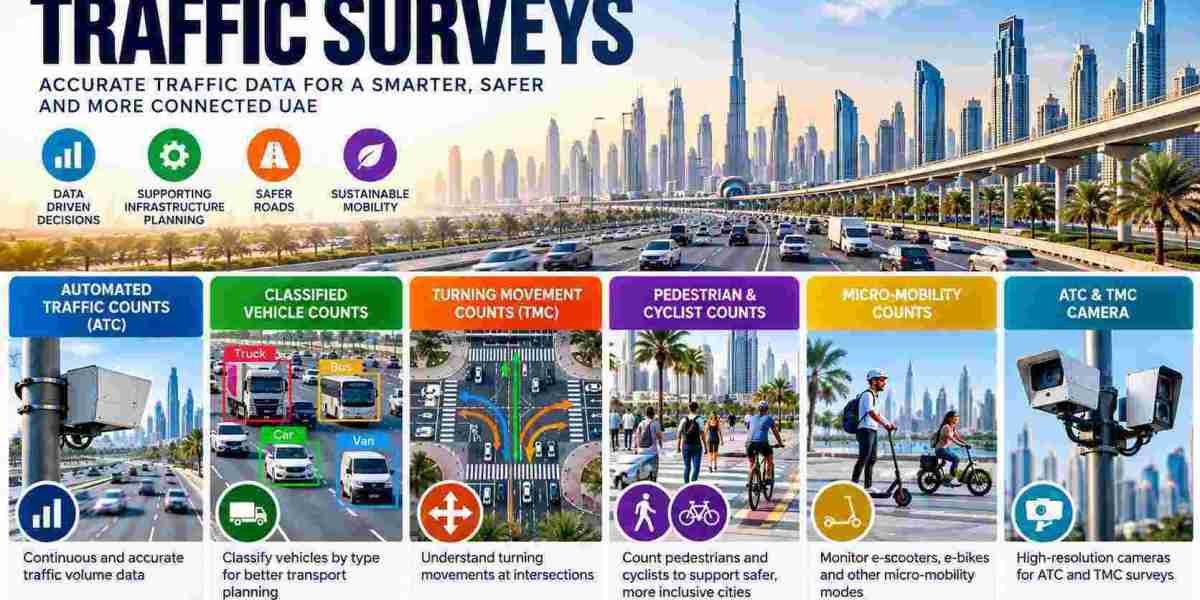
A complete provider offers several services that answer different questions. Some measure how many vehicles pass a point, some measure what types of vehicles they are, some record every turn at a junction, and some count people on foot, on bicycles, or on scooters. The sections below explain each service in plain terms.
Choosing by Question, Not by Method
Start with the question you must answer, such as whether a road needs widening or whether a junction needs signals. The right service then becomes clear, and you avoid paying for data you will never use.
Counting Every Vehicle Over Time
Automated Traffic Counts (ATC) use roadside or road mounted counters that run for days or weeks and record every vehicle by time of day. The result shows daily volumes, peak hours, weekday and weekend patterns, and seasonal swings that a short manual count would miss.
These records are the foundation for road capacity studies, noise and air quality assessments, and long-term forecasting.
Knowing What Kind of Vehicles Use the Road
Total volume hides important detail. Classified Vehicle Counts separate cars, vans, buses, rigid trucks, and articulated trucks, and the mix matters because heavy vehicles need more road space and wear pavements faster. Industrial areas, ports, and logistics parks depend on this information.
Pavement and Safety Decisions
Engineers use the vehicle mix to size lanes, design pavement strength, set speed limits, and plan truck routes and parking.
Understanding Junction Behaviour
Junctions are where most delay and many collisions occur. Turning Movement Counts (TMC) record how many vehicles turn left, go straight, or turn right from every approach, usually in short intervals through peak periods, so signal timings and lane layouts can be tested against reality.
Good junction data also supports signal redesign, roundabout checks, and new access points for developments. Many clients ask for professional traffic survey services in the UAE before submitting a transport statement.
Counting People, Not Just Vehicles
Pedestrian & Cyclist Counts show how many people walk and ride, where they cross, and when they gather. This evidence supports crossings, shaded walkways, cycle tracks, and station access plans, and it is increasingly requested for walkable district and metro catchment studies.
Measuring Safety Risks
Counts combined with observation reveal risky behaviour, such as people crossing mid-block, helping designers fix the cause rather than the symptom.
The New Mobility Layer
Electric scooters, shared bikes, and other small vehicles are now part of daily travel in many districts. Micro-Mobility Counts record these users separately from cyclists and pedestrians, so planners can decide where lanes, parking bays, and speed rules are needed.
Without separate counts, this fast-growing group disappears inside other totals and its needs are overlooked.
Cameras That Do the Counting
A modern ATC & TMC Camera records video that software or trained reviewers convert into counts by vehicle class and movement. Video also gives a permanent record, so figures can be checked later, and one deployment can serve several studies needs at once.
Privacy matters. Footage should be used only for the study, stored securely, and processed so that faces and number plates are not exposed, in line with the federal Personal Data Protection Law. Learn how a camera-based traffic count team handles this in practice.
Traffic Surveys UAE: Standards and Methods
Quality Traffic Surveys UAE clients can rely on follow clear methods: planned site visits, calibrated equipment, trained staff, validation checks, and consistent time periods. Results are normally reported in formats that match guidance from the Institute of Transportation Engineers and the Highway Capacity Manual, so that transport consultants and reviewers can use them directly.
Avoiding Common Data Problems
Counts taken during school holidays, Ramadan, or roadworks can mislead. Choose neutral weeks, record weather and events, and note any unusual conditions in the report.
Traffic Surveys Dubai: Busy Corridors and Fast Growth
Traffic Surveys Dubai projects often involve dense corridors, major junctions, free zones, and rapidly growing districts. Study design should consider Roads and Transport Authority review expectations, Dubai Municipality requirements, and the effect of events and tourism peaks on travel patterns.
Areas such as Business Bay, Dubai South, Jebel Ali, and Dubai Silicon Oasis each show very different patterns, so site specific planning is essential.
Traffic Surveys Abu Dhabi: Planning for Capital Growth
Traffic Surveys Abu Dhabi studies follow the expectations of the Department of Municipalities and Transport and the Integrated Transport Centre, and cover island districts, industrial areas such as ICAD and KEZAD, and growth along major highways. Summer heat and long distances shape how equipment is placed and protected.
Al Ain and the Western Region add further variety, with long rural corridors and different traffic mixes.
From Counts to a Useful Report
Raw numbers become valuable when they are cleaned, summarised, and explained. Look for clear tables, peak hour summaries, charts, site photographs, location maps, and a short statement of method and limitations. Data files in common formats allow modelers to reuse them without retyping.
Delivery Times
Ask for a realistic timetable covering permits, installation, the survey period, validation, and reporting, and plan early because approvals and weather can affect schedules.
Proof Points That Build Trust
When comparing providers, look for experienced engineers, documented projects, calibrated equipment, clear quality checks, safety procedures for work near live traffic, and honest advice about limits. References from consultants and authorities are the strongest evidence of real experience.
For a practical next step, speak with a UAE traffic data specialist and request a plan and quotation for your site.
Conclusion
Reliable Traffic Surveys turn road questions into measured facts, using Automated Traffic Counts (ATC), Classified Vehicle Counts, and Turning Movement Counts (TMC). Pedestrian & Cyclist Counts and Micro-Mobility Counts show how people really move, while an ATC & TMC Camera keeps a permanent record. Strong Traffic Surveys UAE practice meets authority expectations from project start to final report. Traffic Surveys Dubai and Traffic Surveys Abu Dhabi projects each need locally informed planning. Contact Top Precision today to plan your survey.
FAQs
- How long should Automated Traffic Counts (ATC) run to give reliable results?
A full week is common because it shows weekday and weekend patterns, while longer periods help when seasonal change is important.
- Why are Classified Vehicle Counts important for industrial areas?
They separate trucks from cars, which guides pavement design, lane width, truck routes, and parking needs.
- When do I need Turning Movement Counts (TMC) at a junction?
Request them whenever signal timing, lane layout, or a new access point is being designed or reviewed.
- Why record Micro-Mobility Counts separately from cyclists?
Scooters and shared bikes move at different speeds and need different facilities, so separate figures lead to better design.
- Does an ATC & TMC Camera create privacy concerns?
Footage should be used only for the study, stored securely, and processed so faces and number plates are not exposed.