
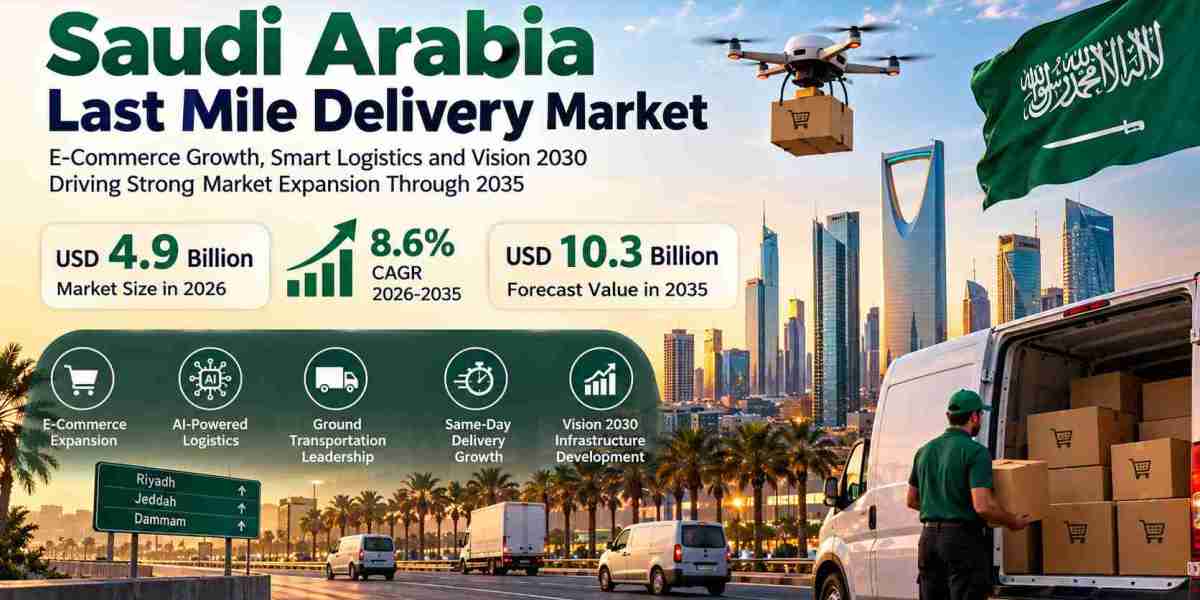
Saudi Arabia's expanding digital economy is changing how goods move from warehouses to consumers. The Saudi Arabia Last Mile Delivery Market is benefiting from increasing online purchases, improvements in delivery infrastructure, and stronger demand for convenient fulfillment services. According to Dimension Market Research, the industry is projected to reach USD 4.9 billion in 2026, before advancing to USD 10.3 billion by 2035, representing a CAGR of 8.6% during 2026-2035.
The transformation extends beyond rising shipment volumes. Retailers and logistics operators are rethinking distribution networks, introducing digital tracking capabilities, and positioning delivery facilities closer to customers. These changes are particularly visible across Riyadh, Jeddah, and Dammam, where commercial activity and consumer demand support extensive parcel delivery operations.
Saudi Arabia's Vision 2030 and National Transport and Logistics Strategy provide an additional foundation for market development. Together, these initiatives support transportation connectivity, logistics modernization, and the Kingdom's ambition to strengthen its position within international supply chains.
What Is the Saudi Arabia Last Mile Delivery Market?
The market encompasses services responsible for transporting shipments through the final stage of distribution, from logistics hubs, stores, or fulfillment facilities to recipients.
Its activities include parcel transportation, retail order fulfillment, grocery delivery, pharmaceutical distribution, and business-related shipments. Delivery methods range from conventional road-based services to emerging technologies involving drones and autonomous transportation.
Because this final distribution stage directly influences delivery costs and customer satisfaction, companies increasingly view last mile logistics as an important business function rather than a routine transportation expense.
Why Is Demand for Last Mile Delivery Increasing?
Online Retail Is Generating Greater Delivery Requirements
The expansion of digital shopping platforms has created substantial demand for dependable parcel distribution throughout Saudi Arabia.
Retailers operating through platforms such as Noon and Amazon Saudi Arabia require efficient delivery networks capable of managing frequent orders and responding to changing customer expectations.
The primary DMR report highlights more than 63 million parcels delivered during Q1 2025, followed by over 50 million parcels in Q2 2025. These figures demonstrate the considerable volume of activity supported by the Kingdom's delivery ecosystem.
For logistics operators, growing online retail activity increases the importance of scalable transportation capacity, strategically located distribution centers, and accurate shipment management.
Get a Free Sample of the Saudi Arabia Last Mile Delivery Market Report
Assessing opportunities in Saudi Arabia's logistics sector? Review the report sample to understand its research coverage, market classification, and competitive analysis before making strategic decisions.
https://dimensionmarketresearch.com/request-sample/saudi-arabia-last-mile-delivery-market/
Saudi Arabia Last Mile Delivery Market: Key Statistics
● 2026 Estimated Market Value: USD 4.9 Billion
● 2035 Projected Market Value: USD 10.3 Billion
● Compound Annual Growth Rate: 8.6%
● Forecast Period: 2026-2035
● Leading Delivery Mode: Ground Transportation
● Prominent Vehicle Category: Light Commercial Vehicles
● Largest Service Category: Business-to-Consumer (B2C)
● Dominant Application: E-commerce and Retail
● Growing Delivery Preference: Same-Day Delivery
These findings illustrate a market in which established road transportation networks remain fundamental while digital capabilities and faster fulfillment models are becoming increasingly important.
Digital Technology Is Changing Delivery Economics
Technology adoption is influencing how logistics companies plan routes, distribute workloads, and monitor shipments.
Artificial intelligence supports demand forecasting and transportation planning, while connected tracking systems provide visibility into shipment locations. Automated sorting technologies can also help distribution facilities process parcels more efficiently.
Digital delivery platforms allow retailers and transportation partners to coordinate fulfillment activities and communicate expected delivery windows.
For businesses, better information across the delivery network can improve vehicle utilization, reduce avoidable journeys, and strengthen service consistency.
Ground Transportation Continues to Lead the Market
Despite growing interest in drones and autonomous vehicles, conventional road transportation remains the dominant delivery mode.
Saudi Arabia's developed highway networks and established courier infrastructure make ground-based services suitable for substantial shipment volumes across metropolitan and regional markets.
Light commercial vehicles are especially important because they provide operational flexibility for parcel distribution. Compact vans can support frequent delivery stops while accommodating different shipment sizes.
The B2C category also holds the largest service-type share, reflecting the importance of digital retail transactions and direct customer fulfillment.
Meanwhile, standard and next-day services continue to dominate delivery time frames, although same-day fulfillment is attracting increasing attention in major cities.
Which Applications Offer Important Growth Opportunities?
E-commerce and retail remain the principal application segment, but other industries are creating demand for specialized delivery capabilities.
Grocery and food delivery services require rapid transportation, temperature management, and effective coordination between merchants and delivery personnel.
Healthcare logistics presents different requirements, including secure shipment handling, temperature-controlled transportation, and traceability for medical products.
Commercial deliveries involving documents, parcels, and business supplies further diversify the market.
These differences suggest opportunities for logistics providers to develop dedicated solutions rather than relying exclusively on conventional parcel delivery services.
Sustainability and Infrastructure Development
Environmental considerations are becoming more relevant to fleet management and transportation planning.
Electric vehicles, alternative fuels, and route optimization are among the approaches being explored to reduce emissions and improve delivery efficiency.
Urban fulfillment centers, parcel lockers, and collection points also offer alternative ways to distribute orders and improve customer convenience.
However, implementation depends on operating costs, infrastructure availability, shipment density, and service requirements.
The industry continues to face challenges involving labor dependency, transportation expenses, congestion, and the complexities of serving rapidly expanding urban areas.
Competitive Landscape: Who Operates in Saudi Arabia?
Saudi Arabia's delivery market includes established domestic service providers, regional logistics companies, and multinational transportation businesses.
Important participants covered in the report include Saudi Post (SPL), Aramex, SMSA Express, Zajil Express, Naqel Express, Ajex, Aymakan, DHL International, FedEx, UPS Saudi Arabia, CEVA Logistics, and Shipa Delivery.
Competition involves geographic coverage, reliable shipment execution, operational efficiency, technology integration, and customer service.
As online retailers seek greater control over fulfillment performance, logistics providers must respond to increasingly demanding service expectations while managing delivery costs.
What Will Shape Market Development Through 2035?
The Saudi Arabia Last Mile Delivery Market is expected to experience continued investment in digital fulfillment systems, transportation efficiency, and modern distribution infrastructure.
Three developments are particularly relevant: increasing e-commerce activity, adoption of intelligent logistics technologies, and greater demand for flexible delivery options.
For businesses evaluating expansion, important considerations include customer density, fulfillment facility locations, service specialization, and potential partnerships with established transportation providers.
The strongest opportunities may emerge where operators can combine dependable delivery networks with effective technology and disciplined cost management.
View the Saudi Arabia Last Mile Delivery Market Report and Purchase Options
Explore the complete research to examine market forecasts, competitive positioning, delivery modes, service categories, applications, and industry developments. The report page also provides licensing and purchasing options for business users.
https://dimensionmarketresearch.com/checkout/saudi-arabia-last-mile-delivery-market/
Frequently Asked Questions
1. How large is the Saudi Arabia Last Mile Delivery Market in 2026?
The market is projected to reach USD 4.9 billion in 2026, supported by online retail expansion and increasing logistics requirements.
2. What is the projected market value in 2035?
Saudi Arabia's last mile delivery industry is forecast to reach USD 10.3 billion by 2035.
3. What is the anticipated market growth rate?
The market is expected to register a CAGR of 8.6% during 2026-2035.
4. Which delivery mode holds the leading position?
Ground transportation dominates, supported by established road infrastructure and its suitability for handling significant parcel volumes.
5. What is driving Saudi Arabia's last mile delivery industry?
Major growth factors include e-commerce adoption, Vision 2030 initiatives, expanding urban logistics infrastructure, digital tracking technologies, and rising demand for faster fulfillment.
Conclusion
Saudi Arabia's last mile delivery industry is becoming an increasingly important part of the Kingdom's digital commerce and transportation landscape.
As the market moves toward its projected 2035 valuation, traditional delivery infrastructure will continue to operate alongside technologies designed to improve shipment visibility, efficiency, and customer convenience.
For retailers, transportation companies, and investors, understanding how digital logistics, service requirements, and infrastructure development intersect will be essential for evaluating long-term opportunities.
Related Last Mile Delivery Market Insights
The global Last Mile Delivery Market Size is projected to increase from USD 170.7 billion in 2025 to USD 398.1 billion by 2034, reflecting a 9.9% CAGR. Worldwide growth is being influenced by digital retail expansion, evolving delivery expectations, and increasing investment in intelligent transportation and fulfillment technologies.
The US Last Mile Delivery Market Share landscape reflects strong competition among established transportation networks, e-commerce fulfillment services, and technology-enabled delivery providers. The US market is forecast to increase from USD 45.6 billion in 2026 to USD 101.9 billion by 2035, registering a 9.3% CAGR as businesses invest in automation and faster distribution capabilities.
The Japan Last Mile Delivery Market Growth outlook highlights opportunities associated with automation, reliable transportation services, and advanced urban logistics. Japan's market is projected to rise from USD 12.7 billion in 2026 to USD 21.8 billion by 2035, expanding at a 6.2% CAGR, supported by digitalization and improvements in delivery efficiency.