Crowded malls, metro stations, airport terminals, and basement car parks are places where a small fire can become a serious emergency within minutes, and Video Analytics lets the cameras Qatar already depends on act as an extra set of eyes that notices flame and smoke the moment they appear.
Why Public Spaces Need Faster Warning
Doha has grown into a city of large public buildings and busy transport hubs. Visitors do not know the exits, crowds move slowly, and in a vast atrium or a long station platform the first minutes after ignition decide whether an evacuation is calm or chaotic.
Every minute gained at the start gives operators time to confirm the event, guide people to exits, and send firefighters to the exact location.
Places Where Early Detection Matters Most
Shopping centers, the Doha Metro and Lusail Tram stations, Hamad International Airport, hotels, stadium legacy venues, and large warehouses all combine high occupancy or high asset value with tall ceilings and open volumes, which are difficult for traditional detectors to cover well.
Hidden Risks in Back of House Areas
Loading docks, kitchens, electrical rooms, plant rooms, and car parks often hold the real ignition risks, such as cooking equipment, charging vehicles, and stored goods, and they receive far less attention than the public areas.
How Cameras Learn to See Fire
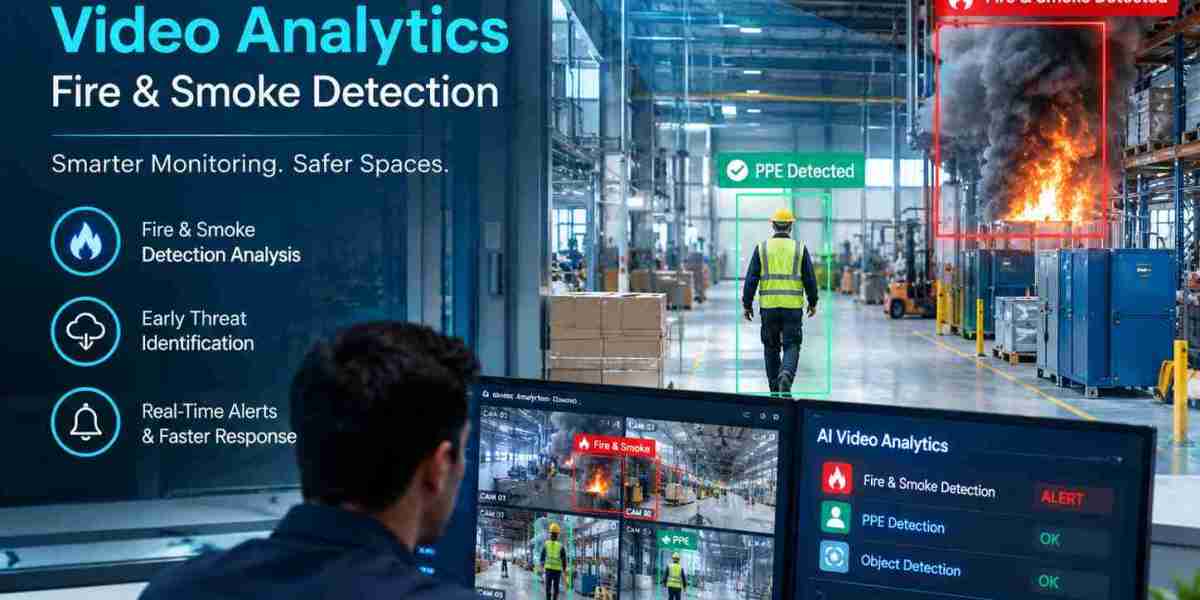
Video from existing cameras is analyzed continuously for the color, shape, flicker, and movement of flames and for the texture and rise of smoke. When enough evidence builds up, an alert is raised with a snapshot and a short clip so a trained operator can confirm within seconds.
Because cameras watch from a distance, they can see a developing fire before smoke has travelled to the ceiling sensors of a tall hall.
The Power of Learning Based Detection
Modern AI-Powered Video Analytics learns from very large collections of real fire and non-fire examples, so it handles unusual lighting, reflections, decorative displays, and changing backgrounds far better than the fixed rules used by older products.
This learning approach is what makes the technology practical in a shopping mall full of bright signs and moving crowds.
The Software Behind the Cameras
Cameras only collect pictures, while capable Video Analytics Software processes streams, applies rules for each zone, stores events, and shows dashboards that operators can read at a glance. Good software also works with the cameras and recorders already installed, so projects do not require a costly replacement.
Search tools help investigators jump to the exact moment of an event instead of scrolling through hours of footage.
Seeing the Hazard While It Is Still Small
Speed is the central benefit. Real-Time Hazard Detection analyzes live video frame by frame, flagging a flame or a growing smoke plume as it appears, which gives staff extra minutes to start suppression, close doors, or begin an orderly evacuation.
Operators also see exactly where the problem is, so firefighters can be sent to the right entrance with a clear picture of what they will find.
Turning Detection into Action
An alert is only valuable if someone acts on it. Automated Emergency Response connects a confirmed event to actions such as notifying the control room, activating local alarms, unlocking escape doors, calling the onsite fire team, and sending the camera view to a responder phone, all within seconds and according to a written plan.
Sensible designs keep a person in the decision loop for critical steps while automating the tasks that save the most time.
Keeping Alarms Believable
False alarms in public buildings are expensive, because they disrupt business and train staff to ignore warnings. A carefully tuned system achieves Reduced False Alarms by combining several clues, using confirmation steps, and excluding known sources such as kitchen steam, vehicle exhaust, or stage lighting in marked zones.
Prove It with a Pilot
The most reliable proof is a pilot on your own cameras. Measure detection and false alarm rates for several weeks and agree clear pass criteria before a full rollout.
A Layer Beside Certified Fire Systems
Video detection should be treated as an additional layer, not a replacement for certified alarms, sprinklers, and detectors, which must still meet Qatar Civil Defence requirements. Complete Video Analytics Solutions combine analytics, integration, training, and support, and you can see how projects are scoped on our fire and smoke video analytics page.
Any link to the fire alarm panel should be designed by qualified fire engineers and approved by the relevant authority.
Designing for Qatar's Climate and Environment
Summer heat, humidity along the coast, dust, and glare through glass facades all challenge equipment. Cameras need protective housings, correct mounting, and regular cleaning, and the analytics must be tested in haze and low light so night operations receive the same protection as day operations.
Scheduled lens cleaning and firmware updates keep detection dependable through the long hot season.
Privacy, Data Protection, and Cybersecurity
Video can include images of people, so projects should follow the Personal Data Privacy Protection Law, Law No. 13 of 2016, and the guidance of the National Cyber Security Agency. Clear signage, restricted access to footage, defined retention, and secure networks protect both visitors and systems.
Fire detection zones can often be configured to focus on hazards rather than on identifying individuals.
Experience and Trust Signals for Qatari Buyers
Our engineering team has delivered video and safety projects across Qatar, the UAE, Saudi Arabia, Bahrain, and Kuwait, giving direct field knowledge of Gulf climate, site conditions, and approval routes rather than assumptions copied from other markets.
Each deployment is handed over with camera layouts, rule settings, test results, and training records, so safety teams and auditors can verify exactly what the system watches and how it responds.
Rollout and Measuring Results
A sensible rollout begins with a site survey and a pilot in one zone, then tuning, operator training, and expansion. Success is measured through detection time, false alarm rate, and response time rather than by the number of cameras installed.
Regular drills using real alerts keep operators confident and reveal where procedures can be improved.
Choosing Video Analytics Qatar Providers Carefully
When comparing offers for Video Analytics Qatar projects, buyers should weigh local references, accuracy proven on their own footage, integration with existing cameras and alarm systems, and the quality of local support, and treat price as one factor among several.
Priorities for Doha Projects
Doha concentrates malls, towers, hotels, transport hubs, and event venues, so Video Analytics Doha deployments often need several sites on one dashboard, fast mobilization, and local support that reaches the site within hours when a fault appears.
Early coordination with civil defence consultants, fire engineers, and building owners keeps integration smooth and avoids rework.
Conclusion
Video Analytics gives Qatari public spaces an early visual warning of fire and smoke, and AI-Powered Video Analytics with dependable Video Analytics Software turns camera footage into action. Complete Video Analytics Solutions deliver Real-Time Hazard Detection and Automated Emergency Response backed by Reduced False Alarms. For Video Analytics Qatar and Video Analytics Doha projects, local experience and accuracy proven on your own site decide long term success. It works best as a layer beside certified fire systems that meet Qatar Civil Defence rules. Contact our team today to plan a safer facility.
FAQs
- How does AI-Powered Video Analytics avoid mistaking bright signs for fire?
It learns from many real examples and combines flame shape, flicker, and persistence, so ordinary bright lights are far less likely to trigger an alert.
- How early can Real-Time Hazard Detection warn in a tall atrium?
Cameras see flames and smoke plumes from a distance, so warning can come before smoke reaches ceiling detectors in a large space.
- What can Automated Emergency Response do after an alert is confirmed?
It can notify the control room, sound alarms, unlock escape doors, and send the camera view to responders within seconds.
- How are Reduced False Alarms achieved in a busy mall?
Systems combine several clues, use confirmation steps, and exclude known sources such as kitchen steam or stage lighting in marked zones.
- Does Video Analytics Software work with existing cameras?
Often yes, because many existing cameras can be connected after a survey confirms image quality, angle, and lighting.