Introduction
Effective higher education marketing starts with understanding the institutions and professionals most likely to need a product or service. Colleges differ in enrollment size, academic programs, ownership, delivery models, and administrative structures, so a broad contact list rarely provides enough detail for meaningful segmentation. According to the National Center for Education Statistics (NCES), U.S. Title IV institutions recorded approximately 22.5 million students in 12-month undergraduate enrollment during 2024–25. The same dataset distinguishes public, private nonprofit, and private for-profit institutions, illustrating the diversity of the higher education market.
For education technology companies, publishers, training providers, and institutional suppliers, a well-structured College Email List should do more than store addresses. It should connect verified professional contacts with relevant institutional characteristics, allowing marketing and sales teams to prioritize accounts, personalize outreach, and evaluate results. This article explains the essential fields, segmentation criteria, data-quality practices, and measurement methods that make a college contact database more useful.
1. Start With Accurate Institutional Profiles
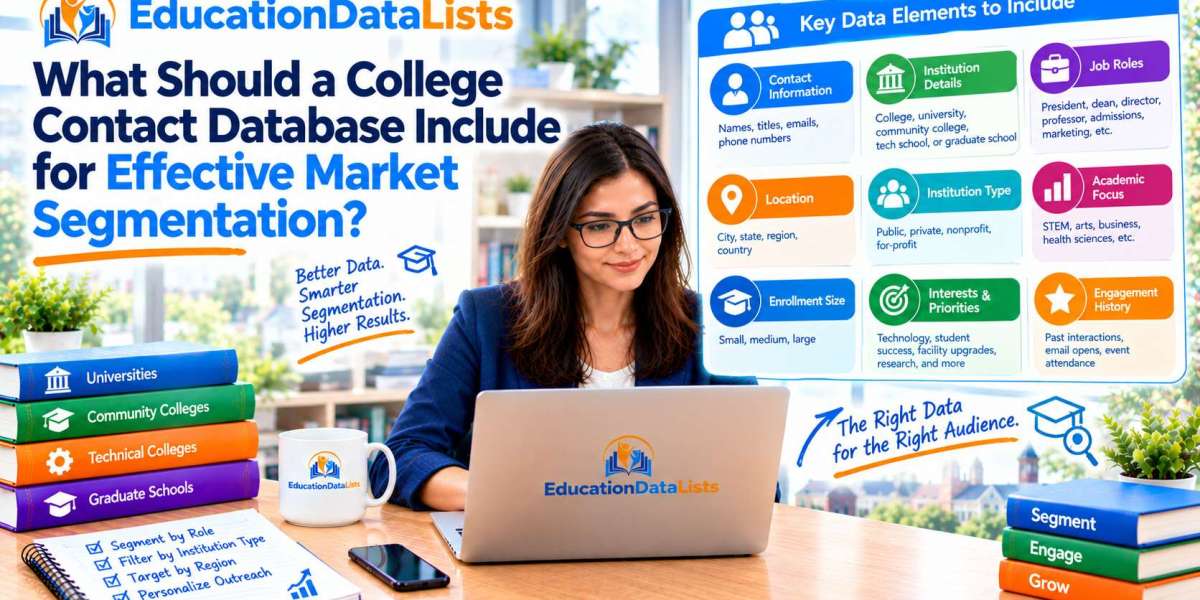
Before segmenting individual contacts, establish a reliable profile for each college or university. Institutional details help marketers determine whether an organization fits their ideal customer profile and which products are most relevant.
The NCES Integrated Postsecondary Education Data System (IPEDS) publishes institutional directory information and data on educational offerings, organization, enrollment, and other characteristics. Its 2024–25 data include information on 5,626 Title IV institutions, demonstrating the breadth of the U.S. postsecondary landscape covered by the system.
A useful institutional record should include, where available:
Official institution name and website
Main campus location and state
Institution type and public or private control
Undergraduate and graduate program availability
Enrollment range
Academic disciplines and degree levels
Online or distance-learning offerings
Parent organization or campus relationships, where applicable
These fields help businesses develop meaningful audience segments. For example, a publisher offering undergraduate laboratory materials may prioritize institutions with relevant science programs, while a provider of learning-management software may focus on colleges with substantial online-learning activity.
A College Email Database should also distinguish institutions from their individual campuses when the distinction affects purchasing. A multi-campus university may centralize procurement, while other institutions may allow departments or campuses to make their own decisions. Confirming this structure before outreach can prevent duplicated sales efforts and help identify the correct account owner.
2. Include Contact Roles That Reflect Purchasing Responsibilities
Institution-level information identifies potential customers, but professional contact data helps marketers reach the people who evaluate, recommend, or approve purchases.
Depending on the product, relevant contacts may include:
Academic leadership: Provosts, deans, department chairs, and academic program directors.
Technology teams: CIOs, IT directors, instructional technology leaders, and digital learning managers.
Procurement and finance: Purchasing managers, procurement officers, and finance administrators.
Student services: Enrollment management leaders, career services directors, and student affairs administrators.
Faculty and program staff: Instructors, researchers, laboratory managers, and curriculum coordinators.
IPEDS reported approximately 22.5 million undergraduate enrollments across Title IV institutions in 2024–25, but that figure alone cannot identify which individual has purchasing authority.
For effective segmentation, each professional record should ideally include the person's name, current job title, department, institution, professional email address, and last-verified date. Where available, adding a purchasing responsibility or functional category can help sales teams distinguish budget owners from product users and technical evaluators.
A targeted College Mailing List should support role-based campaigns rather than treating every contact at an institution as interchangeable. For instance, a cybersecurity vendor might prioritize technology leadership, while a publisher selling academic reference materials might approach library directors or subject-specific faculty.
3. Use Enrollment, Institution Type, and Academic Programs for Segmentation
A useful database should make it possible to group institutions according to characteristics that influence product fit.
NCES data for 2024–25 show that undergraduate enrollment differed considerably by institutional control. Of approximately 22.5 million students enrolled over the 12-month reporting period, about 17.17 million attended public institutions, 3.71 million attended private nonprofit institutions, and 1.64 million attended private for-profit institutions.
These differences provide a starting point for segmentation, although ownership alone does not determine budget, purchasing behavior, or product demand.
Consider organizing a database around the following dimensions:
Segmentation field | How marketers can use it |
|---|---|
Enrollment range | Prioritize small, medium, or large institutions |
Institution control | Tailor messaging to public, nonprofit, or for-profit organizations |
Degree levels | Identify undergraduate, graduate, and professional education prospects |
Academic disciplines | Match specialized products to relevant departments |
Online-learning activity | Identify institutions where digital delivery may be particularly relevant |
Geographic location | Support regional campaigns and territory planning |
Campus structure | Distinguish centralized purchasing from campus-level opportunities |
IPEDS provides relevant data on enrollment, educational offerings, institutional characteristics, and distance education. Its 2024–25 enrollment resources include measures that distinguish students by level and distance-learning status.
Combining these fields helps businesses move beyond broad campaigns. An educational technology provider, for example, could prioritize institutions offering online programs and then identify technology or digital-learning contacts at those institutions. A publisher could select colleges offering specific degree programs before contacting the departments most likely to use its materials.
4. Build Data Freshness and Verification Into the Database
Even detailed segmentation becomes ineffective when records are outdated. Professional contacts change roles, departments are reorganized, and email addresses become inactive. An institution's main contact information may also change as campuses merge or administrative functions are consolidated.
ZeroBounce's 2026 Email List Decay Report, based on more than 11 billion email addresses processed during 2025, found that at least 23% of email data was invalid or degraded, while only 62% of submitted addresses were classified as valid. These results cover multiple industries and are not a college-specific benchmark, but they illustrate the importance of ongoing data maintenance.
A strong database maintenance process should include:
Email validation: Check syntax and assess whether addresses appear deliverable before sending campaigns.
Role verification: Confirm that contacts still hold the listed positions.
Institution checks: Verify that names, websites, locations, and organizational relationships remain accurate.
Duplicate management: Consolidate duplicate contacts and distinguish separate campuses where necessary.
Record provenance: Store the source and date of verification for important fields.
Suppression management: Maintain records of unsubscribes and contacts who should not receive further marketing messages.
The database should also distinguish verified facts from inferred attributes. For example, a college's published online programs may be a reliable segmentation field, while an assumption that it has a large technology budget is not.
EducationDataLists may be considered when evaluating education-focused contact data. Before adopting any provider's College Email List, assess its institution coverage, professional-role fields, update practices, sourcing transparency, and suitability for the intended campaign.
5. Track Data Quality Alongside Campaign Performance
A contact database should help teams understand not only whom they are targeting, but also whether their targeting strategy is producing useful business outcomes.
Google's email sender guidelines require senders to authenticate their domains and monitor spam complaints. For bulk senders delivering more than 5,000 messages per day to personal Gmail accounts, Google requires SPF, DKIM, and DMARC authentication. Google recommends keeping reported spam rates below 0.10% and avoiding rates of 0.30% or higher.
These requirements make contact quality and responsible sending important parts of database management. A well-segmented list can still perform poorly if addresses are invalid or messages are irrelevant.
Track the following metrics by segment:
Hard-bounce rate: Indicates problems with invalid or unavailable addresses.
Positive reply rate: Shows whether contacts find the message relevant enough to respond.
Qualified meeting rate: Measures progress toward genuine sales conversations.
Sample, demo, or proposal requests: Indicates interest in evaluating an offering.
Conversion rate: Connects outreach to sales or other defined business outcomes.
Opt-out and spam complaint rates: Help identify audience mismatch or messaging problems.
Open rates can be useful as a secondary indicator, but they should not be treated as proof of interest. Compare results across institution types, academic disciplines, and professional roles to find segments that consistently generate qualified opportunities.
Practical Takeaways for Building a Better College Contact Database
Higher education marketers can strengthen their segmentation process with five actions:
Define the ideal institution. Specify relevant enrollment ranges, degree levels, academic programs, locations, and institutional types.
Map the buying group. Include relevant decision-makers, technical evaluators, budget owners, and end users where their roles can be verified.
Use reliable institutional data. Cross-check institutional profiles against NCES/IPEDS records and official college websites.
Schedule regular verification. Review email validity, job titles, institution details, duplicates, and suppression records.
Measure segment-level results. Evaluate qualified replies, meetings, proposals, conversions, and deliverability indicators rather than relying on list size or opens alone.
A database should be designed around the decisions marketing and sales teams need to make. Collecting additional fields is useful only when those fields improve audience selection, message relevance, or account prioritization.
Conclusion
An effective college contact database combines accurate institutional profiles, verified professional contacts, meaningful segmentation fields, and consistent data-quality controls. NCES/IPEDS data show that the higher education market includes institutions with different ownership structures, enrollment profiles, educational offerings, and delivery models. Those differences create opportunities for more precise targeting, but institutional characteristics must be combined with current contact information and evidence of product relevance.
For education vendors, the objective is not simply to build a larger College Email List. It is to develop a dependable resource that helps teams identify suitable institutions, reach the right professionals, and learn which segments produce qualified opportunities. By combining reliable institutional research with responsible outreach and ongoing performance measurement, businesses can make their higher education marketing more focused, efficient, and sustainable.
Frequently Asked Questions
1. What should a college contact database include?
A useful database should include institution names, official websites, locations, institutional types, enrollment ranges, academic offerings, relevant professional contacts, job titles, and verified business email addresses where available. Verification dates and data-source information also help teams assess record quality.
2. How can a College Email List improve market segmentation?
A College Email List can be segmented by institution size, ownership, academic programs, geography, online-learning activity, and professional role. These attributes help marketers tailor messages to the needs of specific institutions and departments instead of sending identical campaigns to every contact.
3. What is the difference between a College Mailing List and a College Email Database?
The terms are often used interchangeably. A mailing list generally emphasizes contacts used for outreach, while a database may contain more detailed institutional profiles, job roles, segmentation fields, and verification history. The actual distinction depends on the provider and how the records are maintained.
4. How can marketers verify college contact information?
Marketers can cross-check institutional details against official college websites, published staff directories, and appropriate NCES/IPEDS resources. Email validation can help identify potentially invalid addresses, while job titles and departmental affiliations should be reviewed independently.
5. How often should a College Email Database be updated?
The appropriate schedule depends on the source, contact type, and campaign frequency. Regular reviews and verification before major campaigns help identify outdated addresses, job changes, and organizational updates. Cross-industry email-decay findings suggest that maintaining data quality should be an ongoing process rather than a one-time exercise.
6. Which college contacts should B2B education vendors target?
The right contacts depend on the product. Academic publishers may focus on department chairs, faculty, or library leaders, while technology vendors may prioritize CIOs, IT directors, and digital-learning administrators. Larger purchases can involve several stakeholders, so vendors should research the buying group rather than assume a single contact controls the decision.
7. How can companies measure whether their college segmentation strategy is working?
Compare positive replies, qualified meetings, demo requests, proposals, and conversions across audience segments. Monitor bounce rates, opt-outs, and spam complaints as well. These metrics help teams determine whether their contact data and messaging are generating relevant business opportunities.