Industrial flash memory plays an important role in modern manufacturing, automation, embedded computing, medical equipment, and industrial control systems. It stores firmware, operating-system files, configuration data, application software, and operational information needed to keep equipment running.
In 2026, selecting industrial flash memory involves more than comparing storage capacity and purchase price. Changes in NAND flash manufacturing, evolving technology requirements, component availability, and long product lifecycles are making storage selection increasingly important for engineers and purchasing teams.
For original equipment manufacturers (OEMs), machine builders, and industrial system integrators, the challenge is to find storage that meets technical requirements today while remaining suitable for maintenance and replacement in the future.
This guide examines the major industrial flash memory trends in 2026, the challenges buyers should understand, and the criteria to consider before purchasing a storage solution.
- What Is Industrial Flash Memory?
Industrial flash memory is non-volatile storage designed for use in electronic equipment and computing systems. Non-volatile memory retains stored information when power is removed.
Depending on the application, industrial flash storage may be used for:
- Firmware and boot files
- Operating systems and application software
- Machine configuration data
- Industrial data logging
- Equipment maintenance and software updates
- Embedded computing and control applications
- Data storage in compatible industrial PCs and controllers
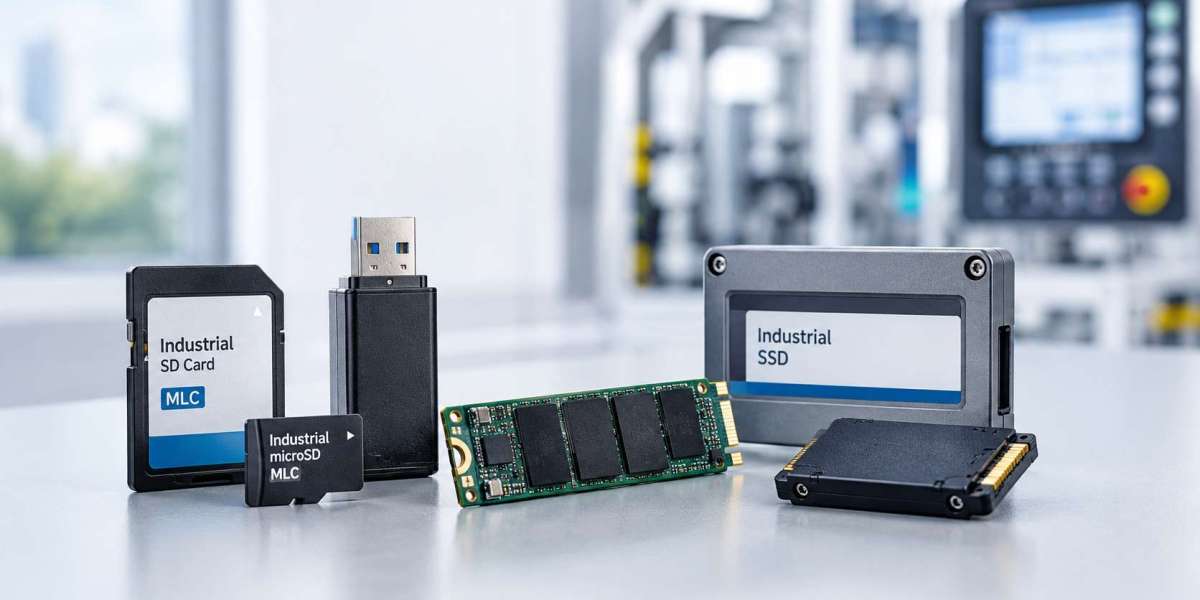
Industrial flash memory is available in different technologies and physical formats. These include NAND flash, NOR flash, USB flash drives, industrial SD cards, CompactFlash cards, embedded storage modules, and solid-state drives.
Not every format serves the same purpose. For example, NOR flash is often used for firmware storage and execute-in-place applications, while NAND flash is widely used for higher-capacity data storage.
The right solution depends on the host system, workload, environmental conditions, and required service life.
- Key Industrial Flash Memory Trends in 2026
Trend 1: Changing availability of legacy MLC and SLC NAND
One of the most significant developments in 2026 is the changing supply landscape for established flash memory technologies.
According to TrendForce reporting published in January 2026, global MLC NAND capacity was projected to decline by 41.7% year over year as major manufacturers reduced or discontinued some production. The report identified industrial control, automotive electronics, medical devices, and networking equipment as continuing sources of demand for MLC memory
This matters because industrial products can remain in service for many years. A machine may still depend on a memory component selected during its original design, even when that component becomes harder to source.
For buyers, the practical implications include:
- Checking component availability before placing repeat orders
- Reviewing the expected lifecycle of the selected product
- Discussing replacement options with suppliers
- Keeping accurate records of approved storage models
- Evaluating alternatives before an urgent replacement is required
A newer memory technology is not automatically a drop-in replacement. Changes in capacity, interface, firmware, physical dimensions, or memory behaviour may require validation.
Trend 2: Growing demand for higher-density NAND
Memory manufacturers continue developing higher-density NAND technologies to meet demand from data centres, AI infrastructure, consumer electronics, and other data-intensive applications.
Higher storage density can allow more data to be stored in a smaller physical footprint. However, industrial buyers should not evaluate a memory device on capacity alone.
The NAND type, controller, error correction, firmware, workload, and operating conditions all influence real-world suitability.
For applications requiring long service life or frequent data writes, engineers should evaluate endurance and data-integrity specifications alongside capacity and cost.
The main purchasing question is not simply, “How much data can this device store?” It is, “Can this device store and retrieve the required data reliably under our actual operating conditions?”
Trend 3: Supply-chain planning is becoming more important
Industrial equipment often has a longer lifecycle than consumer electronics. A product may need maintenance and replacement parts long after its original design is completed.
When memory manufacturers change their product portfolios, OEMs may face availability constraints, price changes, or the need to qualify another storage device.
This makes supplier communication and lifecycle planning increasingly valuable.
Purchasing teams should consider asking suppliers:
- Is the product currently available?
- Is the component expected to remain available for the required period?
- Are product revisions or end-of-life announcements expected?
- Can the supplier recommend a technically compatible alternative?
- Will a change in the component require system-level testing?
These questions are particularly relevant for industrial equipment produced in recurring batches or installed across multiple customer sites.
Trend 4: Edge computing is increasing storage requirements
Edge computing allows data processing to take place close to the equipment generating the data rather than relying entirely on a central server or cloud platform.
Industrial gateways, smart cameras, machine-vision systems, robotics, and connected controllers can generate or process increasing amounts of information.
Depending on the design, these systems may require storage for operating systems, application software, local datasets, logs, configuration files, and updates.
However, higher data volumes do not mean every application needs the same memory technology. A device that mainly reads firmware has different requirements from one that continuously records sensor data.
Before upgrading storage capacity, determine the actual data volume, read/write frequency, retention requirements, and performance needs.
Trend 5: Industrial storage qualification remains essential
As memory technology changes, validating the complete storage device becomes increasingly important.
Two devices with the same capacity and interface may differ in controller design, firmware, endurance, error handling, temperature ratings, and behaviour during unexpected power loss.
For industrial applications, qualification should therefore consider the entire product rather than only the underlying NAND memory.
A replacement device should be tested with the actual hardware and software environment before being approved for production use.
- Major Challenges When Buying Industrial Flash Memory
Understanding market trends is useful, but buyers also need to identify the technical and operational risks that affect their own applications.
Challenge 1: Finding a suitable replacement for legacy storage
Older industrial equipment may rely on specific storage formats such as CompactFlash, industrial SD cards, USB storage, SRAM cards, or other legacy memory modules.
A replacement must match more than the physical connector. The host may impose limits on supported capacities, filesystems, partition layouts, boot behaviour, and interface standards.
Before ordering a replacement, record the original part number and examine the equipment documentation. If the original product is unavailable, compare the proposed alternative and test it in the intended system.
Where necessary, involve the equipment manufacturer or a qualified storage supplier.
Challenge 2: Balancing capacity and write endurance
Different flash technologies offer different trade-offs between storage density, cost, and write endurance.
For example, SLC stores one bit per cell, while MLC stores two bits per cell. TLC stores three bits per cell, and QLC stores four bits per cell. In general, storing more bits per cell increases density but can introduce additional endurance and management trade-offs.
These are broad technology characteristics; actual performance depends on the memory generation, controller, firmware, and product implementation.
Buyers should consider:
- How frequently data will be written
- The approximate amount of data written per day
- Whether the application performs continuous logging
- How long the device must remain in service
- The manufacturer's documented endurance rating
For write-intensive systems, request relevant endurance specifications and compare them with the expected workload instead of assuming a particular technology will always be sufficient.
Challenge 3: Operating temperature and environmental conditions
Industrial equipment may operate inside enclosures, cabinets, production machinery, or outdoor installations.
The storage device must be rated for the actual conditions at its installation point. Relevant factors include operating temperature, humidity, vibration, shock, and any enclosure or environmental protection requirements.
Not all industrial-labelled storage devices support the same environmental conditions.
Check the technical datasheet for the exact model, and distinguish operating temperature from storage temperature. If the device will be installed in a sealed enclosure, consider the temperature near the storage module rather than relying on ambient room temperature.
Challenge 4: Unexpected power loss and data integrity
A sudden loss of power during a write operation can result in incomplete data, corrupted filesystems, or other problems, depending on the device and system design.
Applications that cannot tolerate these outcomes should evaluate the complete data-protection strategy.
Potential measures include:
- Appropriate power-failure handling
- Filesystem and software safeguards
- Backup and recovery procedures
- Storage devices with documented power-loss protection, where required
- Testing under controlled power-interruption conditions
Do not assume that every industrial flash drive includes dedicated power-loss protection. Verify this capability in the product documentation.
Challenge 5: Product lifecycle and total cost
A low purchase price may not represent the lowest overall cost if a storage device is difficult to replace or requires extensive requalification.
For industrial equipment, total cost may include the component price, engineering validation, installation, downtime, maintenance, and the effort needed to restore software or configuration data.
A lifecycle-oriented purchasing strategy considers availability, documentation, replacement options, and compatibility in addition to the initial cost.
- How to Choose the Right Industrial Flash Memory
Selecting suitable industrial flash memory starts with the application rather than the product category.
Step 1: Identify the storage format
Determine whether the equipment requires a USB flash drive, SD card, CompactFlash card, SRAM card, NOR flash, or SSD.
The existing interface and system architecture will often narrow the available options. Do not assume that different storage formats are interchangeable simply because they offer similar capacities.
Step 2: Select the appropriate memory technology
Choose between SLC, MLC, TLC, QLC, or another technology according to the workload and documented specifications.
For applications with frequent writes, long retention requirements, or demanding conditions, evaluate endurance and data-integrity information carefully. For applications that mainly read stored data, other factors may have greater influence.
Step 3: Determine the required capacity
Estimate the space needed for firmware, software, configuration files, logs, and future updates.
Also check the host system's maximum supported capacity and filesystem compatibility. A storage device with more capacity than the system can recognise may not deliver the expected benefit.
Step 4: Verify interface and physical compatibility
Check the connector, interface version, dimensions, mounting arrangement, and host requirements.
For USB storage, verify USB compatibility and any filesystem or boot limitations. For legacy cards, confirm that the replacement matches the required form factor and electrical interface.
Step 5: Check environmental ratings
Compare the device's rated operating conditions with the intended installation.
If the equipment experiences high temperatures, vibration, or other challenging conditions, request supporting specifications and validate the selected model against the application requirements.
Step 6: Evaluate endurance and reliability requirements
Estimate the write workload and compare it with manufacturer-provided endurance information.
If the system stores important operational data, consider data retention, error correction, power-loss behaviour, backup requirements, and recovery procedures as part of the complete design.
Step 7: Confirm availability and replacement planning
For equipment with a long expected service life, discuss supply continuity and alternative products with the supplier.
Where a replacement may differ from the approved model, establish a qualification process before using it in production.
- Industrial Flash Memory Selection Checklist
Use this checklist when evaluating a storage device for a new design or replacement project.
Selection criterion | What to confirm |
Storage format | USB, SD, CompactFlash, SRAM, NOR flash, SSD, or another required type |
Capacity | Required storage and host-system support |
Memory technology | SLC, MLC, TLC, QLC, or another specified technology |
Interface | Electrical and protocol compatibility |
Endurance | Suitability for the expected write workload |
Temperature | Rated operating range |
Data integrity | Error handling, retention, and power-loss behaviour where relevant |
Physical fit | Connector, dimensions, and mounting |
Compatibility | Operating system, filesystem, and boot support |
Lifecycle | Availability, replacement options, and documentation |
Cost | Purchase price plus validation and lifecycle costs |
A documented selection process helps engineering and procurement teams compare alternatives consistently.
- Where to Find Industrial Flash Memory for Your Application
The appropriate storage solution depends on the equipment, required format, memory technology, and operating conditions.
TecSys provides a range of industrial storage products, including industrial SD cards, MLC USB flash drives, and SRAM and Linear Flash memory products. These categories can help engineers and purchasing teams identify storage options for compatible industrial and embedded systems.
Before ordering, confirm the specifications of the exact model and its suitability for the intended application. If you are replacing an existing memory component, provide the original part number, required capacity, interface, operating conditions, and expected workload to help narrow the options.
Conclusion
Industrial flash memory selection in 2026 is influenced by changing NAND supply, evolving storage technology, increasing data requirements, and the need to support equipment over long lifecycles.
For industrial buyers, the most effective approach is to evaluate the complete application: memory technology, capacity, interface, endurance, environmental ratings, compatibility, availability, and total cost.
A carefully qualified storage device can help reduce replacement risks and support long-term equipment maintenance. By reviewing the technical requirements early and working with a supplier that understands industrial storage formats, OEMs, engineers, and purchasing teams can make more informed decisions.
Looking for industrial flash memory for your equipment? Explore TecSys's industrial storage categories and compare available options against your application's technical requirements before purchasing.
Read More: https://tecsysproductguides.blogspot.com/2026/10/industrial-flash-memory-in-2026-key.html