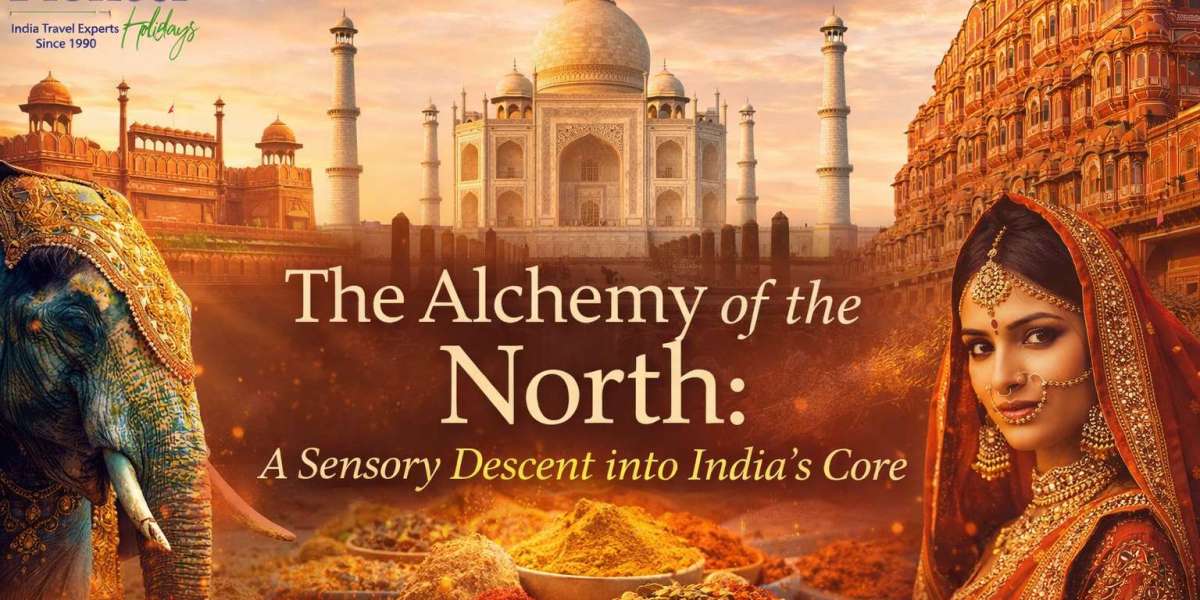
To travel through North India is to witness a chemical reaction between the soul and the soil. It is an alchemical process where the dust of the desert, the spray of a sacred river, and the golden light of a setting sun combine to create something entirely new within the traveler. You do not just observe these landscapes; you are absorbed by them. From the heavy scent of jasmine in a Delhi bazaar to the chilling roar of a predator in the Aravalli hills, the journey is designed to dismantle your expectations and replace them with wonder.
This is a narrative that moves from the structured geometry of man-made dreams to the chaotic beauty of nature and the silent depth of the divine.
Part I: The Geometric Dream – The Golden Triangle
The foundation of this odyssey lies in three cities that function as the pillars of Indian identity: Delhi, Agra, and Jaipur.
Delhi: The Fragrance of Centuries
Delhi is a city of smells—the pungent aroma of spices in Khari Baoli, the damp earth of the Lodi Gardens, and the metallic tang of a modern metropolis.
The Layers of Time: Walking through Mehrauli, you see 13th-century tombs standing silently amidst luxury boutiques. This is the city’s secret: it never discards its past; it simply builds on top of it.
The Heart of the Empire: The Red Fort and the Jama Masjid are the anchors of the old city, representing a time when Delhi was the center of the world.
Agra: The Symmetry of Grief
Agra is a city defined by a single, perfect curve of white marble.
The Taj Mahal: To see the Taj is to understand that love can be solidified into stone. Its perfect symmetry is an architectural prayer, designed to bring the balance of heaven to the earth.
The Red Citadel: Agra Fort serves as the muscular counterpart to the Taj’s ethereal beauty. Its massive ramparts and hidden palaces tell a darker, more complex story of power and betrayal.
Jaipur: The Color of the Sun
Jaipur is a city that feels like it was painted by a single brushstroke.
The Astronomical Pulse: At the Jantar Mantar, you realize that the Rajput kings were not just warriors; they were seekers of cosmic truth. The massive stone instruments still track the sun with a precision that feels magical.
The Royal Heights: Amer Fort, with its intricate frescoes and mirrored halls, offers a vantage point over the Maota Lake that makes you feel like the world is at your feet.
Part II: The Primal Shift – The Ranthambore Extension
As the urban landscape fades, the air changes. It becomes dry, sharp, and carries the scent of the wild. This transition into the untamed heart of Rajasthan is what makes the golden triangle tour with ranthambore a transformative experience for the modern traveler.
Ranthambore: The Jungle of Stone
Ranthambore National Park is a place where the line between history and biology is blurred.
The Tiger’s Throne: This is perhaps the only place on Earth where a Royal Bengal Tiger might use a medieval stone gateway as a scratching post. Seeing a tiger stalking through the ruins of Raj Bagh is a sight that defies the modern world.
The Law of the Forest: In Ranthambore, you are reminded that nature is the ultimate architect. The way the forest has reclaimed the 10th-century fort is a humbling lesson in time.
The Safari Rhythm: The early morning drives, the sudden hush of the forest when a predator is near, and the dust of the trail create a rugged luxury that defines the golden triangle tour with ranthambore.
Part III: The Infinite Flow – The Varanasi Extension
If Ranthambore is about the heartbeat of the earth, then the East is about the breath of the soul. Adding a golden triangle tour with varanasi to your itinerary is the final, essential step in understanding the sub-continent.
Varanasi: The City that Breathes Light
Varanasi, or Kashi, is not just old; it is eternal. It is the city of Lord Shiva, where life and death dance on the banks of the Ganges.
The River of Souls: A boat ride at sunrise is a silent meditation. You see the city waking up—the dhobis washing clothes, the yogis in meditation, and the smoke from the cremation ghats rising towards the sun.
The Symphony of Fire: The Ganga Aarti is an explosion of the senses. The smell of incense, the clanging of brass bells, and the synchronized flames of the priests create a vibration that resonates deep within your chest.
The Path to Peace: Just outside the city’s chaos lies Sarnath, the park where Buddha first shared his path to liberation. The silence here is the perfect anchor for the spiritual intensity of a golden triangle tour with varanasi.
Part IV: The Traveler’s Toolkit for 2026
The Culinary Alchemist
Delhi: The street food of Chandni Chowk—where the oil is as old as the recipes.
Agra: The translucent 'Petha' that tastes like the essence of winter.
Jaipur: 'Dal Baati Churma', the fuel of the desert warriors.
Varanasi: The morning 'Kachori' and the 'Thandai' that leaves you refreshed and grounded.
Strategic Planning
The Logistics: For 2026, the 'Vande Bharat' trains are the best way to bridge the cities of the Triangle. For the extensions, private air travel or specialized heritage trains offer a seamless transition.
The Mindset: Travel in India is about surrender. Let go of the schedule and embrace the 'Indian Stretchable Time.' The most beautiful moments are often the ones you didn't plan.
Frequently Asked Questions (FAQs)
1. Is it better to visit Ranthambore or Varanasi first? We recommend starting with the Golden Triangle, moving to the wildlife of Ranthambore for some adrenaline, and ending with Varanasi for a spiritual climax. It is a journey that moves from the external world to the internal soul.
2. What is the tiger sighting probability in Ranthambore? While nature offers no guarantees, Ranthambore’s tiger density makes it one of the best places in the world for sightings. Taking at least 3-4 safaris across different zones will significantly improve your chances.
3. Is Varanasi overwhelming for a first-time visitor? Yes, it can be. It is intense, crowded, and raw. However, with a professional guide and a well-planned itinerary, that intensity becomes its greatest beauty.
4. What is the best way to travel between Jaipur and Varanasi? A direct flight is the most comfortable and time-saving option. It allows you to skip a 15-hour train journey and spend that time exploring the ghats instead.
5. Are these tours customizable? Absolutely. Whether you want more time in the jungle or extra days for a spiritual retreat in Varanasi, the journey can be tailored to your specific pace and interests.
Conclusion: The Transformation
At the end of this journey, you will find that you are not the same person who arrived at the Delhi airport. The stone of Agra, the stripes of the Ranthambore tiger, and the spirit of the Varanasi ghats will have worked their alchemy on you. You will carry the dust of Rajasthan in your shoes and the light of the Ganges in your eyes.
This is the true power of North India—it doesn't just give you memories; it gives you a new way of seeing the world.
To experience this transformation for yourself and plan a journey that is as unique as your own story, visit us PioneerHolidays.