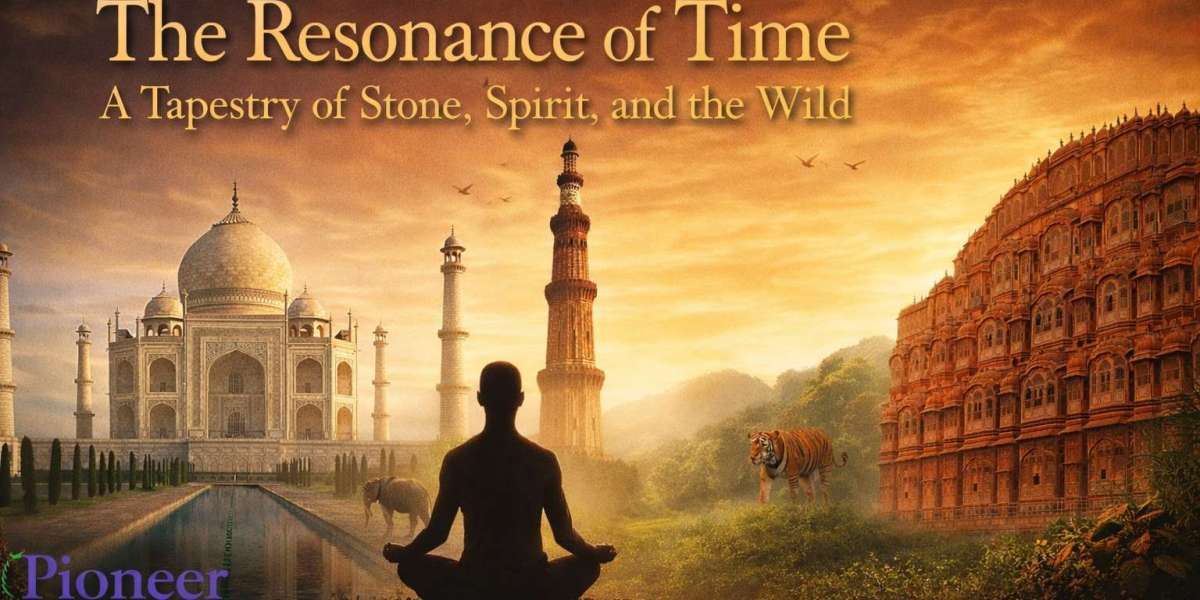
Every traveler who lands in the northern plains of the Indian subcontinent soon realizes that the ground beneath their feet is not just soil, but a layer of compressed history. It is a place where a thousand-year-old temple can stand next to a high-speed metro line, and where the silence of a tiger's gaze is just as communicative as the loud, vibrant chants of a river priest. To walk through this landscape is to participate in an unbroken lineage of storytelling—one that spans from the arrival of Persian architects to the indigenous wisdom of forest dwellers.
The journey we are about to undertake is not merely a geographic loop; it is a transition through the three pillars of existence: the ambition of man (Royalty), the laws of nature (Wilderness), and the search for the infinite (Spirituality).
Part I: The Architectural Soul – The Golden Triangle
The Golden Triangle—comprising Delhi, Agra, and Jaipur—is often called the "Window to India." However, if you look through this window twice, you see something different every time.
Delhi: The Chronicle of Seven Cities
Delhi is a city that refuses to be defined by a single era. It is a collection of fragments.
The Mughal Grandeur: In the heart of the old city, the Red Fort stands as a red sandstone reminder of Shah Jahan’s vision. But the real depth of Delhi is found in the Sufi Shrines of Nizamuddin, where music and mysticism have merged for centuries.
The Colonial Imprint: New Delhi, designed by Edwin Lutyens, offers a contrast with its wide boulevards and the imposing India Gate. It is here that you feel the transition from an imperial past to a democratic present.
The Quiet Corners: Places like the Lodi Gardens provide a rare moment where history and nature coexist, with 15th-century tombs standing amidst lush green lawns and ancient trees.
Agra: The Marble Reflection
Agra is a city built on the banks of the Yamuna, and its identity is tied to the water.
The Taj Mahal: It is not just a tomb; it is a study in perfection. The way the white marble reflects the changing light of the day is a phenomenon that no photograph can truly capture.
The Agra Fort: This massive fortress was the administrative hub of the Mughal Empire. Walking through its maze of palaces, like the Khas Mahal, gives you a sense of the immense scale of royal life.
Fatehpur Sikri: Often called the "Ghost City," this red sandstone capital was abandoned due to water shortages, leaving behind a perfectly preserved monument to Akbar’s pluralistic vision.
Jaipur: The Color of Hospitality
Jaipur, the capital of Rajasthan, is a celebration of Rajputana bravery and aesthetics.
Amer Fort: Perched on a hill, this fort is a blend of Hindu and Mughal styles. The Mirror Palace (Sheesh Mahal) is its crown jewel, where a single matchstick can light up the entire hall like a starry night.
The Pink City: The city's signature color was not a choice of fashion, but a symbol of welcome. Today, its bustling bazaars, like Johari Bazaar, remain the best place to witness traditional crafts like Blue Pottery and Leheriya textiles.
Part II: The Wild Awakening – The Ranthambore Extension
When the stone walls of the palaces begin to feel like a cage, the traveler seeks the raw, unfiltered energy of the jungle. This transition from the structured beauty of Jaipur to the rugged terrain of the Aravallis is what makes the golden triangle tour with ranthambore such a compelling narrative.
Ranthambore: The Fortified Jungle
Ranthambore is perhaps the only place on earth where a tiger might find its throne on the ruins of a medieval palace.
The Apex Predator: Tracking the Royal Bengal Tiger in Ranthambore is a lesson in patience. You learn to read the forest—the alarm calls of the Langur, the sudden flight of a Peacock, and the heavy silence that precedes a sighting.
The Landscape of Ruins: Scattered throughout the forest are crumbling gateways, cenotaphs, and a massive 10th-century fort. This juxtaposition of ancient human architecture and wild nature is hauntingly beautiful.
The Biodiversity: Beyond the tigers, the park is home to leopards, sloth bears, and crocodiles that sunbathe on the banks of the Padam Talao.
The golden triangle tour with ranthambore is designed for those who believe that a holiday should be an adventure of the senses, moving from the refined luxury of a palace hotel to the rustic thrill of a safari jeep.
Part III: The Spiritual Climax – The Varanasi Extension
For many, the ultimate goal of travel is not just to see new things, but to see things with new eyes. This is where the compass turns east. Incorporating a golden triangle tour with varanasi into your travel plans is like adding a soul to the body of your trip.
Varanasi: The Living Eternity
Varanasi, or Kashi, is the city that Hindus believe stands on the trident of Lord Shiva. It is a place where death is not feared, but celebrated as a liberation.
The River of Life: At 5:00 AM, the Ganges is a mirror. Taking a boat ride at dawn allows you to witness the city’s waking rituals—thousands of pilgrims taking a holy dip, priests performing sun salutations, and the smoke rising from the cremation pyres at Manikarnika Ghat.
The Evening Fire: The Ganga Aarti at Dashashwamedh Ghat is a spectacle of fire and faith. The rhythmic movements of the priests with massive brass lamps create a vibration that you can feel in your soul.
Sarnath: Just outside the city, the silence of Sarnath offers a peaceful retreat. This is where Buddha gave his first sermon, and the ancient stupas here represent a different, more quiet path to enlightenment.
Choosing a golden triangle tour with varanasi ensures that your journey ends on a note of deep reflection, providing a spiritual context to the material grandeur you witnessed in the earlier part of your trip.
Part IV: A Connoisseur’s Guide to the North
The Culinary Map
Traveling through these regions is an invitation to feast.
Delhi: Indulge in the street food of Old Delhi—specifically the Daulat ki Chaat and Mughlai Paranthas.
Agra: Try the Petha (ash gourd sweet) that the city is world-famous for.
Jaipur: Experience a traditional Rajasthani Thali with Gatte ki Sabzi.
Varanasi: The morning Kachori-Sabzi and the frothy Malaiyo are essential.
Practical Tips for 2026
Timing: October to March remains the prime season. However, if tiger sightings are your priority, the warmer months of April and May are actually better as animals congregate around water holes.
Ethics: Always choose reputable safari operators and respect the silence of the forest. In Varanasi, be sensitive to the privacy of those performing funeral rites.
Sustainability: 2026 is the year of responsible travel. Support local weavers in Varanasi and stay in heritage properties that contribute to the conservation of their surrounding ecosystems.
Frequently Asked Questions (FAQs)
Q1: How many days are enough for this entire circuit? To comfortably cover the Golden Triangle with both Ranthambore and Varanasi, a 12 to 14-day itinerary is recommended. This allows for at least 3 days in each of the "extensions."
Q2: Is the tiger sighting guaranteed in Ranthambore? While Ranthambore has one of the highest tiger densities in India, sightings are never guaranteed in the wild. We suggest taking at least 3-4 safari drives to increase your probability significantly.
Q3: Is Varanasi safe for international tourists? Yes, it is very safe. However, the city is intense and crowded. We recommend hiring a professional guide to help you navigate the narrow alleys and explain the significance of the various rituals.
Q4: What is the best way to travel from Jaipur to Varanasi? The most time-efficient method is a direct flight. There are also overnight trains for those who want a more traditional experience, but a flight saves you nearly 12 hours of travel time.
Q5: What should I pack for this trip? Pack layers. Delhi and Agra can be quite cold in the winter mornings, while the afternoon sun can be strong. Neutral-colored clothing is best for the jungle safaris in Ranthambore.
Conclusion: The Horizon Awaits
India is a land that requires you to be present in the moment. It is a puzzle where the pieces are made of white marble, tiger stripes, and the golden light of the Ganges. From the royal corridors of Rajasthan to the wild heart of the jungle and the sacred waters of the East, every mile tells a story of resilience and beauty.
The transition from the royal to the wild, and finally to the spiritual, is the most complete way to see this land. It is a journey that moves from the outside in—from the grandeur of empires to the quietude of the soul.
To curate your own path through these legendary landscapes and ensure every detail of your journey is handled with care, visit us PioneerHolidays.