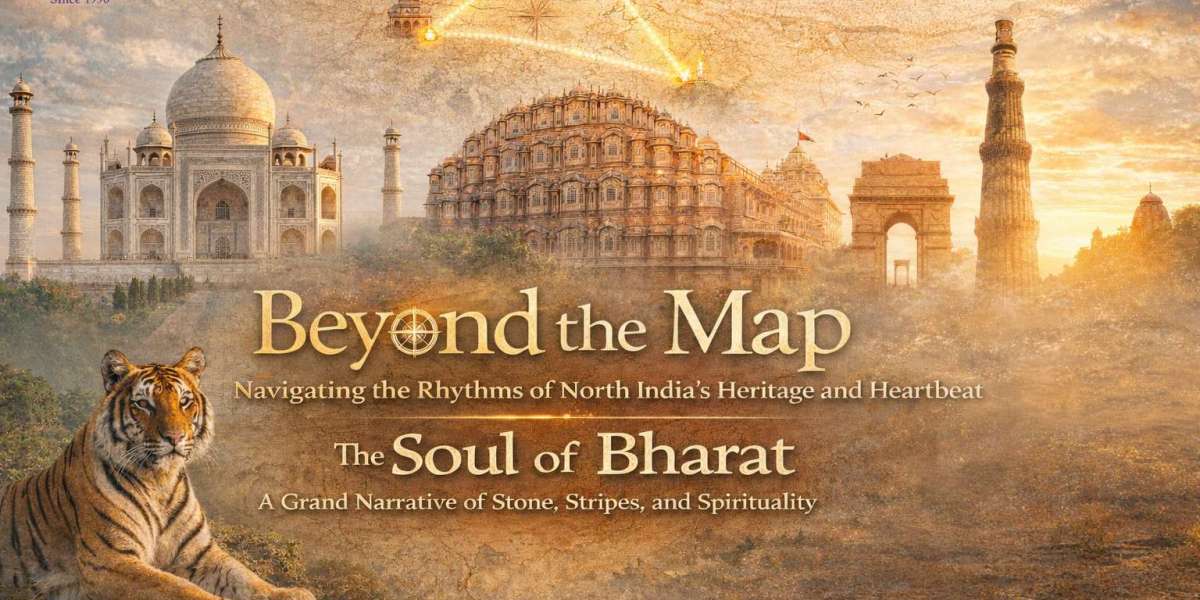
Imagine standing at the edge of a centuries-old sandstone bastion, watching the horizon blur between the golden sands of a desert and the deep green of a prehistoric forest. This is the moment when a traveler realizes that North India is a masterclass in transitions. One day you are decoding the geometric perfection of a Mughal tomb, the next you are silent in a jungle, and by the end of the week, you are witnessing a fire ritual that has been performed daily for over three thousand years.
This journey isn't just about moving between cities; it’s about moving between eras. While the classic route of Delhi, Agra, and Jaipur provides the structural narrative, the real magic happens when you push the boundaries of the itinerary.
The Epicenter of Power and Art: The Heritage Loop
To understand the present, we must walk through the gates of the past. The central circuit of North India is designed around three cities that were the playgrounds of emperors and maharajas.
The Duality of Delhi
Most people see Delhi as a transit hub, but it is actually a time machine. If you stand in the middle of Rajpath, you are surrounded by the colossal British-era architecture of the Parliament House and Rashtrapati Bhavan. But just a few kilometers away, the narrow, winding lanes of Nizamuddin Basti take you back to the 13th century. Here, the air is thick with the smell of roasting kebabs and the soul-stirring sound of Qawwali music. It is this friction between the old and the new that makes Delhi the perfect starting point.
Agra’s Marble Poetry
Agra often gets reduced to a single monument, but the city’s story is much deeper. Beyond the Taj Mahal, there is the Agra Fort, a massive red sandstone city where the walls still seem to echo with the whispers of the royal court. For a fresh perspective, one must visit Fatehpur Sikri at sunset. The abandoned capital of Akbar, with its red corridors and towering gates, feels like a movie set where time has simply stopped.
Jaipur: The Science of Royalty
Jaipur is where the ruggedness of Rajasthan meets the refinement of the Mughals. Unlike other ancient cities, Jaipur was built on a grid—a revolutionary concept for the 1700s. The City Palace is still a living residence, and the Jantar Mantar observatory is a collection of giant architectural instruments that can still predict the weather and track stars with terrifying accuracy.
The Wild Narrative: Into the Shadows of the Aravallis
When the stone walls of the city begin to feel too restrictive, the traveler seeks the openness of the wild. This is where the golden triangle tour with ranthambore changes the entire energy of the trip.
Ranthambore: The Fortified Forest
Ranthambore is perhaps the only place on the planet where a tiger might walk through an 800-year-old stone gateway. The forest here is dry, rugged, and hauntingly beautiful.
The Ghostly Ruins: Scattered throughout the park are the remains of summer palaces, temples, and cenotaphs. Seeing a predator like a leopard or a tiger using these ruins as a vantage point is a visual that no other park in India can offer.
The Adrenaline of the Safari: The real beauty of a golden triangle tour with ranthambore is the shift in pace. You trade the honking of Delhi for the 'alarm call' of a Spotted Deer. You trade the luxury of a city hotel for a high-end tented camp where the only sounds at night are the rustle of the leaves and the distant hoot of an owl.
Conservation and Community: Visiting the local villages around the park gives you a glimpse into how humans and wildlife coexist in one of the most densely populated countries in the world.
The Spiritual Pulse: Where Eternity Meets the Earth
After the adrenaline of the jungle, the soul often craves a deeper connection. Heading east towards the banks of the Ganges is the ultimate conclusion to this odyssey. Choosing a golden triangle tour with varanasi is like adding a final, profound chapter to a grand epic.
Varanasi: The Living Mirror of Humanity
Varanasi (Kashi) is not a place for the faint-hearted. It is raw, it is loud, and it is unapologetically ancient. It is the city where Hindus believe that dying leads to 'Moksha' (liberation from the cycle of rebirth).
The River as a God: In Varanasi, the Ganges is not just a river; she is a mother. Taking a boat at dawn allows you to see the city as it has looked for millennia. The stone ghats are crowded with people meditating, washing, and praying.
The Evening Fire Ritual: The Ganga Aarti at Dashashwamedh Ghat is a sensory overload. The rhythmic movement of the massive lamps, the smoke of the incense, and the collective energy of thousands of people create a vibration that is almost physical.
The Labyrinthine Alleys: The heart of Varanasi lies in its 'Galis.' These lanes are so narrow that two people can barely walk side-by-side. Here, you will find hidden shops selling the world’s finest silk and street vendors serving 'Kachori-Sabzi' that tastes like heaven.
Integrating a golden triangle tour with varanasi into your journey ensures that you don't just see India’s monuments, but you also touch its spiritual core.
The Culinary Map: A Journey for the Palate
North India is a gourmand’s paradise, and each stop on this route offers something distinct:
1. Old Delhi: The 'Daulat ki Chaat' (a frothy, cloud-like milk dessert available only in winter).
2. Agra: 'Bedai' (a spicy, puffy bread served with potato curry).
3. Jaipur: 'Pyaz Kachori' (deep-fried pastry stuffed with spicy onions).
4. Ranthambore: Local 'Bajra Ki Roti' with 'Gatta Curry'.
5. Varanasi: The famous 'Banarasi Thandai' and 'Chura Matar'.
Frequently Asked Questions (FAQs)
Q1: What is the best way to handle the logistics of this multi-city tour? For the Golden Triangle, a private car is the most flexible option. To reach Ranthambore, there are direct trains from Jaipur. For Varanasi, we highly recommend a flight from Jaipur or Delhi to avoid the long 12-hour train journey.
Q2: Is Ranthambore National Park open all year round? No, the park closes from July to September due to the monsoon rains and the breeding season of the animals. The best time for wildlife enthusiasts is between October and June.
Q3: How many days should I spend in Varanasi? Varanasi is intense. Two to three days are usually enough to experience the ghats, the evening Aarti, the Sarnath ruins, and the local markets without feeling completely overwhelmed.
Q4: Can these tours be customized for photography-focused groups? Absolutely. India is a photographer's dream. Whether it is the wildlife of Ranthambore or the street life of Varanasi, the itinerary can be slowed down to ensure you capture the perfect light.
Q5: What should be the budget for such an extensive trip? India offers everything from budget guesthouses to ultra-luxury palaces. A mid-range to luxury tour, including private transport and 4-5 star heritage hotels, is generally recommended for the best experience.
Final Thoughts: The Journey Inward
At the end of the day, a trip to India is less about the miles covered and more about the perspective gained. Whether you are tracking the king of the jungle through the dust of Rajasthan or sitting in silence on the banks of a sacred river, you are witnessing the resilience and beauty of a civilization that refuses to fade.
To curate your own path through these legendary landscapes with the help of experts, visit us PioneerHolidays.