From Master Plan Vision to Measured Reality
The Emirates have set bold urban goals, including Dubai's 2040 Urban Master Plan with its idea of a twenty-minute city, and Abu Dhabi's long-term planning framework for compact, connected districts. Each ambition rests on assumptions about trips, modes, and walking distances.
Field data tests those assumptions. If planners expect residents to walk to a metro station but measured footfall shows people drive for even short trips, the design must change, and it is far cheaper to learn that before construction than after.
Setting a Baseline with Automated Traffic Counts (ATC)
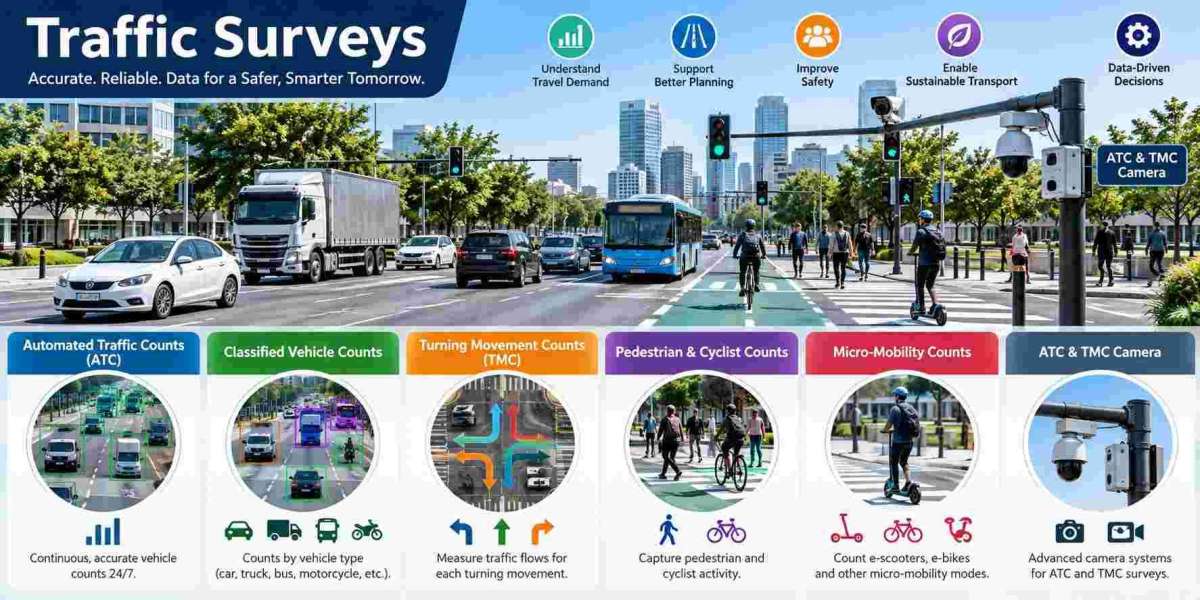
Every planning study needs a starting point. Automated Traffic Counts (ATC) record vehicle volumes continuously over days or weeks, revealing the daily rhythm of a corridor, the strength of weekday and weekend peaks, and seasonal patterns such as summer travel and school terms.
A long record also averages out one-off events such as roadworks or a major exhibition, giving planners a baseline, they can defend in front of an approving authority.
Understanding the Mix with Classified Vehicle Counts
Land use shapes traffic. An industrial edge brings trucks, a residential suburb brings cars and school buses, and a tourist district brings coaches and taxis. Classified Vehicle Counts separate these classes so planners can allocate lanes, choose pavement strength, protect residential streets from through freight, and estimate noise and emissions with confidence.
Testing Junctions with Turning Movement Counts (TMC)
Urban growth usually shows up first at junctions. Turning Movement Counts (TMC) record exactly how many vehicles turn left, go straight, or turn right from each approach, which is the raw material for signal timing, turn lane length, and capacity tests under future development scenarios.
Scenario Testing for New Developments
Once movement data is loaded into a model, planners can add the trips a new tower, school, or mall will generate and see which junction fails first, then decide whether to widen, signalize, or redirect traffic before approving the project.
Planning for People with Pedestrian & Cyclist Counts
A walkable city must first prove that people walk. Pedestrian & Cyclist Counts measure how many people cross a road, use a promenade, or ride a lane, at which hours, and in which direction, guiding decisions about shade, crossing spacing, footpath width, and the location of bicycle parking.
The same counts also reveal unsafe habits, such as people crossing mid-block because the nearest crossing is too far away, a finding that supports a targeted safety fix rather than a generic campaign.
Capturing New Modes with Micro-Mobility counts
Shared scooters and e bikes have become a real part of the Emirati street scene, and Micro-Mobility Counts show where these devices travel, where they mix with pedestrians, and where dedicated lanes, parking bays, or speed limits are justified.
Early data also helps regulators and operators agree on sensible rules for geofencing and parking, supported by numbers instead of anecdotes.
Modern Fieldwork Using an ATC & TMC Camera
Clipboards have largely given way to analytics. A single ATC & TMC Camera can capture continuous volumes and junction movements together, leaving a video record that can be audited. You can see how this equipment supports planning projects on our traffic survey service page, where the survey methods are described in detail.
Camera based collection is also safer for staff, because crews no longer stand at the roadside during peak traffic or summer heat for hours at a time.
Feeding Survey Data into Transport Models
Raw counts become powerful when they feed a calibrated transport model. Planners compare modelled flows with measured ones, adjust the model until the two agree, and then use it to test future scenarios such as a new interchange, a bus priority corridor, or a change in parking supply.
A model built on weak data can look impressive yet mislead, so the quality of the underlying survey is the single most important factor in how far the results can be trusted by reviewers and decision makers.
Supporting Public Transport and Transit Oriented Districts
Metro, tram, and bus investments only succeed if people can reach stations easily. Surveys around station catchments measure how many people arrive on foot, by bike, by scooter, or by car, guiding the design of feeder routes, drop off zones, and safe crossings.
Counts taken before and after a new line opens also show whether car trips fell on parallel roads, helping authorities judge the real return on a public transport investment.
Monitoring Results After a Project Opens
Planning does not end at ribbon cutting. A repeat survey after a new road, bus lane, or cycle track opens shows whether traffic moved as predicted, whether walking and cycling grew, and whether new problems appeared nearby, feeding lessons back into the next project.
Authorities such as the Roads and Transport Authority in Dubai and the Department of Municipalities and Transport in Abu Dhabi value this kind of before and after evidence because it demonstrates real outcomes rather than forecasts alone.
Experience and Trust Signals for Planning Teams
Planners should look for providers with completed work across several emirates, trained field crews, written quality assurance steps, and sample reports that show clean tables and clear methodology. Those signals matter more than a long equipment list.
Data should also be traceable, with survey dates, weather, and any unusual events recorded alongside the counts so a reviewer years later can understand exactly what the numbers represent.
Selecting Traffic Surveys UAE Teams Can Depend On
When commissioning Traffic Surveys UAE planners trust, ask how long equipment stays on site, how gaps are handled, how counts are validated against manual samples, and how quickly a final dataset is delivered, since late data can delay an approval or a design deadline.
Planning Pressure in Dubai
Dubai adds growth, tourism, freight, and dense towers into one network, so Traffic Surveys Dubai projects often need several count types at once and a calendar agreed early with all stakeholders to meet tight review timelines.
Starting early, confirming the report format in advance, and choosing survey days that reflect normal conditions keeps a Dubai planning study on schedule.
Conclusion
Smarter urban planning starts with Traffic Surveys, and Automated Traffic Counts (ATC) give planners a trustworthy baseline for every corridor. Classified Vehicle Counts and Turning Movement Counts (TMC) show how land use and growth affect roads and junctions, while Pedestrian & Cyclist Counts and Micro-Mobility Counts keep people and new modes at the center of design. A reliable ATC & TMC Camera keeps the evidence accurate and auditable. For any Traffic Surveys UAE or Traffic Surveys Dubai planning project, contact our team today to build your next plan on solid data.
FAQs
- Why do city planners rely on Traffic Surveys before approving a new development?
They show current road and walking demand, allowing planners to test whether a new project will overload junctions and what mitigation is needed.
- How long should Automated Traffic Counts (ATC) run for a planning baseline?
Seven days or more is common, so weekday and weekend patterns are both captured and one off disruptions do not distort the average.
- What do Classified Vehicle Counts add to a land use study?
They reveal how many trucks, buses, vans, and cars use a road, which guides lane allocation, pavement design, and freight routing.
- Why measure Pedestrian & Cyclist Counts in a walkable district plan?
They prove actual walking and cycling demand, informing crossings, shade, footpath width, and bicycle parking in the right places.
- Can an ATC & TMC Camera collect both volume and junction data at once?
Yes, one properly mounted camera can record continuous volumes and individual turning movements, reducing equipment and site visits.