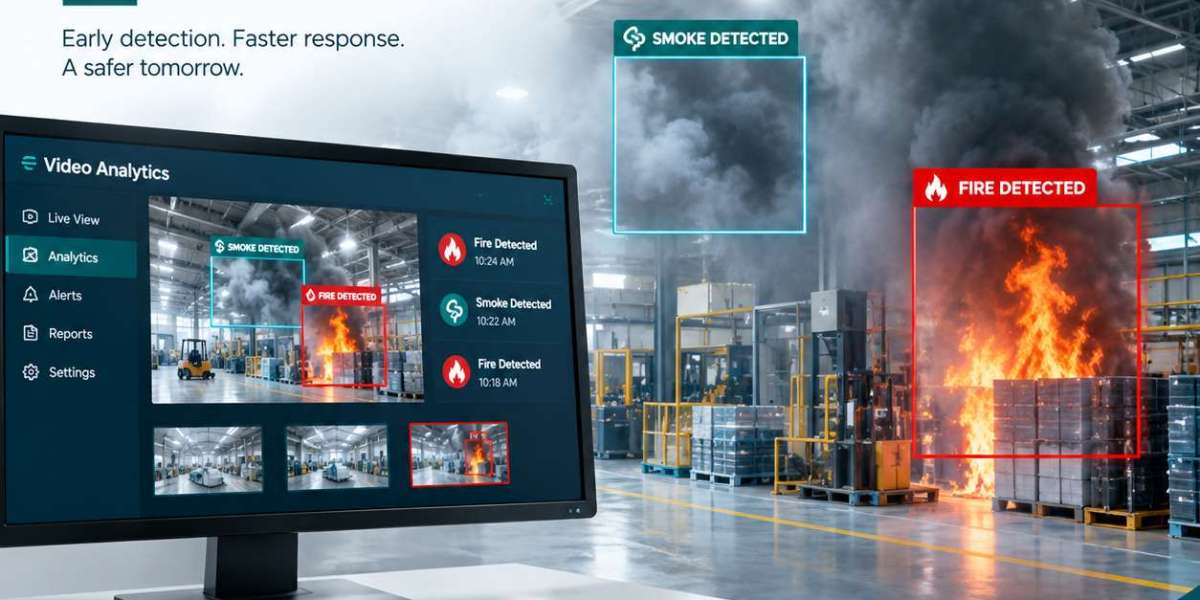
Traditional smoke detectors have protected UAE buildings for decades, but they share one persistent limitation: they only trigger once smoke or heat physically reaches the sensor. Video Analytics changes that equation entirely, using cameras already installed across a facility to spot the visual signature of fire and smoke the moment it appears, often well before a ceiling-mounted detector would ever activate.
This guide explains how this camera-based detection technology works alongside conventional fire systems, why UAE facility managers across warehouses, malls, and industrial sites are adopting it, and what to evaluate before adding it to an existing safety programme.
Why Point Detectors Alone Are No Longer Enough for UAE Facilities
Conventional smoke and heat detectors rely on physics: particles or hot air must physically travel to the sensor before an alarm trigger. In large warehouses, high-ceilinged atriums, and open industrial yards common across UAE developments, that delay can be significant, since smoke from a fire starting at floor level may take minutes to rise and disperse enough to reach a ceiling-mounted detector.
UAE Civil Defence authorities have been steadily encouraging facility operators toward more responsive detection technology, particularly for large-volume spaces where traditional point detectors were never designed to perform at their best. Camera-based detection fills exactly that gap, watching the space itself rather than waiting for airborne particles to reach a fixed point.
How AI-Powered Video Analytics Actually Spot Fire and Smoke
Rather than relying on a single sensor reading, AI-Powered Video Analytics analyse live camera footage frame by frame, trained to recognise the specific visual patterns of flame flicker, smoke plume movement, and colour signatures that distinguish genuine combustion from steam, dust, or shifting shadows that might otherwise confuse a simpler motion-detection system.
This visual recognition happens continuously across every camera in the network simultaneously, meaning a single monitoring platform can watch dozens of zones across a large facility with the same attentiveness a human operator could only maintain for one or two screens at a time.
What the Detection Model Is Trained to Recognise
- Flame characteristics, including flicker frequency and colour temperature that distinguish fire from reflective light sources.
- Smoke plume behaviour, tracking density and movement patterns that differ from steam, dust clouds, or fog.
- Rapid scene changes consistent with a developing fire, rather than gradual lighting shifts from time of day.
Choosing the Right Video Analytics Software for a UAE Facility
Detection accuracy depends heavily on the underlying Video Analytics Software platform running behind the cameras, and not every product performs equally well across the varied environments found in UAE facilities, from air-conditioned retail interiors to dusty, sun-baked outdoor loading yards.
Facility managers evaluating software should look for a platform that has been trained on genuinely diverse lighting and environmental conditions, supports integration with existing camera hardware rather than requiring a full system replacement, and offers configurable sensitivity zones so a busy kitchen's steam does not trigger the same alert threshold as a quiet warehouse aisle.
Deploying Video Analytics Solutions Across Different UAE Building Types
Detection needs vary considerably depending on a facility's layout and risk profile, which means a well-planned rollout of Video Analytics Solutions rarely uses a single, uniform configuration across every camera on site.
Scaling Video Analytics Dubai Facilities Can Grow Into
Dubai's fast-expanding logistics, retail, and industrial sectors mean many facilities add capacity in phases, additional warehouse bays, new retail units, or expanded yard space, rather than opening at full scale from day one. A Video Analytics Dubai deployment should be specified with that growth in mind, using a platform that can absorb additional camera feeds and detection zones without requiring a full software replacement each time the facility expands.
Before finalising a vendor, facility teams should confirm whether the analytics platform can run on existing camera infrastructure or requires proprietary hardware, and whether alert routing can be reconfigured easily as staffing schedules or building layouts change over time. Teams ready to plan a rollout can consult Tektronix's Dubai video analytics integration page for a site-specific recommendation.
Conclusion
UAE facilities are increasingly pairing traditional fire safety equipment with Video Analytics to close the detection gap that point sensors alone cannot cover, particularly across large warehouses, malls, and industrial sites. Backed by AI-Powered Video Analytics, Real-Time Hazard Detection, and Automated Emergency Response, facility teams gain earlier warning, fewer nuisance alarms, and a documented incident record that supports both safety outcomes and compliance requirements as their properties continue to grow.