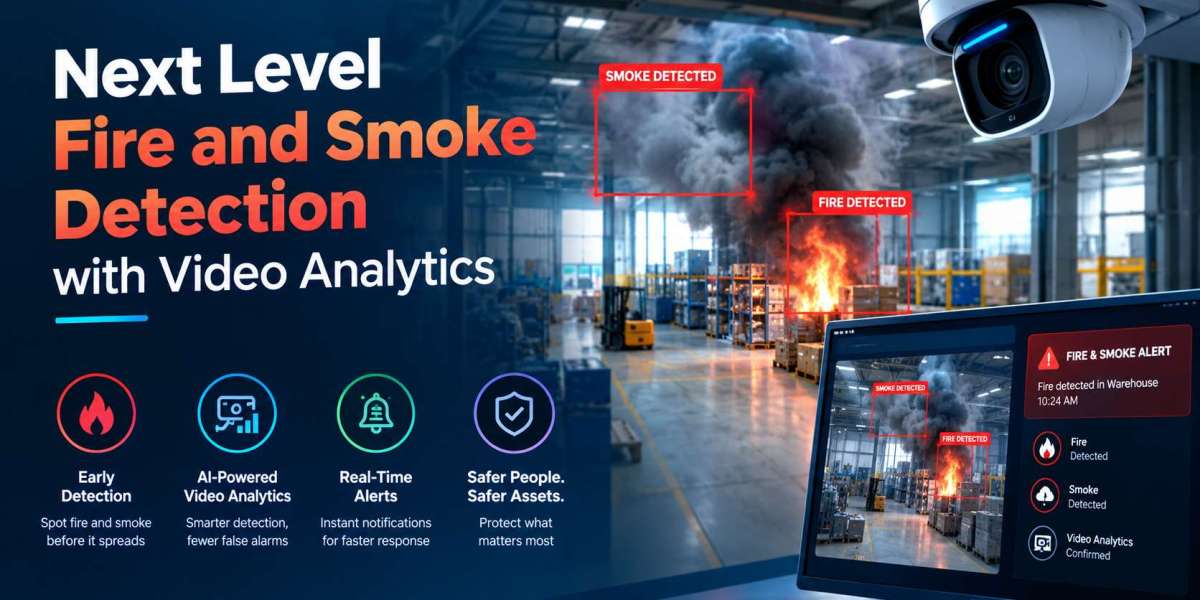
Video Analytics is changing how Saudi Arabia protects its warehouses, factories, malls, data centers, and public buildings from fire. By teaching software to recognise flames and smoke directly in camera footage, facilities can spot a developing fire in seconds, in large open spaces where traditional detectors may take minutes to react.
The Kingdom is building and expanding at a pace few countries can match. Vision 2030 projects, new logistics hubs, industrial cities, and dense commercial towers all raise the stakes of an undetected fire. Joining existing cameras to intelligent software gives safety teams earlier warning, clearer evidence, and faster decisions when every second counts.
Why Fire Safety Is a Growing Priority for Saudi Facilities
Saudi Arabia's built environment is expanding quickly. Giga projects such as NEOM and the Red Sea development, the Riyadh Metro, new airports, large retail destinations, and sprawling industrial zones in Jubail, Yanbu, and Dammam all add fire risk on a very large scale. Many of these sites have high ceilings, open halls, long conveyor lines, and stored goods that make a small flame spread quickly.
Climate adds to the challenge. Summer temperatures above forty-five degrees stress electrical equipment, lithium batteries, and cooling plant, while dust and strong sun make some environments difficult for traditional sensors. The General Directorate of Civil Defense and the Saudi Building Code, including its fire protection requirements, set the baseline, but operators increasingly look for protection that goes beyond the minimum.
The Limits of Conventional Fire and Smoke Detection
Point smoke detectors and heat detectors remain the foundation of any fire alarm system, and they are required by code. Their weakness is that they must wait for smoke or heat to physically reach the sensor. In a warehouse with a twelve-metre ceiling, an atrium, a hangar, or an outdoor storage yard, that delay can stretch from seconds to many minutes.
Conventional systems also struggle to tell staff what is actually happening. A single alarm at a panel says that a zone has triggered, not whether the cause is a small cooking fire, welding sparks, or a pile of burning pallets. Operators must send someone to look, and during that time a controllable incident can grow. Video adds the missing context by showing the event as it unfolds.
What Is Video Analytics and How Does It Detect Fire and Smoke
In fire protection, the technology analyses each frame of a camera feed looking for the visual signature of combustion. Flames have characteristic colour, flicker frequency, and irregular shape, while smoke has a distinctive pattern of rising, spreading, and changing density. The software tracks these features across frames and raises an alert when they match a developing fire.
Because the analysis happens on the video itself, it works anywhere a camera can see, including open yards, loading docks, parking structures, tunnels, and tall halls. It is not a replacement for certified detectors and alarm panels, but a powerful additional layer that detects earlier in the places where traditional sensors are slowest.
AI Powered Video Analytics: How Modern Models Learn to See Fire
AI Powered Video Analytics uses deep learning models trained on large libraries of real fire, smoke, and non-fire scenes. Instead of relying on fixed rules about colour or brightness, the model learns what separates a genuine flame from a flashing vehicle light, a sunset reflection, or a worker in a bright orange vest.
This learning approach is what makes modern systems practical in difficult environments. The same model can be tuned for a dusty construction site, a dimly lit cold store, or a busy retail atrium, and it keeps improving as new examples are added. Edge processing inside the camera or a nearby appliance keeps detection fast and avoids sending large video streams across the network.
Video Analytics Solutions for Different Types of Saudi Sites
Video Analytics Solutions are not one size fits all. A good design starts with the building, the fire load, and the risks, then selects cameras, analytics modules, and integrations to match. Typical applications across the Kingdom include:
- Warehouses and logistics hubs: early detection among tall racking and stored goods
- Industrial plants and refineries: flame and smoke monitoring around process areas and storage tanks
- Data centers: detection of smoke or sparks near cabinets, cable trays, and battery rooms
- Shopping malls and airports: monitoring of large atriums, kitchens, and service corridors
- Parking structures and tunnels: vehicle fire detection where ventilation hides smoke
- Forest edges, farms, and open yards: outdoor detection that point sensors cannot provide
Common Mistakes to Avoid When Adding Video Analytics to Fire Protection
The most frequent mistake is treating the technology as a replacement for certified detection. It is a layer that works with the alarm system, not instead of it. Another is installing cameras without checking lighting, mounting height, and field of view, which limits what the software can ever detect.
Skipping tuning and training is also costly. Systems left on default settings produce either too many alerts or too few, and operators who have never practised a response lose precious seconds. Finally, some sites forget cybersecurity and let camera networks run with default passwords, which undermines the safety benefit entirely.
Conclusion
Video Analytics gives Saudi facilities earlier and clearer warning of fire and smoke. AI Powered Video Analytics running on Video Analytics Software turns ordinary cameras into smart detectors. Video Analytics Solutions enable Real Time Hazard Detection and Automated Emergency Response. Reduced False Alarms and Detailed Incident Reporting keep operations trusted and compliant. For Video Analytics KSA and Video Analytics Riyadh, Tektronix is a dependable local partner.