Data Center Security has become one of the most important investments for Saudi organisations as banks, telecom operators, government entities, and cloud providers move critical workloads into larger and more connected facilities. A single breach, whether it begins with a stolen credential or an unauthorised visitor at the server hall door, can stop services, expose citizen data, and damage trust that took years to build.
Vision 2030 is accelerating this shift. New hyperscale cloud regions, sovereign data programmes, smart city projects such as NEOM, and national digital government platforms all depend on facilities that stay secure, compliant, and available around the clock. Protecting them takes a layered approach that joins cyber defences, physical controls, and well-trained people into one coordinated programme.
Why Saudi Arabia Is Racing to Secure Its Digital Infrastructure
The Kingdom is one of the fastest growing data center markets in the Middle East. International cloud providers have announced regional infrastructure, local operators are expanding colocation capacity in Riyadh, Jeddah, and Dammam, and government entities are consolidating legacy server rooms into modern, purpose-built facilities. Each new site adds capacity, but it also adds a new target.
Regulators have raised expectations in step with this growth. The National Cybersecurity Authority (NCA), the Saudi Data and AI Authority (SDAIA), and the Communications, Space and Technology Commission (CST) all publish requirements that touch the way facilities are designed, operated, and audited. Operators that treat security as an afterthought find that approvals, contracts, and customer trust are all harder to win.
Understanding the Layers of Data Center Security
Effective protection works like an onion rather than a wall. Defence in depth places several independent controls between an attacker and the asset, so that the failure of any one layer does not lead to compromise. In a data center, the layers usually run from the outside in:
- Site perimeter: fencing, lighting, vehicle barriers, and guard posts
- Building entry: reception, visitor screening, and controlled lobbies
- Data hall and cage: restricted doors, mantraps, and audited entry
- Rack and hardware: locked cabinets, tamper alerts, and asset tracking
- Network and workloads: segmentation, filtering, monitoring, and patching
- Data and identity: encryption, key management, and privileged access control
Physical and digital layers support one another. A strong firewall means little if someone can walk out with a server, and a locked cage means little if an administrator account is protected by a weak password.
Cybersecurity for Data Center Environments: Protecting Networks, Workloads, and Identities
Cybersecurity for Data Center operations start with the assumption that attackers will eventually reach the internal network. Modern programmes therefore apply zero trust principles, verifying every user, device, and workload before granting access, and limiting what each can reach once inside. Network segmentation separates management systems, tenant workloads, backup platforms, and storage so that a compromise in one zone cannot spread freely to the rest.
Good hygiene matters just as much as advanced tools. Timely patching, secure configuration baselines, strong administrator authentication, privileged access management, and tested backup and recovery plans stop a large share of real-world incidents. Regular penetration testing and tabletop exercises show where assumptions are wrong before an attacker does.
Data Center Firewalls: Controlling Traffic at Every Boundary
Data Center Firewalls are the gatekeepers between the internet, the corporate network, tenant environments, and management systems. Next generation firewalls inspect traffic by application, user, and content rather than simply by port, which lets security teams block hostile behaviour without breaking legitimate services.
Best practice is to place firewalls at several boundaries rather than only at the edge. East west filtering between internal zones limits lateral movement, web application firewalls shield public services, and clustered pairs remove a single point of failure so that maintenance or a hardware fault never leaves a path open. Rule sets should be reviewed on a schedule, because old and overly broad rules are among the most common causes of exposure.
Data Center Encryption: Protecting Information at Rest and in Transit
Data Center Encryption ensures that stolen or intercepted information is useless without the keys. Strong algorithms such as AES 256 protect stored data on disks, databases, and backup media, while TLS secures traffic moving between users, applications, and sites. Encrypted links between facilities protect replication and disaster recovery traffic that would otherwise cross the network in the clear.
Key management is where encryption succeeds or fails. Hardware security modules, separation of duties, regular key rotation, and clear procedures for retiring keys keep the protection meaningful. Saudi organisations handling personal data also need to show that encryption supports their obligations under the Personal Data Protection Law (PDPL) and any data residency rules that apply to their sector.
Data Center Intrusion Detection: Spotting Hostile Activity Early
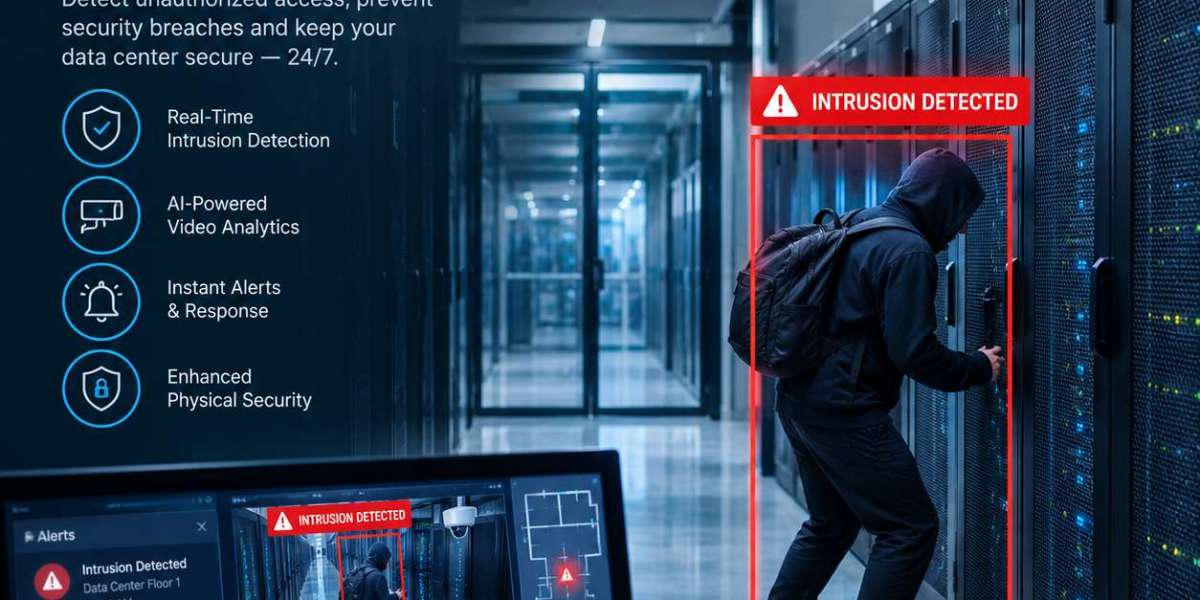
Data Center Intrusion Detection watches networks and servers for signs that someone is probing, exploiting, or misusing a system. Network sensors compare traffic against known attack signatures and behavioural baselines, while host agents look for suspicious processes, file changes, and logins. When tuned well, these tools turn a silent breach into an alert within minutes.
Detection should not stop at the network. Door forced alarms, glass break sensors, vibration sensors on perimeter fences, and tamper switches on cabinets give the same early warning on the physical side. Feeding every one of these signals into a single monitoring platform lets operators see a coordinated attempt that no single sensor would reveal on its own.
Data Center Threat Detection: From Raw Alerts to Confident Action
Data Center Threat Detection goes further by correlating signals from firewalls, servers, identity systems, cameras, and door controllers. A security information and event management (SIEM) platform collects the logs, analytics highlight unusual behaviour, and threat intelligence feeds add context on current attack campaigns targeting the region.
The real value comes from people and process. A security operations centre (SOC), whether in house or managed, needs clear playbooks, defined escalation paths, and measured response times. Tracking how quickly a team detects and contains an incident gives leadership an honest view of readiness, and rehearsed responses prevent confusion when a real event unfolds.
Data Center Access Control: Securing Every Door, Hall, and Rack
Data Center Access Control decides who may enter each zone, at what time, and with what proof of identity. Modern deployments combine smart cards or mobile credentials with biometric verification, so a borrowed badge alone cannot open a server hall. Mantraps and interlocking doors stop tailgating by allowing only one person through at a time, and anti passback rules prevent credentials from being passed back to a second person.
Permissions should follow roles. A cooling engineer may need the plant room but never the data hall, and a customer in a colocation facility should reach only their own cage. Every entry and every denied attempt is logged, and credentials are revoked immediately when a contractor finishes or an employee leaves. Visitor management that registers, badges, and escorts guests closes another gap that paper logs leave open.
Data Center Surveillance: Seeing Everything That Matters
Data Center Surveillance provides the visual evidence that connects people to events. High resolution cameras cover the perimeter, entrances, corridors, data halls, and loading bays, with low light and thermal options for dark or difficult areas. Footage is stored securely for the period required by policy and regulation, with access limited to authorised staff.
Video becomes far more useful when it is linked to other systems. Matching a door event to the exact camera clip shortens investigations from hours to minutes, and video analytics can flag loitering, unattended objects, or people in restricted areas as they happen. Cameras should themselves be hardened, because an unpatched camera on a flat network is a common entry point for attackers.
Bringing Physical and Cyber Security into One Operating Model
Many facilities still run physical security and IT security as separate worlds, with different teams, tools, and reports. That gap is where sophisticated attackers operate. A technician who badges into a hall at an unusual hour, followed by an administrator login from the same console, deserves attention only if both facts are visible together.
Converged operations place access, video, alarm, and network events on a common dashboard and give a single team the authority to respond. This approach also simplifies audits, because one set of evidence can answer both the facility inspector and the cybersecurity assessor.
Data Center Security KSA: Meeting Local Compliance and Operating Requirements
Organisations planning a Data Center Security KSA programme should map controls to the frameworks that apply to them. The NCA Essential Cybersecurity Controls (ECC) and the Cloud Cybersecurity Controls (CCC) set baseline expectations, sector regulators add their own rules, and the PDPL governs how personal data is processed and protected. International standards such as ISO 27001, the TIA 942 facility standard, and Uptime Institute tier certification are widely used as supporting evidence.
Practical details matter as much as paperwork. Arabic and English documentation, local data residency, audit ready logs, and a support team that can reach the site quickly are all part of a credible deployment. A provider that understands how regulators review evidence will help avoid rework before an assessment.
Data Center Security Riyadh: Considerations for the Capital
A Data Center Security Riyadh project often sits in a fast-growing cluster that serves government, finance, and hyperscale cloud customers. Demand for secure capacity is high, sites expand in phases, and many facilities share infrastructure such as power feeds and fibre routes, which makes resilience and clear tenant separation important.
Local conditions affect equipment choices. Summer heat above forty-five degrees, fine dust, and strong sun call for rated outdoor cameras, sealed enclosures, and cooling that keeps electronics within tolerance. Security systems should keep running through power events, which is why battery backed controllers and generator support are standard for access and monitoring equipment.
How Tektronix Delivers Data Center Security Across Saudi Arabia
Tektronix designs, installs, and supports data center security solutions for enterprises, government entities, and colocation providers across Riyadh, Jeddah, Dammam, and the wider Kingdom. Each project begins with a site survey and risk assessment, and the resulting design joins physical protection, monitoring, and integration into a single plan the client can audit.
The same team supports organisations that need layered entry control for server halls, cages, and cabinets, and provides local maintenance so readers, controllers, and cameras keep performing long after handover. Teams comparing physical access control solutions for Saudi data centers can review hardware options, integration capabilities, and deployment experience directly with the Tektronix engineers, and can see the full range on the company website.
Industries Across Saudi Arabia That Depend on Secure Data Centers
Banks and payment providers rely on facilities that keep transaction systems available and auditable, and they face some of the strictest supervisory expectations in the Kingdom. Telecom operators and cloud providers host the services that other organisations build on, so a weakness in one facility can affect hundreds of customers at once.
Government entities, healthcare groups, energy companies, and large industrial projects each add their own needs, from sovereign data handling to operational technology links that must stay isolated from public networks. Educational institutions and research centres are also growing their own facilities and need the same discipline at a smaller scale.
Resilience and Business Continuity: Security That Survives Failure
Security controls must keep working when something goes wrong. Door controllers need battery backup, cameras need protected recording servers, and monitoring platforms need redundant paths so that a single failed switch or power feed does not leave a blind spot. Fail safe and fail secure behaviour for each door should be decided deliberately, with life safety always given priority.
Continuity planning extends to the data itself. Offsite replication, tested restore procedures, and documented recovery time objectives show customers and regulators that an outage will be short and controlled. These plans should be exercised at least once a year, because untested plans often fail in unexpected ways.
People, Governance, and Proof of Experience
Technology alone does not secure a facility. Clear policies, defined responsibilities, background checks for staff with privileged access, and regular awareness training all shape how well the controls work in practice. Governance reviews should look at who holds access, why they hold it, and whether it is still justified.
Experience is also a security feature. A provider that has delivered and supported live facilities understands how to phase work without disturbing production, how to document evidence for auditors, and how to respond when a component fails at an inconvenient hour. When selecting a partner, ask for named reference sites, engineer certifications for the proposed products, and written service levels for response and repair.
Emerging Trends: AI, Automation, and Sovereign Cloud in the Kingdom
Artificial intelligence is changing both sides of the contest. Attackers use automation to scan for weaknesses at scale, while defenders use machine learning to spot unusual logins, abnormal data transfers, and faces or vehicles that do not belong. Video analytics, behavioural monitoring, and automated response playbooks reduce the time between first sign and containment.
Sovereign cloud and local data hosting are also reshaping design choices. Organisations that must keep data inside the Kingdom need facilities with clear tenant separation, transparent audit trails, and operators who can demonstrate where data lives and who can touch it. Edge sites, smaller regional facilities close to users and industrial projects, bring the same needs into locations that may have fewer staff, so remote monitoring and strong automation become essential.
Questions to Ask Before Choosing a Security Partner
Selecting a provider is a long-term decision, so the right questions save time and money later. Strong candidates answer these clearly and in writing:
- Local experience: which live Saudi facilities has the team delivered and still supports
- Compliance knowledge: how will the design map to NCA, SDAIA, and sector requirements
- Integration: will access, video, alarm, and monitoring systems share data in one view
- Resilience: what happens to each control during a power or network failure
- Support: what are the response and repair times, and where are spares kept
- Scalability: can the platform grow from one hall to a campus without replacement
It is equally useful to ask how the provider handles handover. Complete as built drawings, configuration records, administrator training, and a documented maintenance plan make it far easier for an internal team to take over day to day operation with confidence.
The Business Case: Why Security Investment Pays for Itself
The cost of an incident usually exceeds the cost of prevention many times over. Downtime for a financial platform or a government service is measured in lost revenue, penalties, and public confidence, and recovery after a breach consumes months of management attention. Customers of colocation and cloud providers increasingly ask for evidence of controls before signing contracts, which makes strong security a sales advantage rather than only a cost.
Good design also reduces daily effort. Automated credential management, central dashboards, and consistent reporting replace manual registers and scattered logs, and cut the time staff spend preparing for audits.
Deployment Process: From Risk Assessment to Live Operation
A responsible programme follows clear stages so that nothing is missed and live operations are never put at risk:
- Assessment: map assets, threats, and current gaps against the applicable frameworks
- Design: define zones, controls, integrations, and resilience requirements
- Phased installation: start with the highest risk areas and avoid disrupting live halls
- Testing: verify failover, alarms, logging, and response procedures
- Training: prepare operators, guards, and administrators for real incidents
- Support and review: maintain equipment and repeat assessments on a regular cycle
Common Mistakes Saudi Organisations Make When Securing Data Centers
The most frequent mistake is treating security as a project rather than a programme. Credentials that are never reviewed, firewall rules that are never cleaned up, and cameras that are never patched slowly erode a system that looked excellent on the day of handover.
Another common error is spending heavily on the network while leaving doors and racks lightly protected, or the reverse. Attackers choose the weakest layer, so balance matters. Finally, many sites never test their response plans, and discover the gaps only during a real event.
Conclusion
Data Center Security in Saudi Arabia needs cyber and physical controls working as one system. Cybersecurity for Data Center teams rely on Data Center Firewalls and Data Center Encryption to protect networks and data. Data Center Intrusion Detection and Data Center Threat Detection turn hidden activity into fast response. Data Center Access Control and Data Center Surveillance secure every door, cage, and corridor. For Data Center Security KSA and Data Center Security Riyadh, Tektronix is a dependable local partner.
Frequently Asked Questions
- What does Data Center Security include for Saudi organisations?
Data Center Security covers the site perimeter, building entry, data halls, racks, networks, and data itself. It combines physical controls, cyber defences, monitoring, and trained people, and it must align with NCA, SDAIA, and PDPL requirements.
- Why is Cybersecurity for Data Center operations different from office IT security?
Cybersecurity for Data Center environments protect shared, high value infrastructure that serves many users and tenants. They need stronger segmentation, stricter privileged access, and higher availability than a typical office network.
- How do Data Center Firewalls and Data Center Encryption work together?
Data Center Firewalls control which traffic may reach each zone, while Data Center Encryption makes sure that any data that is stolen or intercepted cannot be read. One limits exposure and the other limits the damage if exposure happens.
- What is the difference between Data Center Intrusion Detection and Data Center Threat Detection?
Data Center Intrusion Detection spots suspicious activity on specific networks, hosts, and doors, while Data Center Threat Detection correlates many sources and threat intelligence to reveal larger campaigns and guide response.
- How should enterprises combine Data Center Access Control and Data Center Surveillance?
Link them so that every door event is tied to a camera clip and an identity. Data Center Access Control proves who was permitted to enter, and Data Center Surveillance shows what actually happened, which speeds investigations and audits.