Why New Infrastructure Projects Start with Field Data, Not Assumptions
A brand-new road, bridge, or interchange is a decades long commitment of public and private capital, so planning authorities across the UAE require quantified evidence of existing and forecast demand before a route alignment or budget is approved. Feasibility teams gather this evidence from the surrounding network, nearby developments, and planned growth corridors so that the chosen design reflects how people will actually travel rather than how planners assume they might.
This evidence also protects the project once construction begins, since a well-documented baseline gives contractors and authorities a shared reference point if disputes arise later over design assumptions or environmental impact.
Automated Traffic Counts (ATC) at the Feasibility Stage
Before a route alignment is finalized, planners need continuous, unbiased volume data from every road that will feed into or be affected by the new corridor, and this is exactly what Automated Traffic Counts (ATC) provide. Deployed across a wide study area for several days at a time, ATC equipment records every vehicle passing a point around the clock, producing the volume base that feasibility models and environmental assessments both rely on.
Because new infrastructure projects often affect a much wider area than the immediate construction footprint, feasibility teams typically place ATC equipment at multiple points across the surrounding network rather than at a single location, giving planners a fuller picture of how demand will shift once the new route opens.
Classified Vehicle Counts for Route and Structure Selection
Choosing between a standard arterial cross section and a heavier duty freight corridor depends entirely on knowing who will use the new route once it opens, which is the question Classified Vehicle Counts are built to answer. By separating passenger cars from buses and heavy trucks on the roads feeding a proposed corridor, this data lets planners size bridges, pavement structures, and service roads around the vehicle mix a new project will genuinely attract.
For projects linking to ports, industrial zones, or logistics parks, this classification step often changes the entire structural approach, since a corridor built primarily for passenger cars cannot be retrofitted cheaply once a heavy freight pattern emerges after opening.
Turning Movement Counts (TMC) for Junction Planning on New Corridors
A new road rarely stands alone; it connects into an existing network at multiple junctions, and the success of those connections depends on accurate Turning Movement Counts (TMC) gathered at every affected approach before design begins. This data tells engineers how traffic currently splits at each junction along the proposed route, which is the foundation for deciding whether a new connection needs a simple signal, a roundabout, or a fully grade separated interchange.
Getting this analysis right at the planning stage avoids one of the most common and costly mistakes in new infrastructure delivery, which is building a corridor that performs well along its length but creates a bottleneck at the point where it meets the existing network.
Designing New Corridors Around People, Not Only Vehicles
UAE planning guidelines now expect every new road or community corridor to account for how people will walk, cycle, and cross the route, not only how vehicles will flow through it. Pedestrian & Cyclist Counts gathered in the surrounding area during feasibility studies give designers the evidence needed to plan footpaths, crossings, and dedicated cycle tracks into the new corridor from day one, rather than retrofitting them after public complaints arise.
Alongside these counts, Micro-Mobility counts capture how scooters and other light electric vehicles already move through the study area, a pattern that barely existed a few years ago but now shapes lane widths and barrier placement on almost every new corridor design.
Camera Verified Evidence for High Value Infrastructure Decisions
New infrastructure decisions carry budgets and timelines that cannot be built on disputed numbers, so feasibility and design teams increasingly specify camera verified data collection for new project studies. An ATC & TMC Camera setup records continuous footage alongside the automated counts, allowing any classification or turning movement figure to be checked against a time stamped clip if a reviewer or funding body requests verification.
This verifiable evidence is particularly valuable during environmental and social impact reviews for new projects, where community stakeholders and regulators often want assurance that the traffic case behind a proposed route reflects genuine field conditions rather than modelled estimates alone.
A Field Ready Partner for New UAE Infrastructure Projects
Consulting teams running feasibility and design studies for Traffic Surveys UAE programs need a field partner who can mobilize quickly across wide study areas while a new project is still in its earliest planning stage. Project teams can explore the complete range of traffic survey and data collection services before scoping a count program for an upcoming feasibility study.
Supporting Dubai's Pipeline of New Road and Transit Projects
With new corridors, interchanges, and transit connections constantly moving through planning across the emirate, teams running Traffic Surveys Dubai programs for a greenfield project benefit from a provider who already understands the surrounding network. A specialist field data collection team can scope and deploy a multi-point study across a wide area within a tight feasibility timeline.
Managing Traffic During Construction of a New Corridor
Once a new road or infrastructure project moves from feasibility into construction, the same type of survey data takes on a second purpose, helping contractors plan diversions, temporary signal timing, and lane closures without creating gridlock on the surrounding network during the build.
Authorities overseeing a construction phase often require updated counts at regular intervals throughout the build, since traffic patterns around an active site shift as phases are completed and temporary diversions are opened or closed.
Planning for Growth Beyond Opening Day
A new corridor that only meets demand on its opening day is already behind schedule, which is why forecast ready survey data is used to size capacity for a horizon year well beyond initial completion, protecting the investment against premature congestion as surrounding development continues.
Why Project Teams Choose Top Precision for New Infrastructure Surveys
Feasibility and design teams delivering a new road or infrastructure project need a survey partner who can scope a wide study area quickly, adapt to a changing site as construction phases progress, and deliver data formatted for direct use in transport models.
Top Precision fields trained crews and calibrated ATC and TMC camera equipment for feasibility, design, and construction phase studies across every emirate, delivering classified counts, turning movement data, and non-motorized figures in formats that plug directly into a consultant's planning model. Developers, consultancies, and government project teams can review the full new infrastructure survey service catalogue to match the right methodology to a project's current planning stage.
Clear reporting, transparent field methodology, and responsive scheduling across multiple study phases are why project teams return to the same survey partner from feasibility through to construction on the same infrastructure program.
Conclusion
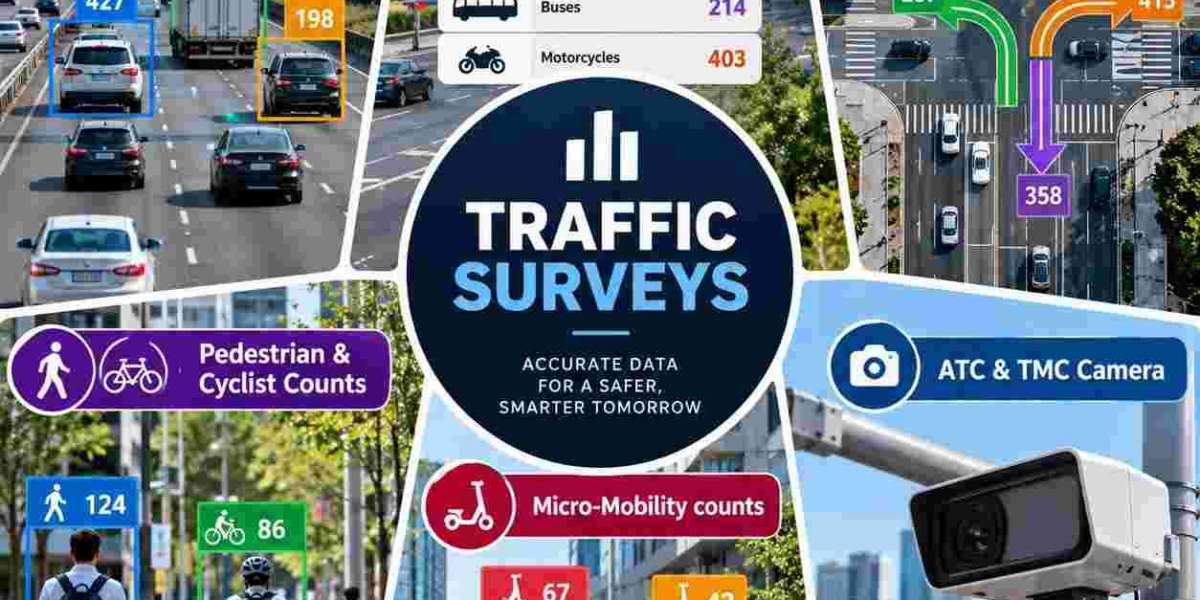
New road and infrastructure projects across the UAE now begin with evidence, and Traffic Surveys remain the starting point for every credible feasibility study. Automated Traffic Counts (ATC) and Classified Vehicle Counts establish the volume and vehicle mix that shape route and structure decisions, while Turning Movement Counts (TMC) guide how a new corridor connects into the existing network. Pedestrian & Cyclist Counts and Micro-Mobility counts keep people centered in the design, and an ATC & TMC Camera layer gives every figure a verifiable trail reviewer can trust. Teams running Traffic Surveys UAE and Traffic Surveys Dubai programs from the earliest planning stage consistently deliver new infrastructure that performs for decades after opening day.
FAQs
- Why are Traffic Surveys commissioned so early in a new UAE infrastructure project?
Feasibility studies and route approvals need quantified evidence of existing and forecast demand, so field data is gathered before design begins to ensure the chosen alignment and scale actually match real travel patterns.
- How do Automated Traffic Counts (ATC) support a feasibility study for a new road?
ATC equipment records continuous volumes across the wider study area for several days, giving planners an unbiased baseline that feasibility models and environmental assessments can both build on.
- Why do Classified Vehicle Counts matter when selecting a new route or structure type?
They reveal the real mix of cars, buses, and trucks expected on a new corridor, which determines whether the project needs a standard arterial design or a heavier duty freight focused structure.
- What role do Turning Movement Counts (TMC) play where a new road connects to the existing network?
They show how traffic currently splits at each affected junction, which planners use to decide between a simple signal, a roundabout, or a grade separated interchange at every connection point.
- How do Pedestrian & Cyclist Counts influence the design of a brand-new corridor?
They give designers evidence of existing walking and cycling activity in the study area, so footpaths, crossings, and dedicated lanes can be planned into the corridor from the start rather than added later.