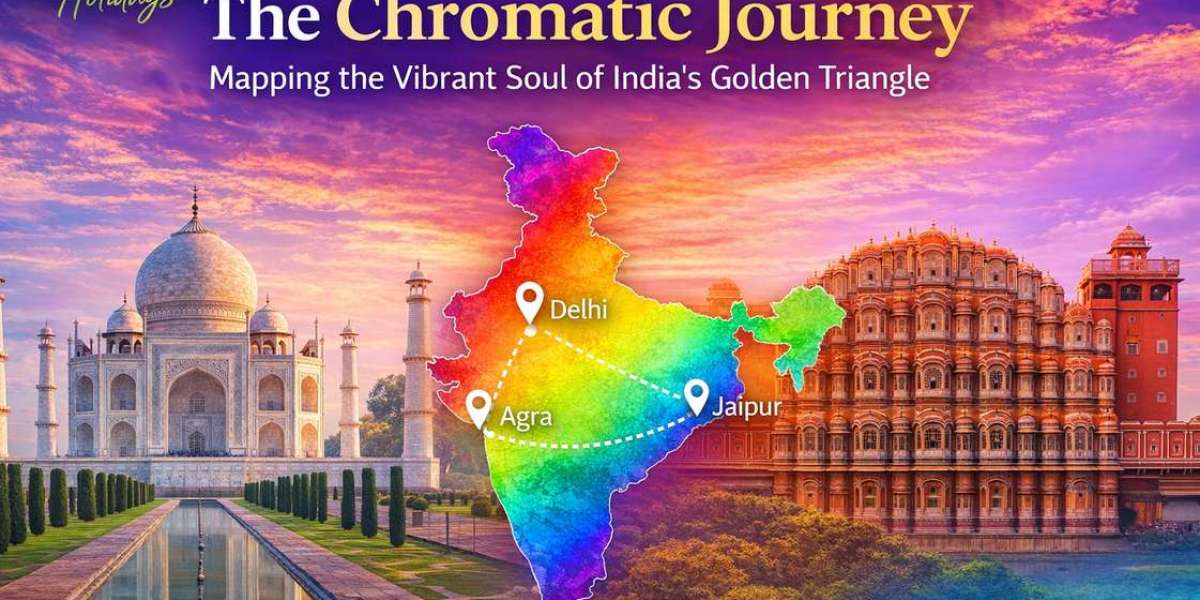
India is not a country that you simply look at; it is a country that you feel through its colors, its textures, and its timeless geometry. The Golden Triangle—the legendary circuit connecting Delhi, Agra, and Jaipur—is often described as the "Introductory Course to India." But for the seasoned traveler, it is much more. It is a chromatic journey where the grey stone of Delhi’s resilience meets the white marble of Agra’s romance and the pink sandstone of Jaipur’s royalty.
Whether you are navigating the brisk tempo of a golden triangle tour india 4 days or opting for the deeper, more resonant rhythm of a golden triangle tour 5 day experience, this path offers a window into the very heartbeat of Asia.
Section 1: Delhi – The Grey Prism of History
Delhi is a city of echoes. It is a place where the modern metro glides over the ruins of empires that rose and fell long before the West was "discovered." Delhi’s color is grey—the grey of ancient stone, the silver of morning mist, and the steely resolve of its people.
The Architecture of Survival
In Old Delhi, the Red Fort stands as a symbol of Mughal might. Built by Shah Jahan, its design was meant to represent the celestial city of Paradise. When you walk through the Lahori Gate, you aren't just entering a fortress; you are entering a timeline.
Just a few miles away, the Qutub Minar rises like a giant finger pointing toward the heavens. This 12th-century brick minaret is a masterclass in calligraphy and stonework. For anyone on a golden triangle tour india 4 days, Delhi is the essential starting point because it teaches you that in India, nothing ever truly dies; it just gets built upon.
The Cosmopolitan Fusion
New Delhi, designed by Lutyens and Baker, offers a different aesthetic. The India Gate and Rashtrapati Bhavan represent the transition from colonial rule to a vibrant democracy. It is this friction between the ancient and the modern that makes Delhi the intellectual capital of the triangle.
Section 2: Agra – The White Symphony of Eternal Love
As you head south, the grey stone gives way to the ethereal glow of white marble. Agra is a city that exists for a single monument, yet that monument is so powerful it defines the entire region.
The Taj Mahal: Engineering the Impossible
The Taj Mahal is often called a "poem in marble," but it is also a triumph of 17th-century physics. From the optical illusions that make the building appear smaller as you walk toward it, to the incredible Pietra Dura (inlay work) where precious stones are fitted into marble with microscopic precision, the Taj is a miracle.
For those on a golden triangle tour 5 day journey, Agra offers more than just the Taj. The Agra Fort, a massive red sandstone citadel, provides a look at the strategic mind of the Mughals. Here, Emperor Shah Jahan spent his final days looking at his creation from a distance—a story of tragedy and beauty that adds a layer of emotion to the stone.
The Ghost City: Fatehpur Sikri
A 5-day itinerary allows you to stop at Fatehpur Sikri. This city was the capital of the Mughal Empire for only 14 years before it was abandoned. Today, it stands perfectly preserved, a "frozen city" of red palaces and empty courtyards that feels like it’s waiting for its king to return.
Section 3: Jaipur – The Pink Radiance of the Desert
The final corner of the triangle takes you into Rajasthan, where the colors explode into vivid pinks, oranges, and deep reds. Jaipur is a city of warriors, but also a city of scientists and artists.
The Amber Fort: The Hillside Jewel
Perched on the Aravalli Hills, the Amber Fort is a stunning blend of Hindu and Islamic styles. Its "Hall of Mirrors" (Sheesh Mahal) is world-famous. A single lamp lit here creates the illusion of a thousand stars, reflecting the Rajput kings' love for celestial beauty.
The Science of the Stars
Maharaja Sawai Jai Singh II, the founder of Jaipur, was an astronomer. His Jantar Mantar observatory is a collection of massive stone instruments that can still predict the weather and track the stars. It’s a reminder that Jaipur was a city of the future even in the 1700s. For a golden triangle tour india 4 days, Jaipur is the vibrant, high-energy finale that leaves you craving for more of Rajasthan.
Section 4: Choosing Your Tempo – 4 Days or 5 Days?
Timing is everything in India. The duration of your tour dictates the depth of your memories.
The 4-Day Sprint: A golden triangle tour india 4 days is for the "Bucket List" traveler. It is efficient, well-oiled, and ensures you see the icons—the Taj, the Red Fort, and Amber Fort—without any wasted motion. It is the perfect weekend getaway for those working in Asia or on a tight global schedule.
The 5-Day Odyssey: A golden triangle tour 5 day plan is for the traveler who wants to look behind the curtain. It gives you the "Day of Discovery"—time to visit a local school, take a cooking class in a Rajasthani home, or watch the sun set over the Stepwells of Abhaneri. It turns a tourist trip into a life experience.
Section 5: The Sensory Trail (Food and Craft)
The Golden Triangle is not just seen; it is tasted and touched.
The Spice of Delhi: From the street-side Chaat to the royal Mughlai curries.
The Craft of Agra: Watching marble inlay artists whose families have been doing this for 400 years.
The Color of Jaipur: Hand-block printed textiles and the sparkle of precious gemstones.
Conclusion: The Circle of Life
The Golden Triangle is a circle that never truly ends. It connects the power of the past with the energy of the future. As you complete your journey, you realize that you haven't just traveled through three cities; you have traveled through a thousand years of human history.
Visit us: PioneerHolidays
Frequently Asked Questions (FAQs)
1. Is 4 days enough for the Golden Triangle? Yes, a golden triangle tour india 4 days is a standard and highly effective way to see the major highlights. It is a busy itinerary but very rewarding for those with limited time.
2. What is the benefit of a golden triangle tour 5 day package? The 5th day allows you to add a visit to Fatehpur Sikri or the Abhaneri Stepwell, and it provides a more relaxed pace for shopping and local cultural interactions in Jaipur.
3. When is the best time to visit? The peak season is from October to March. The weather is cool and pleasant, making it the best time for outdoor exploration.
4. Is the Taj Mahal open every day? No, the Taj Mahal is closed on Fridays for general public viewing. Keep this in mind while booking your golden triangle tour india 4 days.
5. Is it safe to travel between cities by road? Absolutely. The expressways (like the Yamuna Expressway) are world-class. Travelling by a private car provided by PioneerHolidays is the safest and most comfortable way to move between cities.
6. Can I see tigers on this tour? While the standard triangle doesn't include a safari, many people extend their golden triangle tour 5 day by one or two nights to include Ranthambore National Park, which is about 3 hours from Jaipur.
7. What currency should I carry? While many places accept cards, it is always wise to carry some Indian Rupees (INR) for small purchases in local markets and for tipping your guides and drivers.