Saudi Arabia is building digital capacity at remarkable speed, with banks, ministries, telecom operators, and global cloud providers all placing workloads in facilities across the Kingdom. Every one of those workloads depends on the same physical and digital foundations, which is why Data Center Security has moved from an IT department concern to a national priority. A single failure can interrupt payments, healthcare records, and public services for millions of people at once.
Tektronix has delivered security infrastructure for critical facilities across the Kingdom for many years, and its data center security solutions for Saudi Arabia bring physical and digital protection together instead of treating them as separate projects. This article explains the layers a modern facility needs, how Saudi regulation shapes the requirements, and what operators should expect from a supplier.
Why Saudi Data Centers Face a Different Risk Profile
Facilities in the Kingdom operate under conditions that few other markets share. Summer heat places heavy demands on cooling and power systems, desert dust threatens sensitive equipment, and the strategic value of hosted data attracts determined attackers. At the same time, national programs under Vision 2030 are concentrating government and commercial data inside Saudi borders, which raises the stakes for every operator that holds it. A security design that copies a template from another climate or regulatory setting often leaves gaps that only appear during an audit or an incident.
Cybersecurity for Data Center Operations Starts with Governance
Cybersecurity for Data Center environments begins long before any tool is installed. Operators need clear ownership of risk, documented policies for patching and change control, strict management of privileged accounts, and regular testing of recovery plans. Saudi operators typically align these practices with national frameworks issued by the National Cybersecurity Authority, which many governments linked and critical sector clients now require their suppliers to follow and to prove during audits.
Data Center Encryption for Information at Rest and in Motion
Data Center Encryption protects stored data on disks and backups, as well as traffic moving between servers, sites, and customers. If a drive is removed, a backup tape is lost, or a network link is intercepted, properly encrypted information remains unreadable. The weak point is usually key management rather than the algorithm itself, so operators should store keys separately from the data they protect, rotate them on a defined schedule, and keep an audit record of who can use them.
Data Center Firewalls as the Network Gatekeepers
Data Center Firewalls control which traffic may enter, leave, or move between zones of a facility. Modern designs divide the network into segments so that a compromise in one tenant area cannot spread to another, and they inspect traffic for known attack patterns rather than simply opening or closing ports. Rules need regular review, because a firewall policy that was correct on installation day gradually fills with exceptions that nobody remembers approving.
Data Center Access Control for Halls, Cages, and Racks
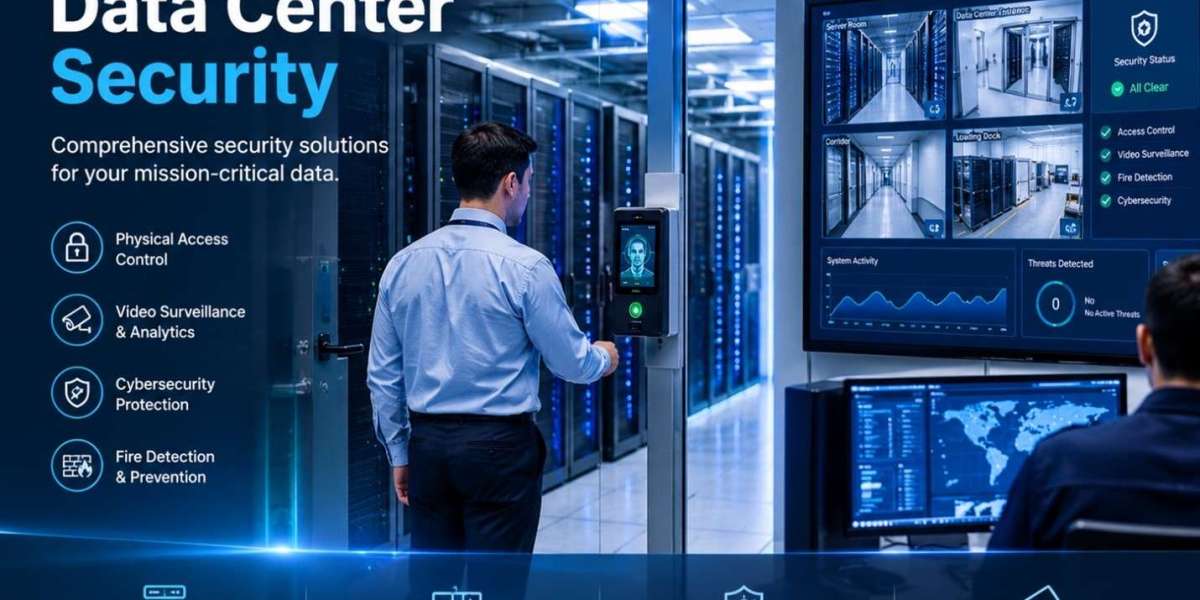
Data Center Access Control decides who can enter the building, which hall they can reach, and which cage or rack they may open. The strongest designs use several layers, for example a card and a face match at the main entrance, a mantrap that admits one person at a time into the white space, and individually locked cabinets for each tenant. Every event is logged, and anti passback rules stop a credential from being reused to follow someone in. Visitors and contractors receive temporary credentials limited to a named task and time window.
Data Center Surveillance for Continuous Visibility
Data Center Surveillance covers the perimeter, car parks, loading docks, corridors, and the server halls themselves. Cameras need to perform in low light and in glare from bright desert sun, and recordings must be stored long enough to satisfy audit and legal requirements. Video analytics can now flag unusual events automatically, such as a person lingering near a restricted cabinet or a door held open too long, so operators no longer depend on a guard noticing something on a wall of screens during a quiet night shift.
Data Center Intrusion Detection on the Perimeter and the Network
Data Center Intrusion Detection operates in two worlds. Physically, sensors on fences, doors, and windows raise an alarm when someone attempts to enter without authorization. Digitally, monitoring systems watch for traffic patterns that suggest probing, lateral movement, or data theft. Operators gain the most value when both streams feed a single operations centre, because a door alarm and a suspicious login at the same hour tell a very different story than either one alone.
Data Center Threat Detection Through Correlation and Analytics
Data Center Threat Detection looks for patterns across time instead of waiting for a single alarm. A credential used from an unusual location, a cabinet opened outside the normal maintenance schedule, or a server that suddenly sends large amounts of data to an unfamiliar address may each look harmless alone. Together they can reveal a developing attack. Facilities that invest in this analytical layer tend to catch problems at the reconnaissance stage rather than after an attacker has gained a foothold.
Data Center Security KSA: Regulation and National Expectations
Saudi operators work within a growing body of rules covering cybersecurity, personal data, and cloud services, issued by bodies such as the National Cybersecurity Authority, the Saudi Data and AI Authority, and the communications regulator. Data Center Security KSA programs therefore need documentation as much as technology, including evidence of physical controls, access logs, encryption practices, and incident response plans. Operators that prepare this evidence from the start find audits far less disruptive than those that try to assemble it afterward.
Data Center Security Riyadh: A Fast-Growing Hub
The capital has become the centre of the country's digital growth, with government platforms, financial institutions, and cloud capacity concentrating there. Data Center Security Riyadh projects often involve large campuses with multiple halls and tenants, which makes segmentation, tenant separation, and scalable access control especially important. Dust, heat, and the pace of expansion also mean that maintenance planning and spare parts availability deserve as much attention as the original design.
Designing Defence in Depth
No single control protects a facility on its own. A sound design layers a monitored perimeter, controlled entry to the building, a mantrap at the data hall, locked cabinets, encrypted storage and links, segmented networks, and continuous monitoring. Each layer is meant to catch what the previous one missed. Operators should test the layers together, for example by checking that a door alarm reaches the operations centre as quickly as a network alert, rather than assuming that separate systems will cooperate during a real event.
Environmental and Operational Resilience
Security controls must be designed alongside power, cooling, and fire protection. Redundant power feeds, backup generators, precision cooling, and gas-based fire suppression protect the same equipment that access control and surveillance guard. Conflicts appear when these teams work in isolation, for instance when a fire suppression test triggers a false intrusion alarm or a security door blocks an emergency exit. A single commissioning process that tests every system together before the facility goes live prevents many of these surprises.
Compliance, Audits, and Evidence
Auditors and customers increasingly ask operators to demonstrate controls rather than describe them. Useful evidence includes access logs showing who entered which hall and when, camera recordings retained for the required period, records of firewall rule reviews, results of vulnerability scans, and minutes from incident response exercises. Platforms that produce these reports automatically save weeks of effort at audit time and make it easier to respond to customer security questionnaires with confidence.
Planning for Growth and Change
Facilities rarely stay the size they were on opening day. New halls, new tenants, and new regulations arrive continuously, so security platforms should scale by adding doors, cameras, and users without replacing the core system. Licensing that follows growth, hardware that accepts remote updates, and reporting that adapts to new compliance requirements keep a facility secure without forcing a costly rebuild every few years.
Engineering Experience and Trust Behind Every Deployment
Tektronix has engineered and commissioned security infrastructure for data centers, banks, and critical facilities across Saudi Arabia and the wider Gulf for well over a decade. An in-house engineering team handles site surveys, network integration, and system configuration rather than passing installation to a subcontractor unfamiliar with the platform, and regional technical support and spare parts keep a failed component from leaving a sensitive area unprotected for long.
Technical documentation covering integration options, supported hardware, and monitoring capabilities is available through the company's data center security page, giving operators and compliance teams verifiable detail to review rather than a marketing summary alone.
Choosing the Right Security Partner for a Saudi Facility
Selecting a supplier is as much about proven experience across both physical and digital layers as it is about any single product. Operators should ask about past data center projects, how physical events are correlated with network monitoring, which encryption and key management practices are supported, and how quickly local engineers can respond if a critical component fails. Organizations that want one accountable partner across the whole stack can review Tektronix's full range of data center physical and access security solutions before finalizing a shortlist.
Conclusion
Strong Data Center Security now means physical and digital defences working together across the Kingdom. Cybersecurity for Data Center operations, Data Center Encryption, and Data Center Firewalls protect the information and the network around it. Reliable Data Center Access Control and continuous Data Center Surveillance show who entered and what happened onsite. Data Center Intrusion Detection and Data Center Threat Detection catch small anomalies before they become serious incidents. Operators planning Data Center Security KSA and Data Center Security Riyadh projects should choose a partner like Tektronix with proven local engineering across every layer.
FAQs
- What is a mantrap and why do data centers use one?
A mantrap is a small airlock style entry with two interlocked doors that admits one person at a time, which prevents tailgating and gives security staff a chance to verify identity before the second door opens.
- Can physical security events be linked with network alerts?
Yes, modern platforms can correlate a door or camera event with network activity on the same rack, so a security team sees one combined picture instead of two unrelated systems.
- How often should firewall rules and access permissions be reviewed?
Most facilities review them at least quarterly, and also whenever staff roles change or a new tenant or vendor is connected, because stale rules and old permissions are a common source of exposure.
- Does encryption still matter if the building is physically secure?
Yes, because encryption protects data if a drive, backup, or network link is ever compromised, which means physical and digital controls support each other rather than replace each other.
- What should an operator check when auditing a security supplier?
A thorough audit looks at past data center projects, evidence of access logs and recording retention, key management practices, test results across systems, and the speed of local support rather than certificates alone.