Why PPE Compliance Is Hard to Enforce Manually
Large Saudi worksites span wide areas, run across multiple shifts, and employ many contractors and subcontractors with different habits and levels of training. Heat makes workers tempted to remove helmets, vests, or gloves when no supervisor is nearby. Safety officers walk the site and issue warnings, but they can only be in one place at a time, and their observations capture a tiny share of the working day. Violations that go unseen become habits, and habits eventually become accidents.
How Camera Based PPE Detection Works
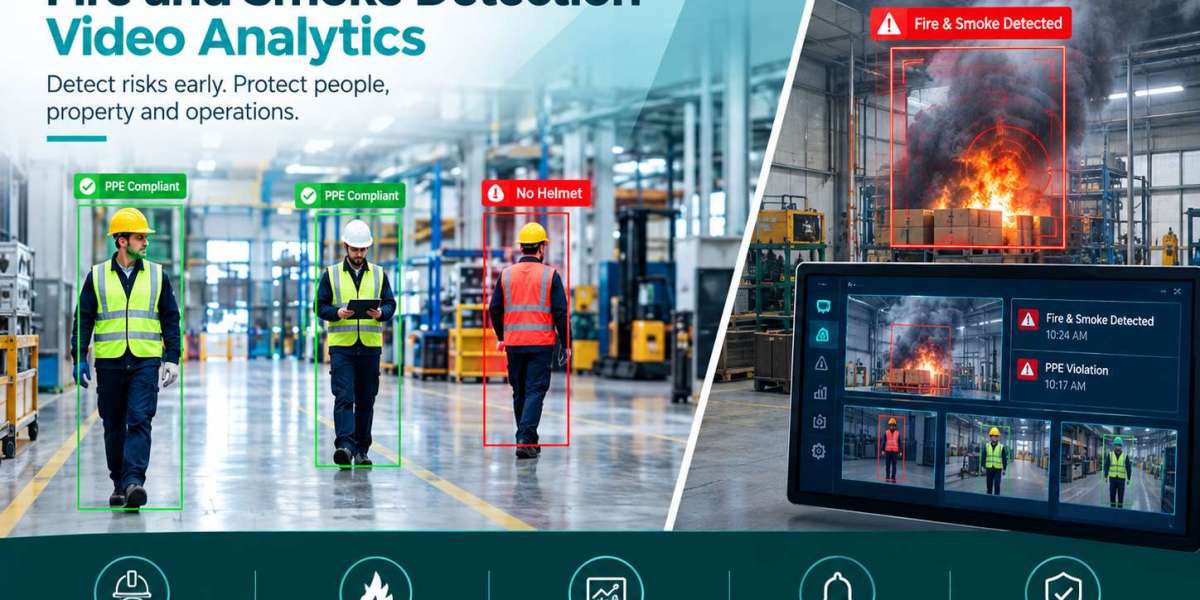
A camera watches a defined area such as a gate, a work zone, or a loading bay. Software analyzes each frame, finds the people in view, and checks whether each person is wearing the required equipment, for example a hard hat, a high visibility vest, safety glasses, gloves, boots, or a harness. When something is missing, the system raises an alert and stores a short clip as evidence. Because the checking happens automatically and continuously, coverage extends to every camera on site, at every hour, without adding supervisors.
AI Powered Video Analytics Behind the Detection
AI Powered Video Analytics learns from thousands of labelled images of workers in real conditions, including different lighting, angles, clothing colours, and weather. This training lets the system tell a hard hat from a baseball cap, and a reflective vest from an ordinary orange shirt, far better than older rule-based motion detection could. Models can also be refined with footage from a specific site, which improves performance on unusual uniforms, local equipment, or recurring visual conditions such as dust.
Video Analytics Software and the Management Platform
Cameras and models only become useful when someone can act on what they find. Video Analytics Software provides the live dashboard, the alert rules, the evidence library, and the reporting tools that safety managers use every day. It shows which zones generate the most violations, which shifts or contractors need extra coaching, and how compliance changes after a toolbox talk or a new rule. Good software also integrates with existing safety and security platforms instead of forcing teams to watch another isolated screen.
Complete Video Analytics Solutions for Industrial Sites
PPE checking is often the starting point rather than the whole project. Complete Video Analytics Solutions can add detection of people entering restricted zones, vehicles operating near pedestrians, fire and smoke, abandoned objects, and crowding at gates, all running on the same camera network and management platform. This consolidation lowers cost and complexity compared with buying a separate product for every hazard, and it gives safety and security teams a single view of what is happening across the site.
Real Time PPE Compliance Monitoring on the Ground
Real Time PPE Compliance Monitoring means a supervisor receives an alert within seconds of a violation, while the worker is still in the area and can be corrected on the spot. Alerts can appear on a control room screen, a mobile phone, a site radio, or a local siren and light, and they can include a snapshot showing exactly who and where. Prompt correction changes behaviour far more effectively than a report read the following week.
AI Powered Object Recognition Beyond Helmets and Vests
AI Powered Object Recognition identifies many kinds of items in a scene, not just clothing. Beyond PPE, it can recognize forklifts, cranes, scaffolding, fire extinguishers, barriers, and vehicles, and it can understand their position relative to people. This capability supports rules such as keeping pedestrians out of a vehicle lane, confirming that a guardrail is in place, or checking that an extinguisher has not been moved from its bracket.
Customizable PPE Rules and Alerts for Each Zone
Customizable PPE Rules and Alerts allow a safety team to match the system to the real hazards of each area. A welding bay might require goggles and gloves, a loading dock might require a vest and boots, and an office corridor might require nothing at all. Schedules can change rules by shift, severity levels can decide who receives an alert, and repeat violations can escalate to a manager. This flexibility prevents alert fatigue and keeps attention on the risks that matter.
Video Analytics KSA: Safety Priorities Across the Kingdom
Saudi Vision 2030 has created a large pipeline of construction, energy, mining, and manufacturing projects, and employers face growing expectations around occupational safety and the wellbeing of their workforce. Video Analytics KSA deployments help companies show that they actively monitor and enforce safety rules, which supports internal audits, contractor management, and conversations with clients and insurers. Employers should also consider the Personal Data Protection Law when recording and storing footage of workers.