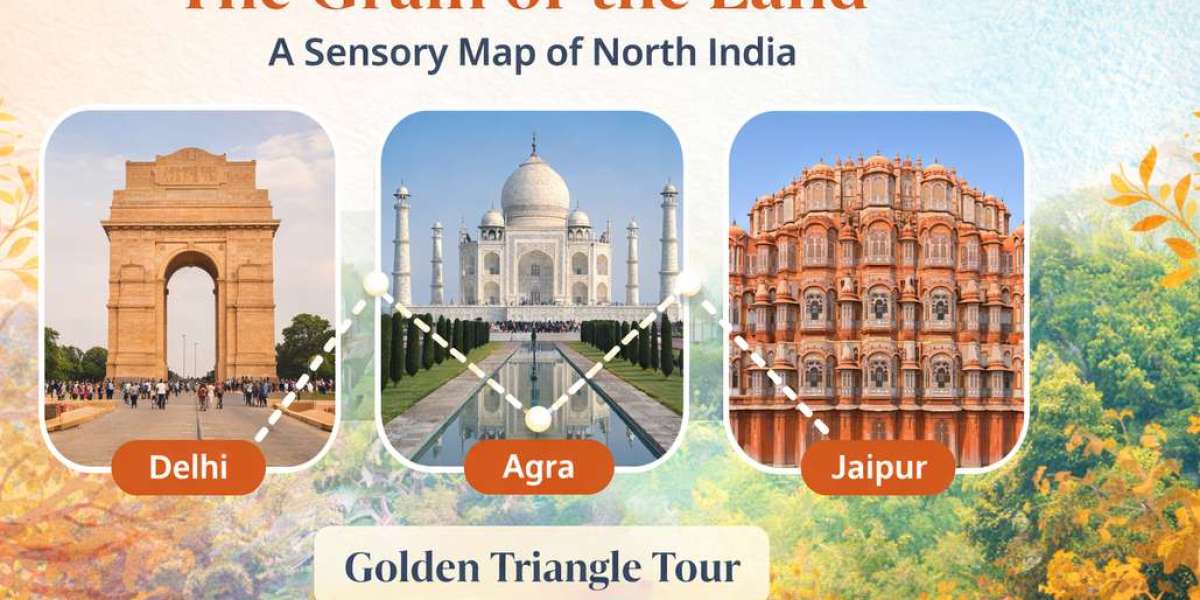
Most travel stories about India talk about kings and monuments. But India isn't built of history; it’s built of textures—the rough sandstone of a desert wall, the cold marble of a tomb, the dry crunch of jungle leaves, and the oily smoke of a riverside fire.
If you are planning your 2026 escape, the classic loop of Delhi, Agra, and Jaipur is your canvas. But to finish the masterpiece, you have to choose your texture: Do you want the Jagged Edge of the wild or the Fluid Grace of the eternal?
Part 1: The Urban Grid (The Foundation)
Before you disappear into the forest or the mist, you must navigate the three cities that define the human experience in the North.
Delhi: The Scent of Overload
Delhi doesn't just look like a city; it smells like one. It’s the aroma of paranthas frying in ghee, the scent of wet earth after a sudden rain, and the sharp ozone of the metro. It’s a city where you learn to find your balance. You move from the narrow, sun-blocked lanes of the old city to the wide, breezy avenues of the new, realizing that India’s greatest strength is its ability to hold multiple centuries in one hand.
Agra: The Weight of Stone
Agra is a city that feels permanent. It isn't just about one famous building; it’s about the river Yamuna that flows behind it, slow and heavy. There is a specific quiet in Agra’s backstreets, where the sound of small hammers hitting marble has been the soundtrack for generations. It’s a place that teaches you that true beauty isn't a flash in the pan—it’s a marathon of craftsmanship.
Jaipur: The Color of the Sun
Jaipur is where the landscape turns to terracotta. It’s a city of artisans and astrologers. Everything here is intentional—from the way the streets are aligned to the way a local dyer dips fabric into a vat of indigo. It’s the final urban checkpoint before the roads turn to gravel and the horizon opens up.
Part 2: The Jagged Edge (The Wild Extension)
When you’ve had enough of human symmetry, you head for the Aravalli hills. This is where a golden triangle tour with ranthambore changes the way you see the world.
Ranthambore isn't a zoo; it’s a kingdom that has reclaimed its throne. Here, 1,000-year-old stone walls are covered in moss, and the only royalty left are the striped ones. The air here is thin and dry, smelling of parched grass.
The real magic of a golden triangle tour with ranthambore is the "Hold." You sit in an open jeep, your breath held, listening to the alarm call of a langur. It’s the tension in the air when the birds go silent. When you finally see a tiger—not behind bars, but walking through the ruins of a gateway—you realize that nature doesn't care about your schedule. It’s a raw, jagged experience that shocks you back into your own skin.
Part 3: The Fluid Grace (The Sacred Extension)
If your heart isn't looking for a thrill but for a "Dissolving," you head East. A golden triangle tour with varanasi is an immersion into a city that has no beginning and no end.
Varanasi is a city of water and fire. It sits on the curve of the Ganges, a river that is treated like a mother. The streets are so narrow that they feel like the veins of a living creature. There is no "tourist mode" here; you simply jump into the current and let it take you.
The climax of a golden triangle tour with varanasi happens on the stone ghats at night. The Aarti ceremony is a sensory explosion—massive brass lamps, the smell of camphor, and a thousand bells ringing at once. But the true shift happens at 5:00 AM on a boat. As the sun rises through the river-mist, you see people praying, washing, and saying goodbye to their loved ones all in the same space. It is a place that tells you that you are just a small part of a very big, very ancient story.
Which Path Calls Your Soul?
Choose Ranthambore if you find peace in the rugged, the raw, and the unscripted. It’s for the adventurer who wants to see the earth before humans took over.
Choose Varanasi if you find peace in the ancient, the symbolic, and the eternal. It’s for the seeker who wants to see the roots of human faith.
2026 Travel Intel: Frequently Asked Questions
1. How do I manage the climate change between these regions? Rajasthan (Ranthambore) is dry heat, while Uttar Pradesh (Varanasi) is humid. In 2026, we recommend traveling between October and March. This ensures you can enjoy a dusty safari in the morning and a breezy boat ride in the evening without the extreme heat draining your energy.
2. What is the most seamless way to travel to Varanasi? Forget the long trains if you are short on time. A 90-minute flight from Delhi or Jaipur is the best way to bridge the gap. It keeps your energy levels high for the intense walking you’ll do in the old city’s alleys.
3. Is the food different in the jungle vs. the holy city? Extremely. In the Ranthambore region, try the 'Bajra Rotis' and 'Ker Sangri'—hardy desert food. In Varanasi, it’s all about the 'Kachori Sabzi' and 'Lassi'. Remember, Varanasi is primarily a vegetarian city due to its sacred status, so prepare your palate for incredible plant-based flavors.
4. Any specific tips for wildlife photography in Ranthambore? Don't just look for the tiger. The light hitting the ruins of the Ranthambore Fort is a photographer’s dream. Use a fast shutter speed for the animals, but take a moment to use a wide-angle lens for the landscapes.
5. Is Varanasi overwhelming for first-timers? It can be. The trick is to have a local guide for the first evening. They help you navigate the "labyrinth" of the alleys so you can focus on the spirituality rather than worrying about getting lost.