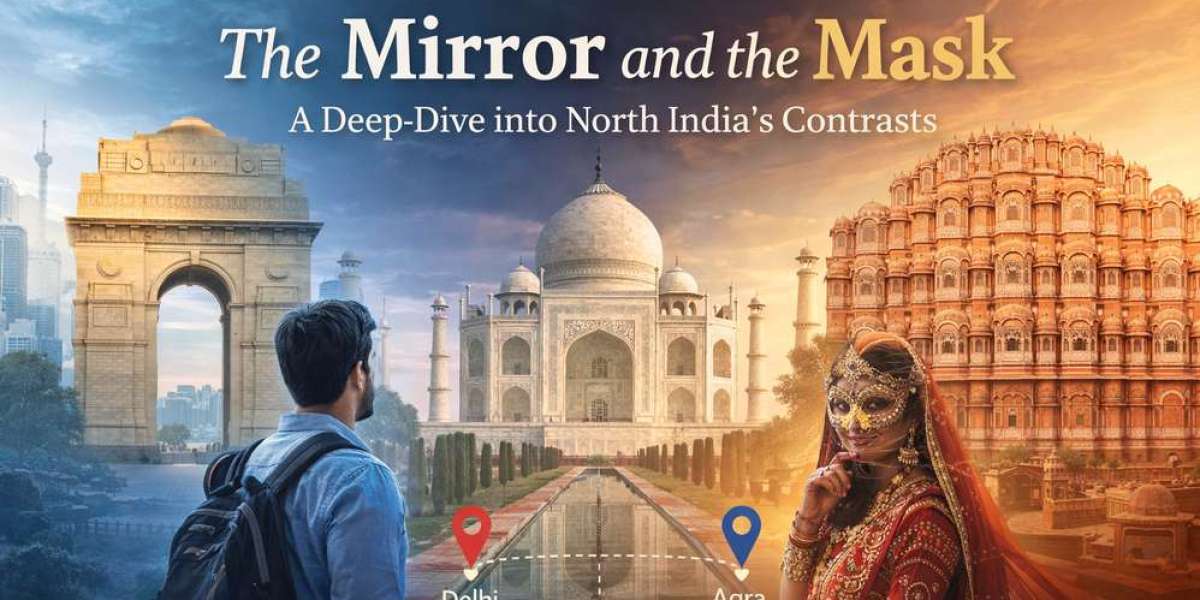
India is not a destination that you merely visit; it is a landscape that demands a confrontation with yourself. Most journeys are anchored by the "Central Axis"—the three-way intersection of Delhi, Agra, and Jaipur. While this trio provides the necessary cultural vocabulary of the subcontinent, it is merely the prologue. The true narrative begins when you depart from the paved roads and choose a path that leads either into the Raw Presence of the wild or the Ancient Absence of the sacred river.
To truly grasp the essence of this land, you must decide which side of yourself you want to meet: the "Instinct of the Hunter" or the "Surrender of the Seeker."
1. The Prologue: The Three Masks of Human Endeavor
Before you reach the deep woods or the eternal current, you must navigate the three cities that define the human condition in India.
Delhi: The Mask of Persistence
Delhi is a city that thrives on the edge of overload. It is a place of "Layered Static," where the 12th century literally bumps into the 22nd on every street corner. To navigate Delhi is to feel the friction of history—the rising steam from ancient street-side tea stalls mixing with the hum of a high-speed digital economy. It is the necessary noise that prepares your senses for the profound silences that lie ahead. It is a city that refuses to be forgotten, forcing you to find your own center within a sea of ten million overlapping stories.
Agra: The Mask of Devotion
Agra operates on a slower, heavier clock. It is a city tethered to the banks of the Yamuna, moving at the deliberate pace of the water itself. Beyond the famous white stone, there is a grit to the backstreets—a world of iron-smiths and marble-cutters who have been refining the same rhythmic stroke for five centuries. Agra is where you learn that true beauty is often a marathon of patience, demanding you slow down your internal rhythm and breathe in the weight of the air.
Jaipur: The Mask of the Desert
Jaipur is where the landscape softens into the colors of baked clay and ochre. It is a city designed for the eye, where human ingenuity has carved symmetry into the dust. From the astronomical towers that map the cosmos to the artisan workshops where fabric is dyed with desert minerals, Jaipur is a celebration of "Human Intent." It serves as the final urban milestone before the roads turn to dust and the horizon opens up into the unknown.
2. The Wild Mirror: The Grip of the Primal Earth
When the urban static becomes too loud, the soul naturally seeks a "Primal Reset." This is where the golden triangle tour with ranthambore shifts your entire sensory experience into a completely different gear.
Ranthambore is not merely a park; it is a sovereign territory where nature has staged a total reclamation of human vanity. The "Earth" here is jagged, dusty, and absolutely honest. The landscape is a mix of ancient ridges and dry valleys that have forgotten the language of man. In this forest, you aren't a guest; you are a biological presence being weighed and measured by eyes you cannot see.
The profound power of a golden triangle tour with ranthambore lies in the "Heightening of Senses." In the city, you look at things; in the jungle, you listen for them. Your entire survival instinct, dormant for years, wakes up. The sudden snap of a dry leaf or the sharp, staccato warning call of a deer creates a tension that no city skyscraper can replicate. When the Bengal Tiger finally emerges—not as a tourist attraction, but as a silent, heavy-shouldered monarch—it is a moment of pure, unscripted reality. It is an "Earth" frequency that grounds you back to the planet in a way that no marble monument ever could.
3. The Infinite Mirror: The Flow of the Liquid Spirit
If your quest is not for adrenaline but for "Dissolution," your compass points toward the East. A golden triangle tour with varanasi is an immersion into the oldest living vibration of human civilization—the element of "Water."
Varanasi is a city that exists on the threshold between the physical and the metaphysical. It is built on the edge of the Ganges, a river that doesn't just flow through a geography, but through the consciousness of a billion souls. While the rest of the world is obsessed with "Innovation," Varanasi is obsessed with "Continuity." The city is a labyrinth of stone veins that feel like the folds of an ancient, cosmic memory.
The transformative intensity of a golden triangle tour with varanasi is most potent at the water’s edge. As the sun dips, the riverbank transforms into a theater of fire. The Aarti ceremony—a wall of golden lamps, thick incense, and booming bells—is a sensory bombardment designed to shatter the ego. At dawn, as you drift through the morning mist on a wooden boat, you see the cycle of life unfolding on the stone steps: people washing, praying, and departing. It is a place that tells you that you are part of a current that started long before you and will continue long after.
The Verdict: The Instinct or the Infinite?
Choosing between these two paths is about recognizing what your soul is missing in the modern world.
The Path of the Instinct (Ranthambore): Choose this if you need to be shocked back into your physical body. It is for those who seek the "External Truth"—the beauty of the predator, the dust of the trail, and the adrenaline of the search.
The Path of the Infinite (Varanasi): Choose this if you need to be pulled out of your ego. It is for those who seek the "Internal Truth"—the stillness of the river, the fire of faith, and the cultural heartbeat of an eternal civilization.
Essential Travel Intelligence for 2026 (FAQs)
Q1: How do I manage the transition between these extreme environments? The "Sensory Whiplash" is real. We recommend a "Buffer Day" in a quiet corner of Jaipur or Delhi before starting your extension. This allows your brain to process the urban architecture before you face the raw power of the tiger or the spiritual intensity of the Ganges.
Q2: What is the most scenic way to connect these regions? For the jungle, a private car from Jaipur allows you to see the changing colors of rural India. For the holy city, a 90-minute flight from Delhi is the most seamless way to bridge the gap between the political capital and the spiritual capital without losing two days to the rails.
Q3: Can I experience both the tiger and the river in a single trip? Yes, but you need at least 14 days to do it justice. We suggest starting with the Triangle, moving to the jungle for some adrenaline, and finishing in Varanasi for a reflective, peaceful conclusion. Doing both requires a "High-Pace" travel mindset.
Q4: What is the most important etiquette to remember? In the jungle, silence is your greatest gift to the animals. In Varanasi, respect is your greatest currency—always ask before taking photos, especially during sensitive rituals or at the cremation ghats.
Q5: What is the "Hidden Gem" of each route? In Ranthambore, it’s the panoramic view from the top of the fort at sunset. In Varanasi, it’s the secret boat rides at 4:00 AM, before the main crowds arrive, when the river is at its most hauntingly beautiful.