Market Overview
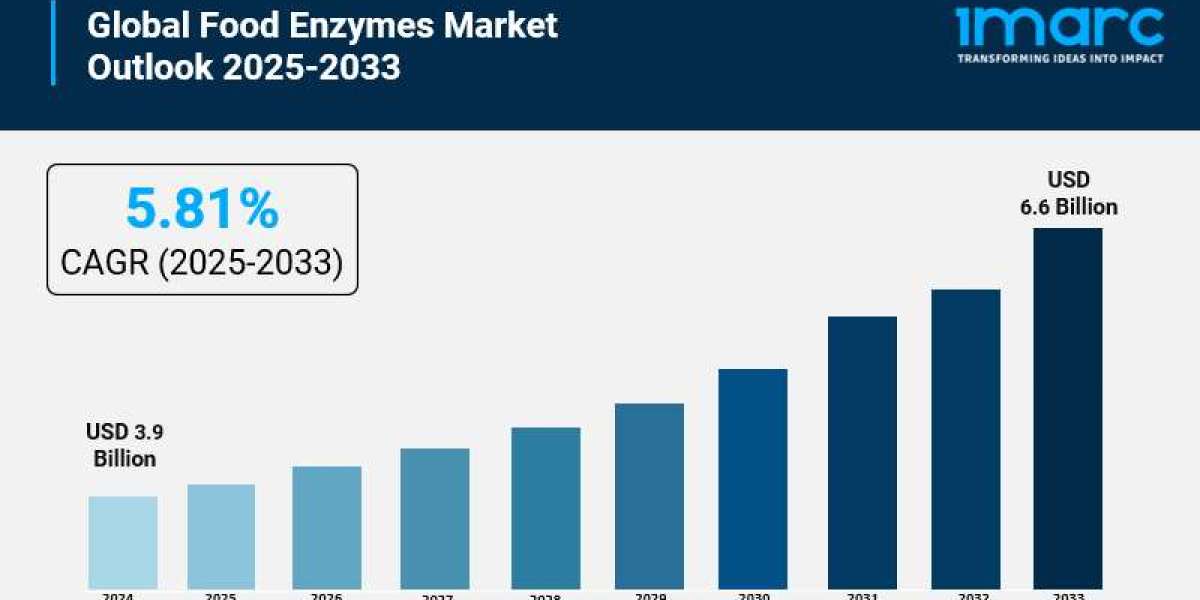
The global food enzymes market was valued at USD 3.9 Billion in 2024 and is projected to reach USD 6.6 Billion by 2033, growing at a CAGR of 5.81% during the forecast period 2025-2033. Growth is driven by the expanding food processing sector, rising consumer health consciousness, advancements in biotechnology, and increased consumption of alcoholic and non-alcoholic beverages. The development of newer and more specific enzymes plays a crucial role in enhancing food quality and processing efficiency.
Study Assumption Years
- Base Year: 2024
- Historical Year/Period: 2019-2024
- Forecast Year/Period: 2025-2033
Food Enzymes Market Key Takeaways
- The global food enzymes market size was USD 3.9 Billion in 2024.
- The market is expected to grow at a CAGR of 5.81% from 2025 to 2033.
- The forecast period for market growth is 2025-2033.
- Carbohydrase is the largest segment by type, including enzymes like amylase and lactase which enhance food texture and digestibility.
- Microorganisms dominate the source segment due to their adaptability and cost-effective production methods.
- Powder is the leading formulation segment owing to stability and ease of handling.
- Processed foods represent the largest application segment, driven by efficiency and improved product quality.
- North America holds the largest regional market share supported by a robust food and beverage industry and technological innovation.
Request for a Free Sample Report: https://www.imarcgroup.com/food-enzymes-market/requestsample
Market Growth Factors
The increasing pace of life worldwide has led to a demand not only for fast food but also ready to eat food. Proteases, amylases and lipases are already major components of the world food processing industry and play a major role in the manufacture of products with a longer shelf life, improved palatability and improved texture, at reduced production costs to keep pace with the increasing demand for food products worldwide.
The health and wellness trend is also making consumers more aware about the ingredients in the food they consume. Enzymes catalyze the breaking down of food into smaller and more absorbable components, thus enabling their use by the human body. With increased scientific credibility about the potential health benefits, food and dietary supplements containing lactase for the digestion of lactose in milk and other dairy products, and cellulase for the digestion of fiber in vegetables and fruit, have been developed.
Growth is also expected from regulation and food safety initiatives by the FDA, the European Food Safety Authority (EFSA) and other regulatory agencies, all of whom have established guidance documents detailing how these enzymes are determined to be safe for use in humans and the environment. For example, rules enforcing that enzymes function in organic food must meet the guidelines for organic certification regulate innovation, access markets, and ensure safety.
Market Segmentation
Breakup by Type:
- Carbohydrase
- Amylase
- Cellulase
- Lactase
- Pectinase
- Others
- Protease
- Lipase
- Others
Examples of carbohydrases include amylase, cellulase, and lactase, which are used to break down starch, sugar and cellulose, as well as to thicken food products, preserve food, or aid digestion.
Breakup by Source:
- Microorganisms
- Plants
- Animals
Microorganisms are the most extensively used biocatalysts as they can be grown under diverse pH and temperature, scaled up using fermentation technology, and engineered to be heat stable and catalytically active.
Breakup by Formulation:
- Powder
- Liquid
- Others
Powdered enzymes are more commonly used because they are more chemically stable and have a longer shelf life, are easier to handle during operation and are cheaper to transport and store.
Breakup by Application:
- Beverages
- Processed Foods
- Dairy Products
- Bakery Products
- Confectionery Products
- Others
Their largest single use is in the processed foods industry, where they reduce cost of production, improve quality and safety of food, and speed up fermentation or curdling of cheese.
Breakup by Region:
- North America
- Europe
- Asia Pacific
- Middle East and Africa
- Latin America
Regional Insights
North America held the greatest share of the global food enzymes market. High growth in the food & beverage industry, technology development in the manufacturing of food enzymes, and support from favorable government laws and regulations such as the FDA of the United States are the key drivers driving this market growth in North America.
Recent Developments & News
- In January 2023, BASF and Cargill expanded their partnership to offer advanced enzyme solutions aimed at animal protein producers, focusing on innovative enzyme-based products for animal feed customers.
- In May 2022, Chr. Hansen launched VEGA™ Boost cultures, enabling the development of dairy-free cream cheese to meet consumer demand for plant-based products emphasizing taste, nutrition, and sustainability.
- In December 2020, DuPont de Nemours, Inc. introduced enzymes for sweet baked goods in Japan, providing anti-staling benefits that keep products fresh longer with improved texture and softness.
Key Players
- DuPont de Nemours, Inc.
- Amway
- BASF
- DSM
- Novozymes
- Chr. Hansen
- Kerry Group
- Biocatalysts
- Puratos Group
- Advanced Enzyme Tech
- Sequence Biotech
- Amano Enzyme
- Aum Enzymes
- Bioseutica
- Dyadic International Inc.
Customization Note
If you require any specific information that is not covered currently within the scope of the report, we will provide the same as a part of the customization.
Ask Our Expert & Browse Full Report with TOC & List of Figures: https://www.imarcgroup.com/request?type=report&id=1624&flag=E
About Us
IMARC Group is a global management consulting firm that helps the world’s most ambitious changemakers to create a lasting impact. The company provide a comprehensive suite of market entry and expansion services. IMARC offerings include thorough market assessment, feasibility studies, company incorporation assistance, factory setup support, regulatory approvals and licensing navigation, branding, marketing and sales strategies, competitive landscape and benchmarking analyses, pricing and cost research, and procurement research.
Contact Us
IMARC Group,
134 N 4th St. Brooklyn, NY 11249, USA,
Email: [email protected],
Tel No: (D) +91 120 433 0800,
United States: +1-201971-6302