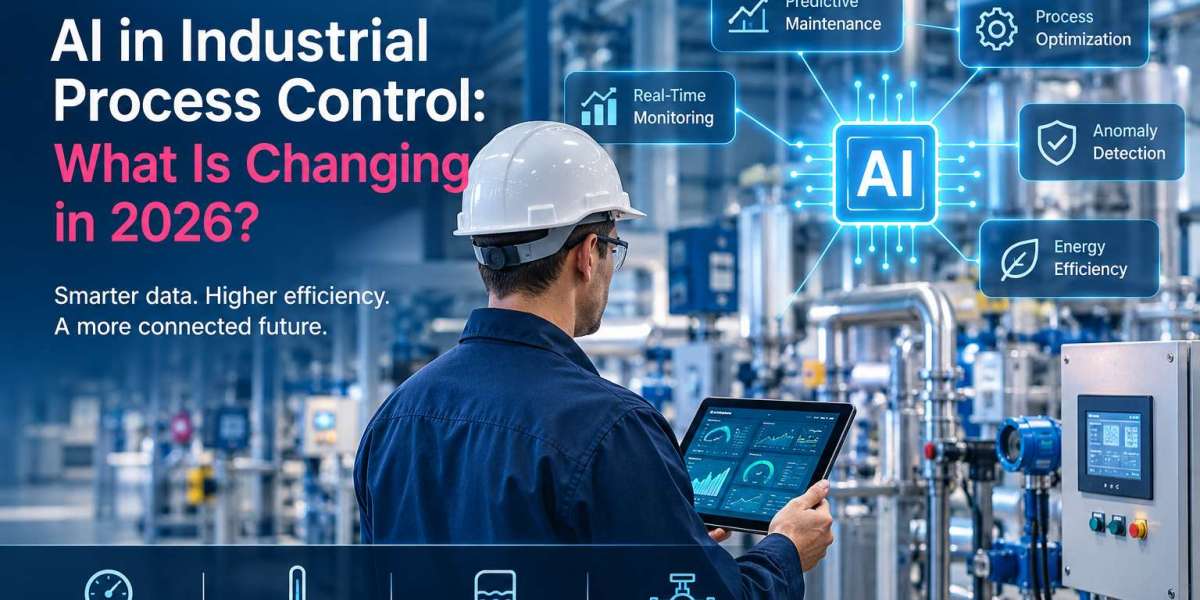
Artificial intelligence is moving from experimental projects toward practical industrial applications. In 2026, manufacturers are increasingly looking at AI not only for data analysis, but also for process monitoring, predictive maintenance, quality control and faster operational decision-making.
For OEMs and machine builders, this does not mean replacing conventional PLCs, sensors or control systems with AI. Instead, AI is increasingly being added around existing industrial systems to extract more value from process data. NIST's 2026 roadmap highlights AI-enabled sensing, digital twins, industrial data analytics, explainable AI and integration with heterogeneous sensing and control systems as important areas for smart manufacturing.
What Is AI-Based Industrial Process Control?
Traditional process control uses sensors, controllers and predefined logic to maintain parameters such as:
- Pressure
- Temperature
- Flow
- Level
- Speed
- Position
AI adds another layer of analysis to this existing infrastructure.
Instead of only asking whether a parameter has exceeded a predefined limit, AI can analyze patterns in historical and real-time data to identify anomalies, trends and potential problems.
For example, a pump may still be operating within its normal pressure range, but AI could identify a gradual change in pressure, temperature, vibration or energy consumption that indicates developing equipment wear.
This makes AI particularly relevant to predictive and condition-based maintenance.
- Predictive Maintenance Is Becoming More Practical
One of the most important industrial AI applications in 2026 is predictive maintenance.
Traditional maintenance often follows one of two approaches:
Reactive maintenance: Repair equipment after failure.
Preventive maintenance: Service equipment according to a fixed schedule.
AI-based predictive maintenance uses equipment data to identify changes in operating behaviour before a failure occurs.
Recent industrial deployments are combining sensor data, edge processing and AI analytics to detect equipment anomalies earlier. Siemens, for example, describes using existing equipment data and edge processing for predictive maintenance applications, including pumps, fans, chillers and other industrial assets.
For manufacturers, the potential benefit is not simply "using AI." The objective is to identify problems early enough to plan maintenance and avoid unnecessary downtime.
- AI Is Moving Closer to the Machine
Another major change in 2026 is the growing use of Industrial Edge computing.
Instead of sending every piece of sensor data to a remote cloud platform, some processing can happen close to the machine.
This can provide:
- Faster response
- Reduced data transfer
- Local processing
- Better availability
- Lower latency
- Easier integration with shop-floor systems
Industrial Edge platforms are increasingly being used to deploy AI models directly within factory environments. Siemens, for example, describes AI models running at the edge for applications such as predictive maintenance and production optimization.
For process control applications, this can be particularly useful when decisions need to be based on current machine conditions rather than delayed cloud analysis.
- Process Data Is Becoming More Valuable
Industrial facilities already generate large amounts of data through sensors, PLCs, SCADA systems and machines.
The challenge is not simply collecting more data.
The challenge is turning that data into useful information.
AI can help identify relationships between parameters that may be difficult to detect using conventional threshold-based monitoring.
For example:
Temperature + pressure + flow + vibration → operating pattern → anomaly detection → maintenance action
This creates an additional layer between raw measurement and human decision-making.
However, the quality and context of the underlying data remain critical. NIST identifies industrial data management and integration with heterogeneous sensing and control systems as important challenges for AI adoption.
- Digital Twins and AI Are Working Together
Digital twins are another important part of modern industrial AI.
A digital twin represents a physical machine, process or system digitally and can combine engineering information with operational data.
When combined with AI, digital twins can help manufacturers analyze process behaviour, test scenarios and identify potential improvements without immediately changing the physical system.
This is particularly relevant for complex production environments where testing directly on operating equipment can be expensive or risky.
NIST's 2026 roadmap identifies digital twins, AI, advanced sensing and process measurement among the technologies shaping smart manufacturing.
- AI Does Not Replace Traditional Process Control
This is an important consideration when evaluating an AI-based solution.
Industrial control systems still require deterministic control, defined operating limits and reliable safety mechanisms.
AI should therefore generally be viewed as an additional intelligence layer, rather than an automatic replacement for established control architectures.
A typical architecture might look like:
Sensors → PLC/Controller → Process Control → Industrial Edge → AI Analytics → Operator/Engineering Decision
The AI layer can identify patterns and provide recommendations while the established control system continues to perform its defined control functions.
This approach can also make AI adoption easier because manufacturers can start with existing equipment and data rather than completely replacing their automation infrastructure.
What Should OEMs Consider Before Buying an AI-Based Process Control Solution?
AI should not be added simply because it is a current technology trend.
Before investing, OEMs and machine builders should evaluate:
Data availability
What sensors and process data are already available?
Integration
Can the solution communicate with existing PLC, SCADA, HMI and industrial networks?
Edge vs. cloud
Does the application require local processing, cloud analytics, or a combination?
Response time
How quickly does the system need to identify and respond to a change?
Reliability
What happens if the AI system becomes unavailable?
Explainability
Can operators and engineers understand why the system has identified an anomaly?
Cybersecurity
How will AI systems connect to the existing OT environment?
Scalability
Can the solution be expanded from one machine to multiple machines or production sites?
These considerations are increasingly important because industrial AI has to operate within existing operational environments rather than in isolation. NIST specifically identifies trustworthy, explainable and reliable AI as important requirements for high-stakes industrial environments.
Where Is Industrial AI Heading in 2026?
The direction is increasingly clear: AI is moving closer to real industrial processes.
The focus is shifting from simply collecting data toward using that data for:
- Predictive maintenance
- Process optimization
- Quality monitoring
- Anomaly detection
- Energy optimization
- Production insights
- Faster troubleshooting
At the same time, edge computing is making it increasingly practical to run analytics closer to the machines generating the data. Recent industrial developments show growing integration between edge platforms, automation systems and AI applications.
For OEMs, this creates an opportunity to consider AI during the design of the complete system rather than treating it as an add-on later.
Choosing the Right Industrial Process Control Architecture
AI can provide valuable capabilities, but successful implementation depends on the complete system: sensors, controllers, industrial computing, connectivity, software and operator interfaces.
For OEMs and machine builders, the first step should be identifying a specific process problem that AI can address, such as unexpected equipment behaviour, difficult-to-detect process deviations or excessive maintenance requirements.
From there, the appropriate combination of conventional process control, industrial computing, edge processing and AI can be evaluated.
TO-ES supports customized industrial process technology and control solutions for OEM applications, including measurement and control technologies for pressure, temperature, level and flow.
If you are evaluating a new process-control architecture or looking to integrate intelligent monitoring into an existing industrial system, define the application requirements first and then select the appropriate technology.
Read More: https://tecsysproductguides.blogspot.com/2026/09/ai-in-industrial-process-control-what.html