
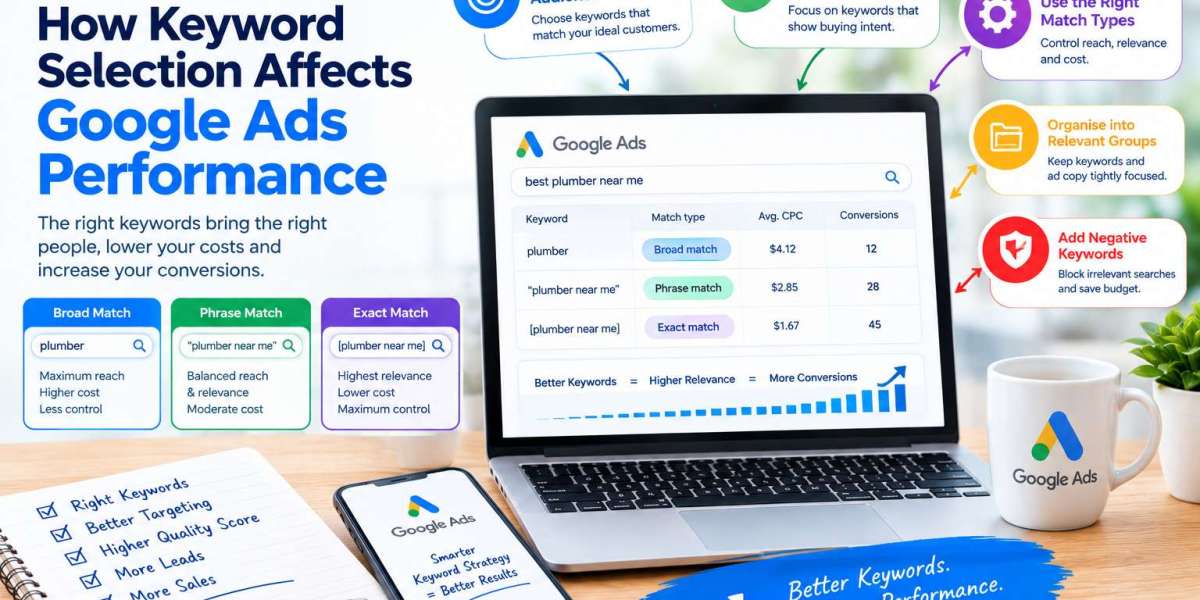
Of all the decisions made when building a Google Ads campaign, keyword selection has the widest-reaching impact. Keywords determine who sees an ad, how much it costs to compete for that visibility, how relevant the resulting traffic actually is, and ultimately whether the campaign generates genuine leads or simply consumes budget on the wrong audience. Two campaigns with identical budgets, industries, and locations can produce dramatically different results purely based on how carefully their keywords were chosen and managed.
This article looks at exactly how keyword selection shapes performance across every part of a Google Ads account, and what that means for building a campaign that performs well rather than one that merely runs.
Keywords Determine Who You're Actually Competing Against
Every keyword sits inside its own competitive auction, and the level of competition for that specific term directly shapes cost per click. A highly competitive keyword — one that many advertisers in the same industry are bidding on — will typically carry a higher cost per click than a more specific, less contested variation, even if both keywords are relevant to the same business.
This is why broad, generic keywords ("lawyer," "plumber," "accountant") are often both expensive and less effective than more specific alternatives ("family lawyer consultation Melbourne," "emergency plumber blocked drain," "small business tax accountant"). More specific keywords tend to face less direct competition, cost less per click, and — critically — attract searchers whose intent is much clearer and closer to an actual buying decision.
Keyword Specificity Signals Search Intent
Search intent exists on a spectrum, from broad, early-stage research through to highly specific, ready-to-act searches. Keyword choice is really a choice about which point on that spectrum a campaign is targeting, and that choice has enormous downstream effects on conversion rate.
Someone searching "how does home insurance work" is in a research phase, likely months away from a purchasing decision, if one ever eventuates. Someone searching "compare home insurance quotes Australia" is actively comparing options and likely to make a decision relatively soon. Someone searching "[specific insurer name] home insurance quote" is even further along, potentially ready to purchase immediately. Targeting keywords further along this intent spectrum generally produces a smaller total audience, but a dramatically higher conversion rate, since the traffic is inherently closer to a decision.
Match Types Control the Precision of Targeting
Beyond the keyword itself, match type determines how strictly Google interprets that keyword when deciding which searches trigger the ad. Exact match targets very close variations of a specific phrase, offering the tightest control but the smallest reach. Phrase match allows for additional words before or after the core phrase while preserving its meaning, offering a reasonable balance between control and reach. Broad match allows Google's algorithm to interpret the keyword loosely, showing ads for any search it considers conceptually related, which can surface valuable, unexpected traffic but also carries the highest risk of irrelevant clicks without careful oversight.
The right match type isn't universally "best" — it depends on how much control a campaign needs relative to how much reach it's seeking, and how well-developed the negative keyword list is to catch irrelevant broad match traffic before it consumes meaningful budget.
Keyword Grouping Affects Ad Relevance and Quality Score
How keywords are organised into Google Ads groups has a significant, often underestimated effect on performance. When closely related keywords are grouped together with ad copy written specifically for that shared theme, ad relevance improves — Google can see a clear, tight connection between what someone searched for and what the ad says in response.
When keywords are grouped too broadly — combining several different services or intents under one generic ad group with a single, general ad — relevance suffers for most of the searches in that group, since no single ad can speak precisely to every different search term contained within it. This directly affects Quality Score, since ad relevance is one of its core components, and a lower Quality Score typically results in higher cost per click for the same ad position.
Negative Keywords Are Keyword Selection in Reverse
Choosing which keywords to target is only half of effective keyword strategy; choosing which searches to explicitly exclude is equally important. Negative keywords prevent an ad from showing for searches that share some relationship with a target keyword but don't represent genuine intent — job seekers, DIY researchers, bargain hunters looking for free options, or searches for a completely different but linguistically similar product or service.
Without a developed negative keyword list, even carefully chosen positive keywords can end up matched to irrelevant searches, particularly under broader match types. Reviewing the search terms report regularly and continuously refining negative keywords is, in effect, an ongoing extension of the original keyword selection process, not a separate, one-time task.
Keyword Choice Shapes Landing Page Strategy
The keywords a campaign targets should directly inform which landing page that traffic is sent to. A generic landing page trying to serve visitors from many different keyword themes at once will inevitably feel less relevant to any individual visitor than a dedicated page built around a specific keyword theme's exact search intent.
This connection between keyword and landing page relevance affects both conversion rate and Quality Score. A visitor searching "same day carpet cleaning" who lands on a page speaking directly to same-day service, with pricing and availability clearly addressed, is far more likely to convert than one landing on a general carpet cleaning services page covering many different offerings without addressing the specific urgency behind their search.
Local and Long-Tail Keywords Often Outperform Broad Terms
For many local and small businesses, longer, more specific keyword phrases — often called long-tail keywords — can outperform shorter, broader, more competitive terms, despite (or because of) their lower individual search volume. A phrase like "24 hour emergency locksmith Parramatta" will generate far fewer searches than simply "locksmith," but the searches it does generate come from people with a much clearer, more immediate need, and the term itself faces far less competition, typically resulting in a lower cost per click.
Building a keyword strategy around a collection of well-chosen long-tail phrases, rather than relying primarily on a small number of broad, expensive, highly competitive terms, is often a more efficient approach for businesses with limited budgets, since the combined long-tail traffic can produce a similar or greater number of genuine leads at a lower overall cost.
Keyword Selection Affects How Quickly a Campaign Can Optimise
Automated bidding strategies rely on conversion data to make decisions, and that data accumulates faster when keywords are chosen and grouped in a way that generates a reasonable, consistent volume of relevant traffic. A campaign spread across too many low-volume, overly narrow keywords may struggle to generate enough data for effective optimisation, while a campaign concentrated on a smaller number of well-chosen, appropriately specific keywords can reach meaningful data volume more quickly, allowing automated bidding to begin working effectively sooner.
This is part of why keyword strategy often benefits from starting narrower and expanding gradually, rather than launching with an extremely broad keyword list from day one — a focused starting point allows the account to build a track record of genuine performance data more efficiently.
Reviewing and Refining Keyword Performance Over Time
Keyword selection isn't a decision made once at launch and left unchanged. Search behaviour shifts, new competitors enter the market, and some keywords that initially seemed promising may underperform once real data accumulates, while others discovered through the search terms report may reveal valuable opportunities that weren't part of the original keyword list at all.
Regularly reviewing keyword-level performance — cost per click, conversion rate, and ultimately cost per lead for each keyword or keyword theme — allows underperforming keywords to be paused, refined, or moved to a different match type, while strong performers can be expanded with related variations or increased bids to capture more of that valuable traffic.
Balancing Volume and Quality
A common tension in keyword strategy is the trade-off between search volume and traffic quality. Broader keywords generally offer more volume but often lower conversion rates, while narrower, more specific keywords offer less volume but typically convert at a meaningfully higher rate. Neither approach is inherently correct — the right balance depends on the specific business's capacity to handle lead volume, the value of each conversion, and how much budget is available to test broader keywords without excessive risk.
For most businesses, especially those with modest budgets, prioritising quality over volume in keyword selection — even if it means a smaller total number of leads — tends to produce a more sustainable, profitable outcome than chasing maximum traffic through broad, less relevant keyword targeting.
Final Thoughts
Keyword selection isn't just one setting among many in a Google Ads account — it's the foundation that shapes cost per click, ad relevance, Quality Score, landing page strategy, and ultimately conversion rate and cost per lead. A campaign built around specific, intent-matched keywords, organised into tightly themed ad groups, supported by a continuously refined negative keyword list, will consistently outperform a broader, less deliberate approach, even with an identical budget.
Treating keyword strategy as an ongoing process — reviewing real performance data, refining match types, expanding around genuine winners, and excluding what doesn't convert — is ultimately what separates a Google Ads account that reliably generates qualified leads from one that simply generates traffic.