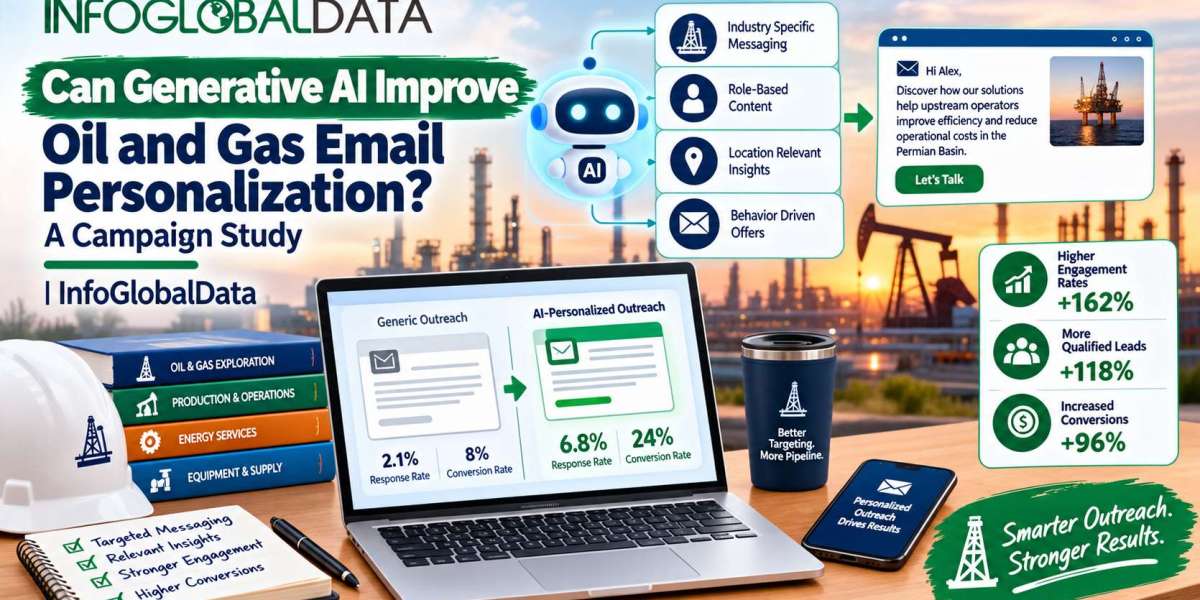
Generative AI is moving from experimentation toward practical deployment across the energy sector. KPMG's 2025 Global Energy, Natural Resources and Chemicals CEO Outlook found that 65% of CEOs ranked generative AI as a top investment area, while 72% planned to allocate 10–20% of their budgets to AI over the following year. At the same time, data fragmentation, cybersecurity, ethics, and regulatory complexity remain significant barriers.
For B2B marketers, this raises a specific question: can generative AI make outreach to oil-and-gas decision-makers more relevant without turning personalization into automated, generic copy? This campaign study examines current evidence from oil and gas, B2B sales, email marketing, and controlled email experiments to determine where AI can improve personalization—and where human judgment remains essential.
Why does AI personalization matter for oil and gas outreach?
Oil and gas is not a single homogeneous buying market. A drilling contractor, refinery, pipeline operator, oilfield-services company, equipment manufacturer, and energy technology provider can have completely different commercial priorities.
The same is true within individual companies. Procurement executives may evaluate supplier cost and reliability, while operations leaders focus on uptime and productivity. Engineering teams may care about technical compatibility, whereas executives may be more interested in risk, profitability, capital efficiency, and strategic value.
Recent industry research confirms that AI adoption is accelerating across this environment.
McKinsey's 2026 research on the oilfield-services and equipment (OFSE) sector surveyed 164 executives across service providers, EPC companies, equipment manufacturers, and service-focused businesses. More than three-quarters believed generative AI could deliver operational efficiencies, but fewer than 25% of companies had progressed beyond pilot phases. Only 1% reported significant GenAI scale.
That combination—high expectations but uneven implementation—creates an important opportunity for marketers. AI can help analyze account information and create tailored drafts, but personalization needs to reflect where the prospect actually sits within the oil-and-gas value chain.
What does current oil and gas AI adoption tell marketers?
The sector is already using AI for business and operational purposes, which makes AI-assisted outreach less disconnected from the industry's broader technology direction.
Deloitte's 2026 Oil and Gas Industry Outlook reports that AI and generative AI currently account for less than 20% of total IT spending among U.S. oil-and-gas companies but are projected to exceed 50% by 2029. Around half of current AI and GenAI spending is directed toward process optimization.
The Dallas Fed's fourth-quarter 2025 Energy Survey provides another useful perspective. Among 45 E&P executives responding to a special AI question, 62% expected AI to lower their firm's break-even price for new wells by at least some amount, although expectations differed sharply between large and small producers.
These findings suggest that oil-and-gas prospects are not necessarily unfamiliar with AI. However, an outreach message that simply says “AI can transform your business” adds little value.
A better email connects AI to a specific commercial or operational issue.
For example:
Production: reducing downtime or improving equipment performance
Procurement: identifying supply or cost efficiencies
Engineering: accelerating analysis or technical workflows
Maintenance: improving predictive maintenance
Commercial: improving customer targeting and account intelligence
Executive leadership: translating technology investment into measurable business value
That is where a well-segmented Oil and Gas Industry Email List becomes more useful than an undifferentiated industry database.
Does generative AI actually improve email personalization?
Evidence from broader marketing research suggests that AI can make personalization more scalable, but it does not automatically make the resulting message better.
HubSpot's 2026 State of Marketing research surveyed more than 1,500 marketers. Nearly half identified using AI to create personalized content as a leading marketing trend, while 93.2% said personalized or segmented experiences had generated more leads and purchases. However, only about 13% reported using hyper-personalization such as behavioral messaging or recommendations.
The distinction is important.
AI can generate hundreds or thousands of variations much faster than a human sales representative. But if every variation is based on the same shallow inputs—first name, company name, job title, and industry—the result may be personalized in appearance without being genuinely relevant.
For an Oil and Gas Industry Mailing List, useful AI inputs can include:
company segment,
operating region,
business model,
job function,
seniority,
technology adoption,
stated business priorities,
recent company developments,
and the specific product or service being offered.
The more meaningful the underlying data, the more useful the generated message can become.
What does controlled research say about AI-generated email copy?
One of the strongest recent pieces of evidence comes from a 2026 academic study of email marketing.
Researchers Jean-Pierre Dubé and Ariel Xu conducted three randomized controlled trials at Wine Access to evaluate whether and how a business should use large language models for email creative. The research compared human-written, AI-generated, and human-edited AI approaches.
The study is valuable because it uses controlled experimentation rather than simply asking marketers whether they like AI.
However, it is important not to overextend the result. Wine Access is a consumer business, not an oil-and-gas B2B company. Its findings therefore demonstrate that AI-generated email content can be experimentally tested for commercial performance, but they do not establish a specific response-rate advantage for an oil-and-gas campaign.
For InfoGlobalData-style B2B prospecting, the lesson is methodological: test AI personalization rather than assuming it works.
Where can AI make an oil and gas campaign more personalized?
AI is particularly useful when personalization requires analyzing multiple pieces of information.
1. Account-level research
An AI system can summarize information about an account and identify potential business-relevant signals before a salesperson writes the message.
Instead of:
“We help oil and gas companies improve efficiency.”
The marketer could develop a message around the company's apparent operational context and explain why the offering may be relevant.
2. Role-specific messaging
The same account may require several versions of an email.
A procurement leader could receive a message focused on supplier economics.
An operations executive could receive one focused on uptime.
A technology leader could receive one focused on integration.
An executive could receive one focused on financial or strategic outcomes.
3. Faster campaign variation
HubSpot's research shows that AI has become deeply embedded in marketing workflows. Its 2026 data indicates that 80% of marketers use AI for content creation, while 48.57% identify AI-generated personalized content as a leading marketing trend.
This makes AI especially useful for creating multiple controlled variants instead of asking a sales team to manually rewrite every message.
4. Signal-based personalization
AI can combine account information with buying signals and recent activity.
This moves personalization beyond:
“Hi John, I noticed you work at ABC Oil.”
Toward:
“Your team appears to be expanding its use of automated production monitoring. We work with operations teams evaluating…”
The second approach has a clearer reason for contacting the recipient.
Why can too much AI personalization hurt?
More personalization is not automatically better.
Gartner's 2025 research found a significant personalization paradox: among 1,464 B2B buyers and consumers surveyed across North America, the U.K., Australia, and New Zealand, 53% said personalized marketing produced a negative experience. Those customers were 3.2 times more likely to regret a purchase and 44% less likely to purchase again.
The research also found that personalization could make customers more likely to feel overwhelmed by information and pressured to move forward.
For oil-and-gas prospecting, this has an important implication: AI should not be instructed to insert as many personal details as possible.
Instead, marketers should ask:
Does this information help explain why the offer is relevant?
If not, it probably does not belong in the email.
A reference to a prospect's recent business initiative may be useful. An unnecessary reference to an individual's social-media activity may feel intrusive.
Why should humans remain involved?
AI is increasingly capable of researching accounts, identifying patterns, and producing drafts. But current B2B research shows that buyers still value human sellers for contextual judgment.
Gartner's 2026 survey of 645 B2B buyers found that buyers were 39 percentage points more likely to say a sales representative understood their needs than GenAI. Buyers were also 32 percentage points more likely to say a representative made them confident in a purchasing decision.
The same Gartner research found that buyers increasingly use AI themselves: 45% had used GenAI during a recent purchase, and 69% preferred validating AI-generated insights with a sales representative.
This supports a hybrid model.
AI can perform the high-volume research and drafting work. Human sellers can verify the premise, add industry context, remove unsupported claims, and decide whether the message actually deserves to be sent.
What should an AI-personalized oil and gas campaign test?
Rather than comparing “AI” against “human” as a single variable, marketers can build a controlled campaign with three groups:
| Campaign cell | Personalization approach |
|---|---|
| A — Human | Research and copy completed manually |
| B — AI-assisted | AI researches the account and creates the first draft |
| C — Human + AI | AI creates research/draft; salesperson edits and approves |
Keep the following variables consistent:
target audience,
sender,
offer,
CTA,
campaign timing,
email length,
follow-up schedule,
and landing page.
Then measure:
delivery rate,
bounce rate,
click rate,
positive reply rate,
qualified conversations,
meetings,
opportunities,
pipeline value,
unsubscribe rate,
and spam complaints.
This produces a much more meaningful campaign study than simply asking which email “sounds better.”
How does data quality affect AI personalization?
AI cannot create reliable personalization from unreliable inputs.
This is particularly important for an Oil and Gas Industry Email Database, where organizational structures can span operating companies, subsidiaries, contractors, equipment providers, engineering firms, and service businesses.
If an AI system receives an outdated job title, incorrect company affiliation, or irrelevant industry classification, it can generate a highly polished email that is still wrong.
Current energy research highlights the broader problem. The 2025 Powering Possible report from ADNOC and Microsoft surveyed more than 850 global experts and identified security, data quality, and talent among the top requirements for deploying AI at scale. Nine in ten companies surveyed had increased AI investment since 2024, while 73% reported deploying AI across multiple business functions.
The lesson for email campaigns is simple: better AI personalization starts with better prospect data.
A carefully maintained Oil and Gas Industry Email List can give AI more reliable inputs for segmentation and message generation, while verification helps reduce the risk of personalization based on outdated information.
5 practical ways to use GenAI in oil and gas email campaigns
1. Use AI for research, not just wording
Feed the model structured company and contact information and ask it to identify the most relevant business angle before generating copy.
2. Personalize around business signals
Prioritize operational priorities, investments, expansion, technology adoption, and other meaningful signals over superficial personal details.
3. Create role-specific variants
Develop separate messaging for procurement, operations, engineering, IT/digital, maintenance, commercial, and executive audiences.
4. Keep humans in the approval loop
Have a salesperson verify every material claim, especially references to company activity, technology adoption, operational conditions, or recent events.
5. Run controlled tests
Compare human, AI-assisted, and human-edited AI messaging while keeping the audience and offer consistent. Judge the campaign using qualified engagement and pipeline outcomes rather than open rates alone.
How can InfoGlobalData support AI-assisted personalization?
The role of a Oil and Gas Industry Email List is not simply to provide a larger audience. For AI-assisted campaigns, contact and company information functions as the foundation on which personalization is built.
InfoGlobalData can be positioned as a data resource within this workflow, helping marketers identify relevant oil-and-gas companies and decision-makers that can then be segmented according to campaign objectives. The value comes from combining accurate targeting with human-reviewed messaging and AI-assisted execution—not from treating AI-generated copy as a substitute for campaign strategy.
Conclusion
Generative AI can make oil-and-gas email personalization substantially more scalable, but current evidence does not justify claiming that AI-generated emails automatically outperform human-written messages in this sector. Oil-and-gas companies are rapidly increasing AI investment, while broader marketing research shows that AI can help teams create personalized content at much greater scale.
The strongest approach is therefore hybrid: use reliable prospect data to identify the right accounts and roles, use AI to research and generate campaign variations, and rely on human sellers to validate relevance, context, and claims. For teams using an Oil and Gas Industry Mailing List, the next competitive advantage is unlikely to come from simply sending more AI-generated emails. It will come from combining accurate data, meaningful signals, useful personalization, and disciplined experimentation.
Frequently Asked Questions
Can generative AI personalize oil and gas sales emails?
Yes. Generative AI can use company, role, industry, and behavioral information to create different messaging for individual prospects or segments. However, personalization quality depends heavily on the quality and relevance of the data supplied to the model.
Does AI-generated email copy outperform human-written copy?
There is no credible public benchmark establishing that AI-generated B2B emails consistently outperform human-written emails specifically in the oil-and-gas industry. A 2026 randomized controlled study at Wine Access demonstrated that AI-generated email content can be tested experimentally, but that consumer-business evidence should not be treated as an oil-and-gas B2B benchmark.
What information should AI use to personalize an Oil and Gas Industry Email List?
Useful inputs can include job title, department, company type, operating segment, geography, business priorities, technology adoption, and relevant account-level signals. The objective is to identify a legitimate business reason for contacting the prospect rather than simply adding personal details.
Why is human review important for AI-generated sales emails?
Human review helps verify company facts, remove unsupported claims, and ensure that the proposed business value is appropriate for the recipient's role. Gartner's 2026 research found that B2B buyers were substantially more likely to say sales representatives understood their needs than GenAI.
How should marketers measure AI email personalization?
Measure positive replies, qualified conversations, meetings, opportunities, pipeline, conversions, bounces, unsubscribes, and spam complaints. Open rate alone is insufficient for determining whether AI personalization created meaningful commercial value.
What is the best way to test AI personalization?
A controlled three-cell experiment can compare human-written, AI-generated, and human-edited AI emails. Keep the audience, offer, sender, timing, CTA, and follow-up structure consistent so that differences in performance can be more confidently attributed to the copy approach.
Why does data quality matter for AI email personalization?
AI can only personalize reliably from the information it receives. Incorrect company affiliations, outdated job titles, or inaccurate industry classifications can cause AI to produce a convincing but irrelevant message, making a verified Oil and Gas Industry Email Database an important foundation for personalization.
Is AI widely adopted in the oil and gas industry?
Adoption is accelerating, although implementation maturity varies. McKinsey's 2026 OFSE research found that more than three-quarters of surveyed leaders expected GenAI to deliver operational efficiencies, while fewer than 25% of companies had moved beyond pilot phases.