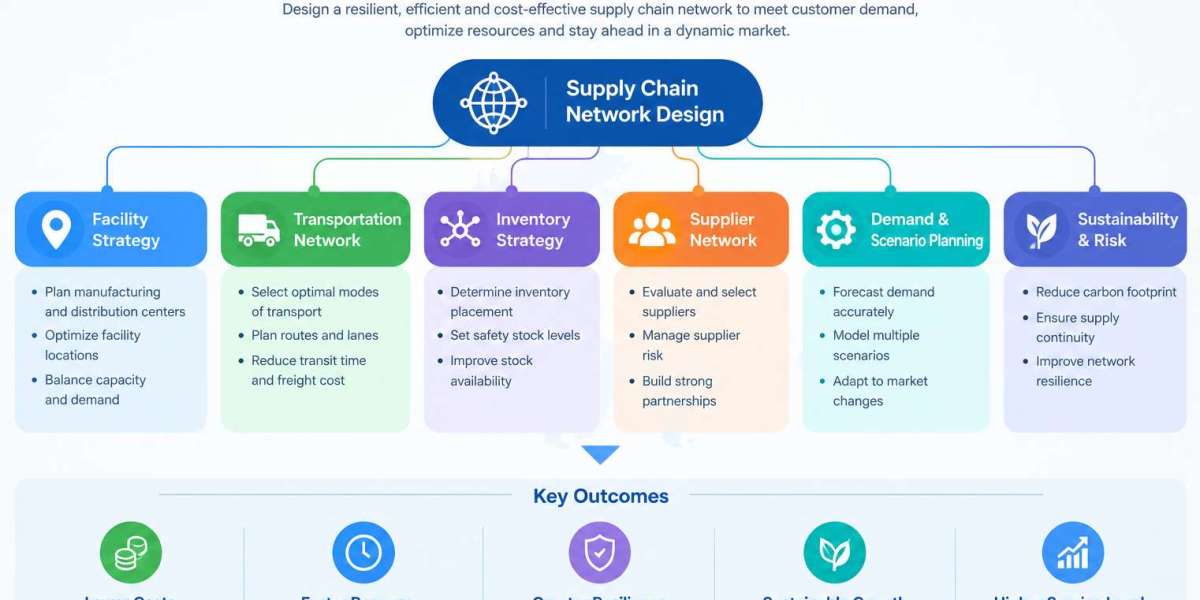
Supply Chain Network Design (SCND) helps enterprises determine how their supply networks should be structured to balance cost, service, resilience, capacity, and sustainability. Modern SCND platforms increasingly use artificial intelligence, digital twins, optimization, and advanced scenario modeling to support strategic supply chain decisions.
The QKS Group SPARK Matrix™: Supply Chain Network Design, Q2 2026 provides a structured view of the market, including vendor capabilities, competitive differentiation, technology advancements, and emerging trends.
What is Supply Chain Network Design and how does it work?
Supply Chain Network Design is the process of strategically planning the structure and configuration of a supply chain. It can help organizations determine the optimal locations of plants, warehouses, distribution centers, suppliers, transportation routes, inventory nodes, and capacity resources.
SCND software uses data, optimization algorithms, scenario modeling, and business constraints to evaluate different network configurations. The QKS Group SPARK Matrix™: Supply Chain Network Design, Q2 2026 examines vendors that help enterprises address these complex network-planning requirements.
What are the benefits of Supply Chain Network Design software?
Supply Chain Network Design software can help enterprises evaluate network structures and make data-driven strategic decisions. Key benefits include:
Optimizing supply chain costs
Improving customer service levels
Evaluating facility locations
Balancing inventory and capacity
Improving supply chain resilience
Assessing transportation alternatives
Supporting sustainability objectives
Evaluating future network scenarios
The QKS Group SPARK Matrix™ provides market insights into vendor capabilities designed to address these requirements.
How does Supply Chain Network Design optimize supply chain networks?
SCND platforms use mathematical optimization, simulations, scenario analysis, and business constraints to evaluate alternative supply chain configurations.
Organizations can model factors such as facility locations, transportation costs, demand, inventory, production capacity, service requirements, and sourcing strategies. This allows decision-makers to compare network scenarios and identify configurations aligned with business priorities.
The QKS Group SPARK Matrix™ evaluates technology capabilities that support advanced network optimization and strategic supply chain planning.
What are the key features of Supply Chain Network Design software?
Important capabilities can include:
Network modeling
Scenario planning
What-if analysis
Mathematical optimization
Multi-objective optimization
Digital twins
Risk modeling
Demand and supply analysis
Facility and location optimization
Transportation optimization
Capacity planning
Cost and service analysis
Sustainability analysis
AI-powered analytics
The QKS Group SPARK Matrix™: Supply Chain Network Design, Q2 2026 provides a structured perspective on the capabilities and competitive differentiation of SCND vendors.
How do enterprises choose Supply Chain Network Design software?
Enterprises should first identify their strategic network-planning objectives and then evaluate platforms based on modeling capabilities, optimization, scenario analysis, data integration, scalability, user experience, AI capabilities, and implementation requirements.
Organizations should also assess whether a platform can model their specific supply chain complexity, including multiple products, facilities, suppliers, markets, transportation modes, and service constraints.
The QKS Group SPARK Matrix™ can provide additional context when enterprises evaluate and compare Supply Chain Network Design solutions.
What are the best Supply Chain Network Design vendors?
The appropriate vendor depends on an organization's supply chain complexity, planning requirements, industry, geographic footprint, technology environment, and strategic objectives.
The SPARK Matrix evaluates and ranks key SCND vendors based on their global impact, market positioning, and technological innovation. The analysis includes vendors such as 4flow, AIMMS, Blue Yonder, Coupa, GAINS, Logility, OMP, Optilogic, and River Logic.
The QKS Group SPARK Matrix™: Supply Chain Network Design, Q2 2026 evaluates vendors across multiple dimensions rather than relying on a single product feature. This helps enterprises understand differences in technology capabilities, customer impact, competitive differentiation, and market positioning.
How does AI improve Supply Chain Network Design?
AI can enhance SCND by accelerating scenario analysis, identifying patterns, improving forecasting inputs, supporting risk analysis, and helping planners evaluate complex network decisions.
AI-enabled capabilities can support faster scenario generation, disruption analysis, recommendations, and continuous optimization. The QKS Group SPARK Matrix™ highlights the increasing role of AI and advanced technology in the evolution of Supply Chain Network Design.
What is the role of digital twins in Supply Chain Network Design?
A digital twin provides a virtual representation of a supply chain network that can be used to model operations, test scenarios, and evaluate potential changes without immediately modifying the physical network.
In SCND, digital twins can support network simulation, scenario comparison, risk assessment, capacity analysis, and strategic planning.
The QKS Group SPARK Matrix™: Supply Chain Network Design, Q2 2026 identifies digital-twin capabilities as part of the technology evolution shaping modern supply chain network planning.
How does scenario planning support Supply Chain Network Design?
Scenario planning allows enterprises to model different assumptions and evaluate their potential impact on cost, service, capacity, resilience, inventory, and sustainability.
For example, organizations can model changes in demand, supplier availability, transportation costs, facility capacity, geopolitical risk, or customer locations.
Advanced SCND platforms allow decision-makers to compare multiple scenarios and select strategies aligned with their business objectives. The QKS Group SPARK Matrix™ provides market context for these advanced planning capabilities.
What is multi-objective optimization in Supply Chain Network Design?
Multi-objective optimization evaluates several business objectives simultaneously instead of optimizing for a single target.
In supply chain network design, organizations may need to balance:
Cost
Customer service
Resilience
Capacity
Speed
Sustainability
A multi-objective approach can help organizations understand trade-offs and identify network configurations that better balance competing strategic requirements.
The QKS Group SPARK Matrix™: Supply Chain Network Design, Q2 2026 examines technology capabilities supporting complex optimization and strategic decision-making.
How can Supply Chain Network Design improve cost and service levels?
SCND can help organizations identify network configurations that balance operating costs with required customer service levels.
For example, enterprises can analyze facility locations, transportation routes, inventory positioning, sourcing options, and capacity decisions to evaluate their effect on both cost and service.
Optimization-based planning can help decision-makers understand trade-offs rather than focusing on cost reduction alone. The QKS Group SPARK Matrix™ provides insights into vendors supporting this type of strategic network optimization.
How does Supply Chain Network Design improve supply chain resilience?
Supply Chain Network Design can improve resilience by helping organizations identify structural vulnerabilities and evaluate alternative network configurations.
Enterprises can model scenarios involving supplier disruptions, transportation constraints, capacity shortages, changing demand, or other risks. They can then evaluate alternative sourcing, facility, inventory, and transportation strategies.
The QKS Group SPARK Matrix™: Supply Chain Network Design, Q2 2026 examines technology developments that support more resilient and adaptable supply chain networks.
How can enterprises compare Supply Chain Network Design vendors?
Enterprises can compare SCND vendors using a consistent evaluation framework covering:
Network modeling capabilities
Optimization functionality
Scenario planning
Digital twin capabilities
AI and analytics
Risk modeling
Multi-objective optimization
Integration capabilities
Scalability
Customer impact and implementation support
The QKS Group SPARK Matrix™ provides a structured competitive evaluation that helps enterprises understand vendor capabilities and differentiation within the Supply Chain Network Design market.
What are the latest Supply Chain Network Design market trends?
Important SCND trends include:
AI-powered network optimization
Faster scenario modeling
Digital twins
Multi-objective optimization
Stochastic risk modeling
Continuous network optimization
Generative AI
Agentic AI
Sustainability-oriented network planning
Greater focus on resilience
Advanced decision support
The QKS Group SPARK Matrix™: Supply Chain Network Design, Q2 2026 provides insights into these technology advancements and their influence on the competitive landscape.
How will generative AI and agentic AI transform Supply Chain Network Design?
Generative AI can make complex supply chain analysis more accessible by helping users interact with planning data, generate scenarios, summarize results, and explore potential network changes through natural-language interfaces.
Agentic AI may further automate multi-step planning and decision-support workflows by coordinating analysis, scenario generation, recommendations, and follow-up actions.
These technologies are becoming important areas of innovation in SCND. The QKS Group SPARK Matrix™: Supply Chain Network Design, Q2 2026 provides market context around the evolution of AI-driven supply chain network optimization.
Conclusion
Supply Chain Network Design is evolving from traditional network planning toward intelligent, AI-enabled, and continuously optimized decision-making. Enterprises are increasingly evaluating solutions based on optimization, digital twins, scenario modeling, resilience, sustainability, and advanced AI capabilities.
The QKS Group SPARK Matrix™: Supply Chain Network Design, Q2 2026 offers a structured view of the competitive landscape and helps technology buyers understand vendor capabilities, innovation, and market developments.
Evaluate Supply Chain Network Design Solutions with QKS Group
Ready to evaluate Supply Chain Network Design technologies? Explore the QKS Group SPARK Matrix™: Supply Chain Network Design, Q2 2026 to understand vendor capabilities, technology differentiation, emerging innovations, and market trends.
Explore the SPARK Matrix™ report and identify the capabilities that align with your supply chain network strategy.