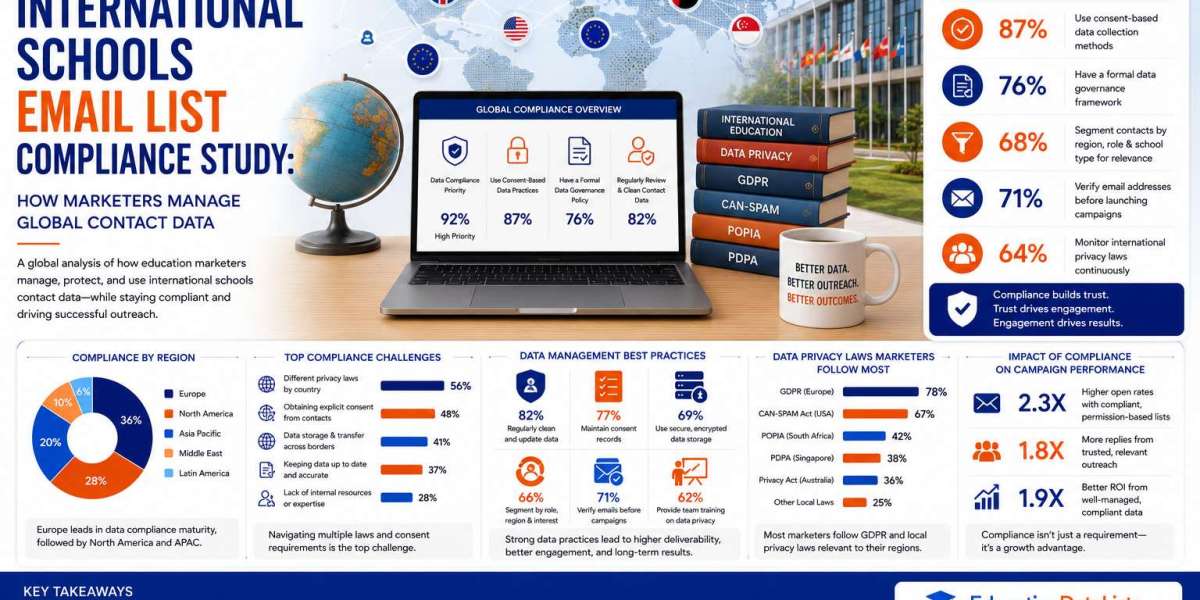
Introduction
Managing an International Schools Email List is more complex than simply collecting school names and professional email addresses. Global education outreach can involve contacts across multiple jurisdictions, each with different privacy, electronic-marketing, transparency, and data-retention requirements. The European Commission's GDPR guidance, for example, requires organizations to process personal data lawfully and transparently, limit collection to necessary information, maintain accuracy, and avoid retaining data longer than necessary. (European Commission)
The compliance challenge is becoming more important as marketers use larger datasets, automation, enrichment platforms, and AI-driven personalization. The 2025 IAPP Organizational Digital Governance Report describes a growing need to coordinate privacy, AI governance, cybersecurity, and other digital responsibilities. (IAPP.org)
This study examines the major compliance considerations for marketers using global school contact data and outlines a practical framework for building a more responsible International Schools Email Database.
Why Global School Contact Data Requires Greater Oversight
An international school database can span dozens of countries, meaning a single campaign may involve multiple regulatory environments.
The key issue is that an email address can constitute personal data when it identifies an individual, such as a teacher, principal, admissions director, technology leader, or administrator. GDPR principles therefore become relevant when personal data belonging to individuals in the EU is processed, even when the organization processing the information is located elsewhere. (European Commission)
The European Commission identifies seven core GDPR principles:
Lawfulness, fairness, and transparency
Purpose limitation
Data minimization
Accuracy
Storage limitation
Integrity and confidentiality
Accountability
For marketers, these principles translate into practical database requirements.
An International Schools Mailing List should not simply contain as much information as possible. It should contain the information genuinely needed for a defined marketing purpose, with reasonable processes for maintaining accuracy and respecting individual rights.
What Does GDPR Mean for International School Outreach?
GDPR is particularly relevant when an organization processes personal data associated with people in the European Economic Area.
The European Commission states that organizations must collect only data that is adequate, relevant, and limited to what is necessary for the stated purpose. It also requires organizations to keep personal information accurate and up to date. (European Commission)
This has direct implications for education marketers.
For example, a database might contain:
Contact name
Professional email address
Job title
School name
Country
Department
Business phone number
Source of the record
Verification date
Not every campaign requires every field.
Data minimization means marketers should evaluate whether each field has a legitimate and documented purpose.
Accuracy Is Also a Compliance Requirement
Accuracy is not simply a campaign-performance issue.
Under GDPR principles, organizations must take reasonable steps to ensure personal data is accurate and up to date. Incorrect information should be corrected or deleted without undue delay where appropriate. (European Commission)
For international schools, this matters because staff frequently change roles, schools, departments, or institutions.
Consequently, maintaining a database can serve two purposes:
Better targeting + better data governance
Lawful Basis Matters Before Sending Marketing Emails
One of the most important compliance questions is not "Is this email address publicly available?" but rather:
Do we have an appropriate legal basis for processing and marketing to this person?
The UK's Information Commissioner's Office explains that consent and legitimate interests are among the lawful bases that may apply to direct marketing, depending on the circumstances. However, legitimate interests is not automatically available for every campaign. Organizations must consider whether their processing is necessary, proportionate, and reasonably expected by the individual. (ICO)
This distinction is important for organizations using an International Schools Email List.
A publicly displayed professional email address does not automatically eliminate privacy obligations. Marketers should evaluate the applicable rules in the recipient's jurisdiction and document the reasoning behind their processing and outreach practices.
Email Marketing Rules Can Exist Alongside Privacy Law
Privacy legislation and electronic-marketing regulations are not necessarily the same thing.
The ICO explains that UK PECR governs certain electronic marketing activities, while the UK GDPR and Data Protection Act may also apply when personal information is used. (ICO)
This means a marketer may need to consider two separate questions:
Can we lawfully process this personal data?
Can we legally send this marketing communication through this channel?
The answer can depend on factors including:
Recipient type
Jurisdiction
Marketing channel
Relationship with the recipient
Nature of the communication
Applicable consent requirements
Legitimate-interest assessment
Therefore, global campaigns should not rely on a single compliance rule for every country.
Data Minimization Should Shape the International Schools Email Database
A common database mistake is collecting every available field simply because technology makes it possible.
GDPR's data-minimization principle requires organizations to limit personal data to what is necessary for the intended purpose. (European Commission)
For an International Schools Email Database, marketers could establish a minimum required schema such as:
| Data Field | Potential Purpose |
|---|---|
| Contact name | Personalization and identification |
| Professional email | Communication |
| School name | Account identification |
| Country | Regional segmentation |
| Job title | Audience qualification |
| Department | Relevance |
| Source | Data governance |
| Verification date | Freshness monitoring |
| Opt-out status | Suppression |
Additional fields should have a clear business or compliance rationale.
This approach reduces unnecessary data exposure while still supporting effective segmentation.
Why Data Retention Matters
Data does not become permanently compliant simply because it was collected correctly.
The European Commission's GDPR guidance states that personal data should be stored for no longer than necessary for the purpose for which it was collected. Organizations should establish periods for deletion or review. (European Commission)
This is particularly important for an International Schools Mailing List because professional roles change over time.
A record that was accurate two years ago may no longer represent the same professional relationship today.
A practical retention program can include:
Regular data reviews
Verification-date fields
Suppression of unsubscribed contacts
Removal of unnecessary records
Revalidation of older data
Documented deletion procedures
The objective is not simply to maintain a large database. It is to maintain a defensible and useful one.
International Data Transfers Add Another Layer
Global education marketing can involve data moving between countries.
For example, an education technology company based in the United States might source or manage contact information involving schools and professionals located in Europe, Asia, Africa, and the Middle East.
Where personal data is transferred internationally, organizations may need to assess applicable transfer mechanisms and safeguards.
This makes vendor due diligence important.
Before using a third-party provider, marketers should understand:
Where data is stored
Where processing occurs
Whether subprocessors are involved
What security controls are used
How deletion requests are handled
What contractual protections apply
How international transfers are addressed
Compliance should therefore extend beyond the database itself to the technology ecosystem surrounding it.
AI Makes Data Governance More Important
AI is changing how marketers segment, score, enrich, and personalize contact data.
The IAPP's 2025 AI Governance Profession Report found that 77% of surveyed organizations were working on AI governance, rising to nearly 90% among organizations already using AI. The research also found that privacy, legal/compliance, IT, and data-governance functions increasingly participate in AI governance. (IAPP.org)
For education marketers, this is relevant when AI systems are used to:
Enrich contact profiles
Predict interests
Generate personalized emails
Score prospects
Segment audiences
Automate outreach
Analyze engagement
The more extensively AI processes personal data, the more important governance becomes.
AI should not be treated as a reason to collect unlimited information. Instead, organizations should establish clear rules regarding what data AI systems can access, why they can access it, and how outputs are reviewed.
5 Practical Steps for Compliant International School Outreach
1. Map every data source
Document where each record originated and what information was collected.
2. Classify contacts by jurisdiction
Identify countries or regions represented in the database and determine which privacy and electronic-marketing requirements apply.
3. Maintain accurate records
Use verification processes and record the date of the latest validation. Remove or correct outdated information.
4. Maintain suppression and opt-out controls
A robust International Schools Email List should maintain clear suppression records so that contacts who object or unsubscribe are not inadvertently reintroduced.
5. Document your compliance rationale
Keep records explaining the purpose of processing, lawful basis where applicable, data sources, retention approach, and applicable marketing rules.
Documentation becomes especially important when multiple vendors, countries, and automated systems are involved.
How EducationDataLists Fits Into a Responsible Data Strategy
For marketers seeking international education audiences, EducationDataLists can be considered as a data resource within a broader compliance and campaign-management process.
The important point is that no database provider can replace the marketer's own responsibility for determining whether a particular campaign is lawful in its target jurisdictions.
A responsible workflow is:
Audience definition → Data sourcing → Jurisdiction review → Verification → Segmentation → Compliance review → Outreach → Suppression management → Data refresh
This approach allows an International Schools Email Database to support lead generation while keeping data governance integrated into campaign planning.
Compliance Checklist for International School Email Campaigns
Before launching a campaign, marketers should ask:
Is the purpose of processing clearly defined?
Is each data field necessary?
Is the information reasonably accurate and current?
Have applicable privacy laws been identified?
Is an appropriate lawful basis established where required?
Have electronic-marketing rules been reviewed?
Are opt-outs and suppression records maintained?
Is there a documented retention policy?
Are international data transfers appropriately addressed?
Have vendors and subprocessors been evaluated?
Are AI systems governed when they process contact data?
Can the organization demonstrate how the data was obtained and used?
This checklist cannot replace jurisdiction-specific legal advice, but it provides a useful operational framework.
Conclusion
Managing an International Schools Email List in 2026 requires a broader perspective than simply improving deliverability or adding more contacts. Privacy principles increasingly emphasize transparency, purpose limitation, data minimization, accuracy, retention controls, security, and accountability. (European Commission)
At the same time, the growth of AI and automated marketing is making data governance more complex. IAPP's 2025 research found that 77% of surveyed organizations were already working on AI governance, demonstrating how organizations are expanding governance beyond traditional privacy programs. (IAPP.org)
For marketers using an International Schools Mailing List, the strongest strategy is therefore to combine accurate data with jurisdiction-aware compliance processes, clear consent or lawful-basis assessments where applicable, strong suppression controls, and regular database maintenance. EducationDataLists can be part of that data strategy, but compliance ultimately depends on how the information is sourced, processed, stored, and used.
Frequently Asked Questions
What is an International Schools Email List?
An International Schools Email List is a collection of professional contact information associated with international schools, such as administrators, educators, technology leaders, and other relevant staff. When individual professionals are identifiable, their information may constitute personal data under applicable privacy laws.
Is an International Schools Email Database GDPR compliant automatically?
No. A database itself cannot guarantee that every future use of the data complies with GDPR or other privacy laws. Marketers must assess their own processing purpose, lawful basis, transparency obligations, retention practices, and marketing requirements.
Can marketers use publicly available school email addresses?
Public availability does not automatically remove privacy or electronic-marketing obligations. Organizations should assess the applicable jurisdiction, purpose of processing, type of recipient, and marketing rules before using a publicly available address.
What information should an International Schools Mailing List contain?
The database should generally contain only information necessary for the intended purpose. Depending on the campaign, this might include professional name, work email, school, job title, country, department, source, verification date, and suppression status.
How often should international school contact data be updated?
There is no universal legal update interval. However, GDPR requires organizations to take reasonable steps to maintain accurate personal data, making regular verification and review an important part of database governance. (European Commission)
What is data minimization?
Data minimization means collecting and processing only the personal information necessary for a defined purpose. The European Commission identifies it as one of the core GDPR principles. (European Commission)
What is a lawful basis for email marketing?
A lawful basis is the legal justification for processing personal data under applicable data-protection law. The ICO identifies consent and legitimate interests as two lawful bases that may apply to direct marketing, depending on the circumstances and other applicable marketing rules. (ICO)
Do international campaigns need to follow different privacy laws?
Potentially, yes. Requirements can differ by jurisdiction, and organizations may need to consider privacy, electronic-marketing, data-transfer, and other applicable regulations in the markets they target.
Why is data retention important?
Privacy frameworks generally discourage keeping personal information indefinitely. Under GDPR principles, personal data should not be stored longer than necessary for its purpose, and organizations should establish appropriate review or deletion periods. (European Commission)
How does AI affect international school contact-data compliance?
AI can increase the number of ways personal data is analyzed, enriched, scored, or used for personalization. IAPP's 2025 research found that 77% of surveyed organizations were working on AI governance, highlighting the growing importance of formal controls around AI-related data processing. (IAPP.org)
:::
Note: This article addresses compliance at a general informational level. Because requirements can vary by country, recipient type, and campaign circumstances, organizations should obtain jurisdiction-specific legal advice before launching international email campaigns.