
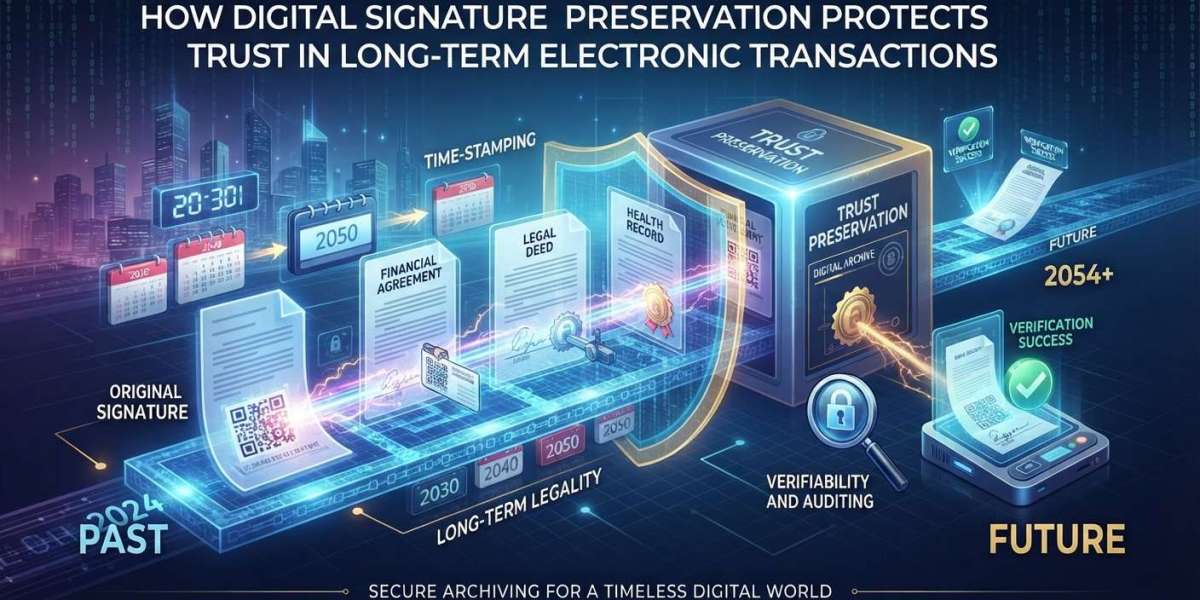
Electronic transactions have transformed how organizations approve agreements, complete business processes, and exchange legally important information. Contracts are signed digitally, approvals happen online, and critical records are created without any physical paperwork. While this improves speed and efficiency, it also introduces a long-term challenge: how can organizations prove that an electronic transaction remains trustworthy years after it happened? A digital signature that is valid today may face challenges in the future as certificates expire, signing platforms change, cryptographic technologies evolve, and original systems are retired. Digital Signature Preservation helps organizations protect the trust behind long-term electronic transactions by preserving not only the signed document but also the evidence required to verify its authenticity, integrity, and validity over time.
Electronic Transactions Need Long-Term Trust, Not Just Fast Approval
Digital signatures have become an essential part of modern business operations. Organizations use them for contracts, purchase agreements, customer approvals, financial documents, employment records, and regulatory submissions.
The immediate benefits are clear:
- faster approval cycles
- reduced paperwork
- easier collaboration
- improved workflow efficiency
- better tracking of signing events
However, the value of a digital signature extends beyond the moment of signing.
Many electronic transactions must remain reliable for years. A contract signed today may still be relevant during a future audit, legal dispute, compliance review, or business transaction.
The challenge is that the technology environment surrounding the signature will not remain unchanged.
A trustworthy electronic transaction requires more than a signed file. It requires preserved evidence that explains why the signature should still be trusted in the future.
A Digital Signature Is More Than a Visual Mark
Many users associate digital signatures with the visible signature appearance displayed inside a document. However, the visible mark is only one part of the overall trust model.
A digital signature depends on multiple technical elements, including:
- signer identity information
- digital certificates
- cryptographic mechanisms
- timestamps
- validation information
- audit records
- document integrity checks
These elements work together to demonstrate that a specific person or organization approved a specific document at a specific point in time.
If some of these elements disappear over the years, the organization may still have the document but lose the ability to prove the original signing conditions.
Digital Signature Preservation protects this wider evidence chain.
Certificate Expiration Creates Long-Term Verification Challenges
Digital certificates have limited validity periods. They confirm identity and support signature verification at the time of signing, but they eventually expire.
This creates an important long-term question.
If a certificate is expired today, does that mean the signature created years ago was invalid?
Not necessarily.
The relevant question is whether the certificate was trustworthy when the document was signed or validated.
Without preserved historical evidence, organizations may struggle to demonstrate this.
Digital Signature Preservation helps maintain the information required to evaluate signatures based on their original trust conditions rather than relying only on current certificate status.
Cryptographic Changes Can Affect Future Trust
Digital signatures rely on cryptographic technologies designed to protect integrity and authenticity. However, cryptographic methods evolve as security requirements change.
Algorithms considered secure today may eventually be replaced by stronger approaches.
This does not automatically invalidate existing signatures. Instead, it creates a need for long-term preservation strategies that account for technology changes.
Organizations with long retention requirements need to ensure that future verification does not depend entirely on outdated cryptographic methods.
Digital Signature Preservation supports this by maintaining evidence and applying preservation measures that help extend trust beyond the original technical environment.
Trusted Timestamps Preserve the History of Electronic Transactions
Time is a critical element in proving the validity of electronic transactions.
A timestamp helps establish when a signature or document existed. This becomes increasingly important as certificates expire and systems change.
For example, a company may need to prove that a contract was signed before a specific deadline or that a digital approval existed before a regulatory requirement changed.
Without reliable time evidence, organizations may need to rely on weaker sources such as file dates or system logs.
Digital Signature Preservation helps maintain trusted time information so future reviewers can understand the historical sequence of events.
Preserving Only the Signed Document Creates Evidence Gaps
A common mistake is assuming that saving the final signed document is enough.
The document may remain accessible, but important supporting information can disappear.
For example:
- the original signing platform may be retired
- validation services may no longer exist
- certificate information may be unavailable
- audit history may be lost
- metadata may be separated from the document
When this happens, organizations face an evidence gap.
They can show the document, but they may not be able to fully prove the conditions under which it was signed.
Digital Signature Preservation prevents this problem by preserving the signed record together with the information required to establish trust.
Integrity Protection Ensures Records Remain Reliable
Electronic transactions depend on confidence that the approved document has not been changed.
This becomes more challenging as records move through different environments.
A signed agreement may be migrated during:
- application retirement
- cloud transformation
- repository consolidation
- storage modernization
During these processes, organizations need confidence that records remain complete and unchanged.
Integrity protection helps verify that preserved records maintain continuity from the original transaction.
This can include:
- cryptographic verification
- controlled migrations
- preservation records
- validation processes
- documented lifecycle events
The objective is not preventing all movement. Digital records often need to move.
The objective is ensuring that movement does not weaken trust.
Metadata Maintains the Business Context Behind Transactions
A signature alone does not explain the full business meaning of an electronic transaction.
Future users may need to understand:
- which customer or supplier was involved
- which agreement was approved
- who initiated the process
- what business event triggered the signature
- which version was final
- what retention rules apply
Metadata preserves this context.
Without it, organizations may have technically valid signatures attached to documents that are difficult to interpret years later.
Digital Signature Preservation connects the signed document with the surrounding information needed to understand its role in the business process.
Application Retirement Can Put Signed Transactions at Risk
Many organizations discover digital signature challenges during application retirement projects.
A legacy system may contain years of electronically signed contracts, approvals, or transaction records. However, the signature evidence may not exist entirely inside the document itself.
Important information may be stored separately, including:
- workflow history
- certificate records
- approval metadata
- transaction details
- audit trails
A basic export may successfully move documents while losing the evidence needed for future verification.
Digital Signature Preservation should therefore be considered before retiring systems that contain important electronic transactions.
The goal is preserving the trust behind the transaction, not simply moving files.
Digital Signature Preservation Supports Regulatory Requirements
Many industries rely on electronic transactions that must remain trustworthy for extended periods.
Examples include:
- financial agreements
- insurance records
- healthcare documentation
- government submissions
- legal contracts
- compliance evidence
In these environments, organizations may need to prove not only that a record exists but also that it has remained authentic.
Digital Signature Preservation supports stronger governance by helping maintain:
- authenticity evidence
- integrity protection
- traceability
- retention controls
- long-term accessibility
This gives organizations a stronger foundation when electronic records are reviewed years after creation.
Audit Trails Provide Evidence of Transaction History
A digital transaction does not end when the signature is applied.
The record may later be archived, migrated, accessed, reviewed, or placed under legal hold.
A meaningful audit trail helps explain what happened throughout the record's lifecycle.
Important events may include:
- signature completion
- validation activity
- preservation actions
- system transfers
- access events
- retention changes
This history supports accountability and helps organizations demonstrate that electronic transactions were managed properly over time.
Long-Term Accessibility Is Part of Trust
A record cannot provide reliable evidence if future users cannot access or interpret it.
Technology changes continuously.
Applications disappear. File formats evolve. Viewing tools become outdated.
Organizations must therefore consider accessibility as part of preservation.
Digital Signature Preservation helps balance two requirements:
- Protecting the original signed evidence.
- Ensuring future users can access and understand the record.
A preserved electronic transaction should remain both trustworthy and usable.
Digital Signature Preservation Supports Business Continuity
Business continuity is not only about keeping systems operational during disruptions.
It is also about ensuring important information survives organizational change.
Companies merge, replace platforms, change vendors, and restructure processes.
Without preservation, electronic transactions may become dependent on systems or employees that no longer exist.
Digital Signature Preservation creates independence between the record and the original technology environment.
The organization can continue proving important transactions even after the original signing platform has disappeared.
Backups Cannot Replace Digital Signature Preservation
Backups are essential for recovering information after data loss, system failures, or security incidents.
However, backups are not designed to maintain long-term transaction trust.
A backup may restore a signed document, but it may not preserve:
- signature validation evidence
- historical trust information
- metadata relationships
- preservation history
- retention context
Recovery focuses on restoring availability.
Digital Signature Preservation focuses on maintaining evidence and trust.
Both are valuable, but they solve different problems.
The Future of Electronic Transactions Depends on Preservation
Digital transactions will continue expanding across industries.
More agreements, approvals, and business decisions will happen electronically. As this continues, organizations will need confidence that these transactions remain defensible years later.
The challenge is no longer simply creating digital signatures.
The challenge is ensuring those signatures continue to prove what they were created to prove.
Digital Signature Preservation provides the foundation for long-term trust by protecting the evidence surrounding electronic transactions.
Conclusion
Electronic transactions have changed the way organizations operate, but long-term trust requires more than completing a digital signature process. Certificates expire, platforms change, cryptographic technologies evolve, and business systems are replaced.
Without proper preservation, organizations may eventually have signed documents but lack the evidence needed to prove their authenticity.
Digital Signature Preservation protects the complete trust chain behind electronic transactions by maintaining signature evidence, timestamps, integrity information, metadata, audit history, and long-term accessibility.
The goal is simple: when an important electronic transaction is reviewed years later, the organization should not only be able to show the document. It should be able to prove why that document remains trustworthy.