
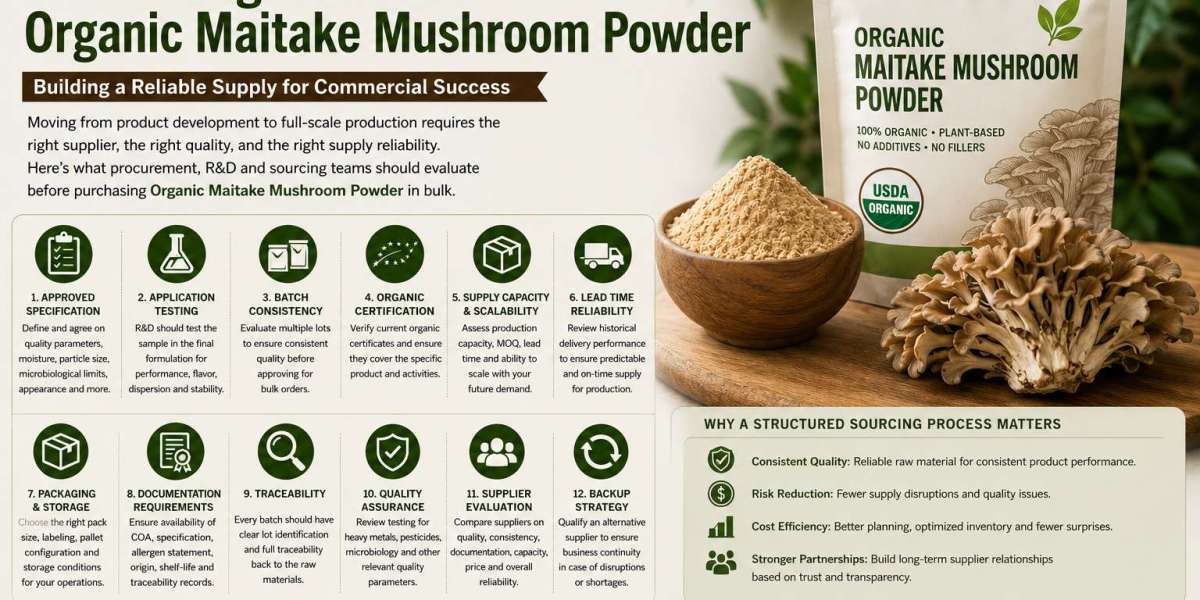
The sample may have the expected appearance, documentation, and handling characteristics, but a later commercial lot can behave differently in production. Changes in cultivation conditions, harvest maturity, drying, milling, moisture, and storage may affect particle size, color, aroma, and flow. For companies purchasing Organic Maitake mushroom Powder bulk, controlling this variability should be part of the sourcing strategy from the beginning.
Define the Material Before Comparing Suppliers
Maitake, or Grifola frondosa, is cultivated commercially and processed into powder for food, beverage, nutritional, and supplement applications. However, the term “maitake powder” does not necessarily describe the same raw material across suppliers.
A buyer should first establish whether the powder is derived from fruiting bodies, mycelium, or another defined portion of the mushroom. Cultivation substrate and processing methods can also influence the final material.
When evaluating Organic Maitake mushroom Powder, procurement teams should document species identity, cultivation origin, processing location, and traceability. These details are useful not only for qualification but also when investigating why a future lot differs from the approved reference.
Formulation Requirements Should Come First
Maitake powder may be used in dry mixes, powdered beverages, capsules, tablets, and functional food products. Each application creates different requirements for the raw material.
In dry formulations, moisture, bulk density, particle size, and flowability can influence blending, dosing, and handling. Significant particle-size differences can also contribute to segregation during transportation or production.
Beverage applications require a different evaluation. Mushroom powders contain insoluble components, so formulators should assess dispersion rather than assume complete dissolution. Particle characteristics, mixing speed, addition sequence, and interactions with other ingredients can affect the finished formulation.
One practical decision trigger is to test the ingredient under production-relevant conditions. A small laboratory trial can demonstrate initial suitability, but it may not reproduce commercial equipment, mixing time, shear, or ingredient loading.
Build the Specification Beyond the COA
For buyers sourcing Organic Maitake mushroom Powder bulk, a certificate of analysis should establish the analytical baseline, not serve as the entire supplier qualification.
Depending on the finished application, buyers may specify:
- Botanical identity
- Moisture content
- Particle-size distribution
- Bulk density
- Microbiological limits
- Heavy metals
- Pesticide residues
- Foreign matter
- Organic certification
- Country of origin
- Traceability
Species verification deserves particular attention with mushroom ingredients. Procurement and quality teams should understand the testing approach used to confirm Grifola frondosa and the controls used to prevent substitution.
Organic certification should also be verified for the specific ingredient and relevant processing facility. Additional documents may include allergen information, GMO status, shelf-life details, packaging specifications, and storage requirements.
Where the finished formulation depends on a defined compositional marker, the analytical method and acceptance range should be agreed before commercial purchasing begins.
The Real Challenge Is Often Lot Consistency
One of the more useful observations from bulk sourcing is that lot variation does not always create an obvious specification failure.
Two lots may meet the same broad analytical requirements but still differ in color, aroma, flow, or particle distribution. Cultivation conditions influence the raw mushroom, while drying and milling can affect the physical characteristics of the final powder.
Storage can introduce additional variation. Moisture exposure during transportation or warehousing may contribute to caking and poor flow. Packaging, transportation conditions, and recommended storage parameters should therefore be reviewed during supplier qualification.
A retained reference sample can provide a useful practical benchmark. Incoming lots can be compared with the approved sample for appearance, aroma, flow, particle behavior, and other agreed characteristics alongside laboratory testing.
For critical applications, qualifying multiple commercial lots before committing to long-term purchasing provides better evidence of consistency than approving a single sample.
Price Is Only One Part of the Sourcing Decision
When purchasing Organic Maitake mushroom Powder bulk, procurement teams should evaluate price alongside minimum order quantities, lead times, packaging formats, cultivation capacity, seasonal factors, transportation conditions, and storage requirements.
A lower-cost material may create a higher overall cost if inconsistent lots require additional testing, production adjustments, rework, or rejection.
Supply continuity also deserves attention. Buyers should understand whether the supplier can maintain cultivation and processing capacity as order volumes increase. For organic ingredients, certification continuity and traceability should remain available across future lots.
A Practical Procurement Benchmark
The strongest approach to Organic Maitake mushroom Powder connects procurement, quality, and R&D requirements from the start. Buyers should evaluate species identity, cultivation and processing controls, organic certification, analytical quality, physical characteristics, and lot-to-lot consistency.
For manufacturers purchasing Organic Maitake mushroom Powder bulk, one successful sample demonstrates potential suitability. Several consistent commercial lots provide stronger evidence of supply reliability.
Ultimately, dependable sourcing is about reducing uncertainty before the ingredient reaches production. The powder should remain predictable from cultivation and processing through transportation, storage, blending, and finished-product manufacturing. That is the benchmark that matters when moving from supplier qualification to a sustainable commercial supply.