
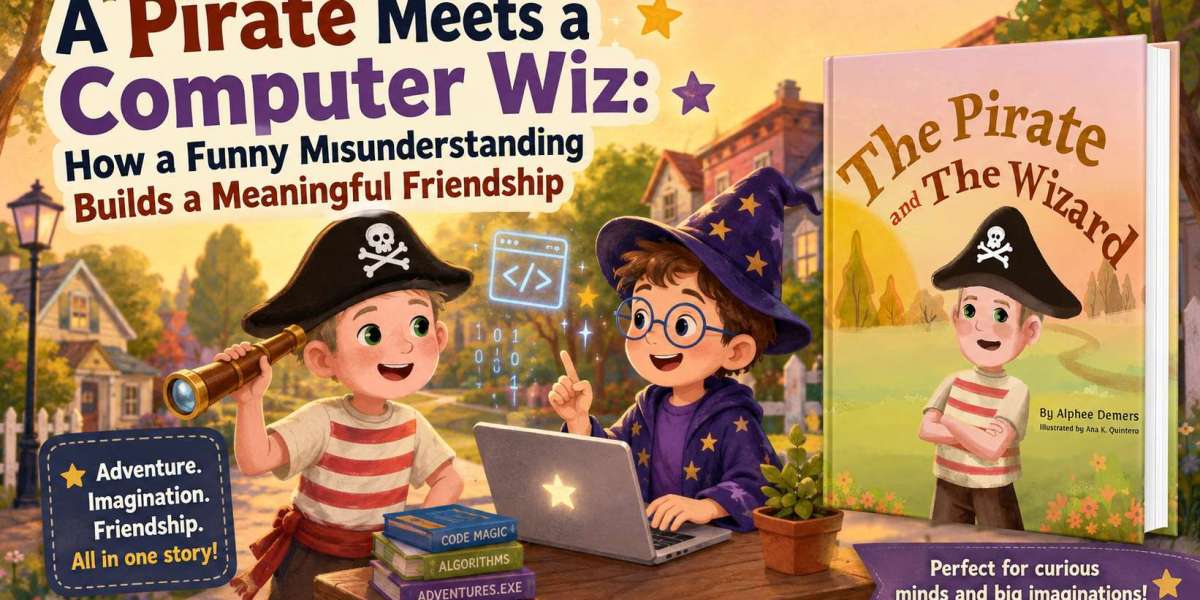
Childhood friendships do not always begin with careful introductions. Sometimes they begin with a mistake, a bold request, and an invitation impossible to refuse. In The Pirate and the Wizard, written by Alphee Demers, edited by Rebecca Demers, and illustrated by Ana K. Quintero, one boy searches for a magical guide and finds a computer wiz instead. The misunderstanding is genuinely funny, but it becomes the foundation of a story about difference, confidence, teamwork, and the people who help us move beyond our own limits.
The Mistake That Starts the Adventure
At the beginning, the young pirate is not yet on an adventure. He is bored. He wants to move, change his mood, and become somebody more exciting than the child at home. After considering costume choices, he selects his pirate clothes and heads outside with one instruction from his mother: return before dark. That parental boundary gives the story a recognizable frame. The adventure may feel enormous to the child, but it grows from a safe world.
Once outside, the pirate decides he needs the biggest treasure ever seen. His desire arrives before his plan, which is how many childhood projects begin. The goal is dramatic, the details are missing, and confidence fills the gap. He reasons that a treasure hunt requires expert help, then remembers the "wizard" living only two houses away.
Readers are encouraged to imagine the same figure the pirate expects. There should be a cloak, a staff, a beard, perhaps a pointed hat, and some visible sign of magic. Instead, another little boy opens the door. He is the pirate's size and appears ordinary. When asked whether he is the wizard, he explains that he is a wiz, but of the computer.
The wordplay is simple for children to understand and rich enough to support the entire plot. One child hears a category; the other hears a skill. One imagines spells; the other understands technology. The computer wiz attempts to explain the difference, but the pirate has decided that the distinction does not matter. He needs help; the boy says he can help, and that is enough.
This is where the misunderstanding becomes important. The pirate does not reject the boy for failing to match his fantasy. He simply expands the role. The computer wiz may not look magical, but he knows things the pirate does not know. In a world where children can sort one another by interests, personalities, or abilities, the story offers a generous response: difference can be useful, interesting, and fun.
Different Strengths, One Shared Mission
The pirate proposes a partnership. The wizard will locate the treasure, the pirate will get them there, and they will divide the fortune. His plan is wonderfully uneven, but it gives both boys a place in the mission. The computer wiz does not need much persuasion. That small detail reinforces the book's family-friendly grounding while preserving the excitement of independence.
As the boys set out, their friendship is compared to garden seeds beginning to grow. The image is brief, but it identifies the real movement beneath the treasure hunt. They are called an unlikely duo and a perfect team in the same breath. The apparent contradiction is the point. Compatibility does not always mean similarity.
That pattern continues when they reach the scrap yard. The pirate’s confidence helps them to get through the uncertainty. But enthusiasm alone will not solve every problem—the yard is a labyrinth of cars, broken windows, gaps, and towering equipment. And the deeper they go, the more the story tests if their partnership is just a sham or really works.
When Knowledge Looks Like Magic
The great crane gives the most positive answer. It appears to be impassable, barring the way. For a moment, neither child knows what to do. Then the computer wiz moves toward the controls. He is nervous, and the story does not hide that nervousness. Courage here is not fearlessness. It is the decision to climb into the cabin, look carefully, and say, "I can figure this out."
For young readers, that line carries real weight. Children often think that machines, puzzles, schoolwork, and social situations look too complicated at first. The wizard is not self-assured because he knows all the answers already. It depends on his strength to observe and learn. The scene gives problem-solving a sense of drama usually reserved for sword fights or spells.
From the pirate's perspective, the wiz may as well have cast magic. The machine starts, the obstacle moves, the way is open. This is a clever spin on the original joke. The boy says he is not a wizard, a magical wizard, but the magic of what he knows is magical to his friend. The story doesn't erase the difference between technology and sorcery. It shows how mastery can inspire awe.
The wizard, for his part, acknowledges the pirate's contribution. Their success is shared, not claimed by the louder child. The pirate may have launched the quest, but the wizard saves it at the crucial moment. Young readers see a partnership in which leadership changes according to the problem. One friend can set the direction; the other can create the solution. Both forms of contribution matter.
The narrative's rhyming structure gives these ideas a light touch. The book never pauses for a formal speech about inclusion or collaboration. Instead, values emerge through movement, dialogue, and comic contrast. The boys run, wonder, disagree about language, accept help, face disappointment, and keep choosing the adventure together. The lessons are present because the friendship feels active.
The scrap-yard attendant adds another layer to the theme. When the boys cannot pay the entrance fee, he remembers his own youth and lets them pass. His generosity suggests that imagination can connect people across age as well as personality. He sees two children at the start of a story and decides not to close the gate. In that moment, he becomes a quiet ally to their friendship.
Ana K. Quintero's illustrations can deepen every contrast that makes the book work: pirate costume and everyday street, expected wizard and ordinary boy, computer and wagon, intimidating crane and determined child. Picture books often communicate emotional meaning through scale, expression, and visual rhythm. Here, the images can help readers feel how large the world becomes when seen through the boys' eyes.
A Friendship Beyond First Impressions
The final value of the misunderstanding is that it never needs to be corrected. The pirate continues to call his new friend a wizard, but the word changes meaning. It no longer describes a robe, beard, or spellbook. It describes the person who joined the quest, understood the controls, and believed another adventure was worth having.
The Pirate and the Wizard is therefore more than a tale built around a pun. It is a warm argument for meeting people beyond first impressions. The pirate finds someone different from the helper he imagined, yet better suited to the journey he actually faces. The computer wiz finds someone bold enough to turn his skills into an adventure. Their friendship begins because one child gets the word wrong and the invitation right.