Helping children understand where their water comes from is becoming increasingly important as communities around the world face drought, groundwater depletion, and growing concerns about water conservation. A new children's picture book is making these complex environmental topics approachable through the power of storytelling.
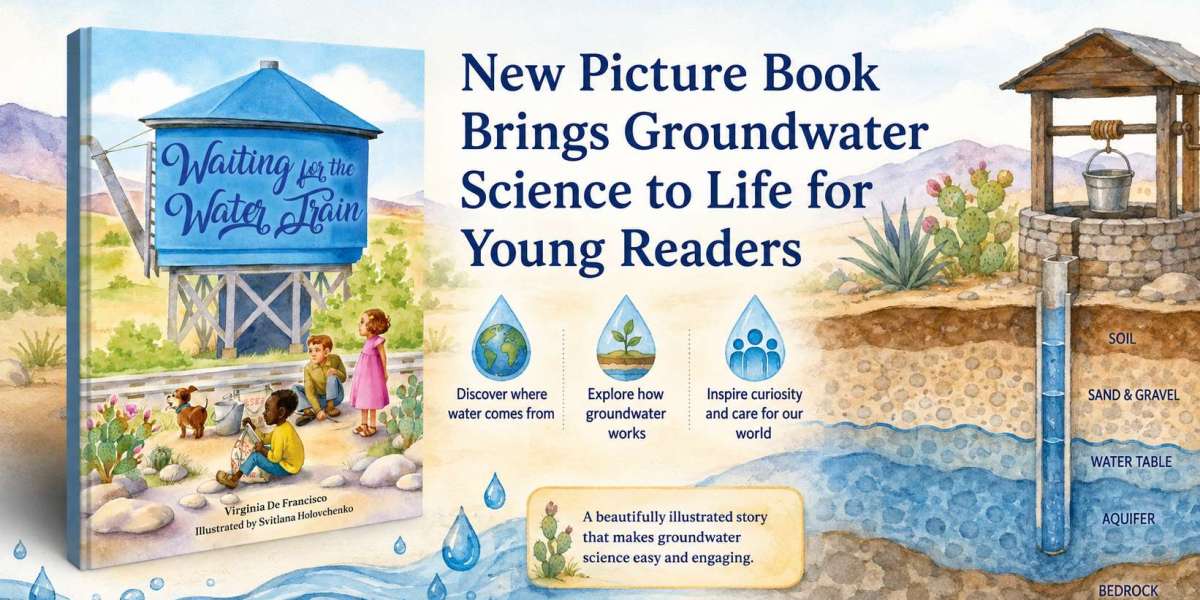
Waiting for the Water Train, written by Virginia De Francisco and illustrated by Svitlana Holovchenko, introduces young readers to the science behind groundwater while telling the heartfelt story of a young girl whose community learns that clean water is one of life's most valuable resources. Blending engaging narrative, memorable illustrations, and age-appropriate scientific concepts, the book serves as both an entertaining read and an educational resource for classrooms, libraries, museums, and homeschool families.
Designed to support elementary science and literacy instruction, Waiting for the Water Train demonstrates that environmental education is most effective when children can connect scientific ideas to everyday life. Instead of presenting technical definitions alone, the story allows readers to experience the consequences of changing environmental conditions alongside its main character, Emma.
Emma lives in a small community in California's Mojave Desert, where daily life depends upon a single well drawing water from an underground aquifer. Like many children, Emma rarely thinks about where the water flowing from her faucet originates. She happily runs sprinklers, splashes through puddles, makes mud pies, and enjoys long bubble baths, believing there will always be plenty of water available.
Her perspective changes dramatically when the town's underground water supply begins to disappear.
As the water table drops lower and lower, the community well can no longer reach enough groundwater to meet everyone's needs. Eventually, the well begins pumping mud instead of clean water. Without dependable access to water, everyday routines come to a halt. Cooking, bathing, cleaning, watering plants, and caring for animals suddenly become difficult challenges that affect every family in town.
To help the struggling community, a neighboring town begins delivering water by train. Although the weekly deliveries provide temporary relief, the limited supply quickly runs out when residents continue using more water than necessary. Emma witnesses firsthand how individual choices affect an entire community and learns that conserving water is everyone's responsibility.
Through Emma's journey, readers are introduced to several essential scientific concepts that form the foundation of groundwater education.
The story explains groundwater as the water stored beneath Earth's surface and shows how millions of people depend upon it every day. Children learn that this hidden resource supplies homes, farms, schools, and businesses, even though it cannot be seen.
The book also introduces aquifers, the underground layers of sand, gravel, and rock that naturally store groundwater. Rather than describing aquifers through complicated scientific language, Waiting for the Water Train demonstrates their importance by showing what happens when too much water is removed too quickly.
Readers also discover the role of the water table, the level below the ground where soil and rock become saturated with water. As Emma's community uses more groundwater than nature can replace, the water table falls below the reach of the town's well, causing the water supply to fail.
The story clearly explains how wells function as gateways to underground water and why they stop producing water when groundwater levels become too low.
Another important concept introduced is natural recharge, the process through which rainfall and snowmelt slowly replenish groundwater supplies. Young readers learn that aquifers are renewable resources only when water returns naturally at a rate equal to or greater than the amount being withdrawn. When groundwater is pumped faster than recharge can occur, shortages become inevitable.
The book also explores the environmental effects of drought, illustrating how prolonged dry conditions reduce natural recharge and place additional pressure on underground water supplies. Rather than presenting drought as an abstract weather event, the story demonstrates how it affects families, communities, and local ecosystems.
Beyond groundwater science, Waiting for the Water Train introduces children to the practical realities of water transportation, storage, and distribution. The arrival of the water train illustrates how communities sometimes depend upon creative infrastructure and regional cooperation to meet essential needs during emergencies.
These scientific lessons become meaningful because they are woven into Emma's daily experiences. Young readers watch familiar activities disappear one by one as water becomes scarce, making abstract environmental concepts easier to understand and remember.
To extend learning beyond the story itself, Waiting for the Water Train includes a wealth of educational resources for teachers, parents, librarians, and homeschool educators.
The back matter features an accessible explanation of groundwater, aquifers, water tables, wells, recharge, and drought, helping reinforce the scientific principles introduced throughout the narrative. Readers will also find a California groundwater map that illustrates how underground water resources support communities across the state.
Additional water education links provide opportunities for further exploration, while a collection of STEAM activities encourages students to investigate water through observation, experimentation, and critical thinking.
Suggested classroom exercises include modeling groundwater movement, exploring the water cycle, measuring water volume, comparing conservation techniques, examining well construction, and discussing how communities prepare for drought. These activities encourage inquiry-based learning while reinforcing both scientific literacy and environmental stewardship.
Educators will appreciate how the book integrates science with reading comprehension, vocabulary development, geography, engineering, environmental studies, and social-emotional learning. Emma's experiences naturally generate classroom discussions about responsibility, cooperation, gratitude, problem-solving, and community resilience, helping students recognize that science is closely connected to everyday life.
The story is equally valuable as a classroom read-aloud, a library resource, or a homeschool teaching tool. Its engaging narrative, realistic environmental setting, and carefully developed educational content make complex scientific ideas accessible to elementary-aged learners without sacrificing accuracy.
Illustrator Svitlana Holovchenko further enriches the educational experience through expressive artwork depicting the Mojave Desert landscape, wildlife, trains, wells, and changing environmental conditions. The illustrations provide visual context that helps children better understand the scientific concepts presented throughout the story while inviting repeated readings and classroom discussion.
As groundwater conservation becomes an increasingly important topic across the United States and around the world, Waiting for the Water Train offers educators a timely resource that inspires both curiosity and action. By helping children understand how groundwater systems work—and why protecting them matters—the book encourages lifelong respect for one of Earth's most essential natural resources.
Availability
Waiting for the Water Train by Virginia De Francisco, illustrated by Svitlana Holovchenko, is available through major online retailers and booksellers.
Review copies are available for science education publications, STEM organizations, environmental education media, school districts, museums, libraries, homeschool associations, literacy organizations, and children's book reviewers.
Schools, libraries, museums, environmental organizations, and educational conferences are invited to schedule author interviews, classroom visits, library presentations, educator workshops, literacy events, and community outreach programs. Teacher resources, discussion guides, and educational support materials are available to help educators integrate the book into science, literacy, and STEAM curricula.
Contact:
Amazon: Waiting for the Water Train
Author: Virginia De Francisco
https://www.facebook.com/profile.php?id=61591557835010#