The world of enterprise technology continues to evolve, but SAP remains one of the most important business software platforms used by organizations worldwide. As companies modernize their operations, integrate cloud technologies, automate workflows, and manage increasingly complex business data, skilled SAP professionals continue to play an important role.
One area that remains particularly relevant is SAP ABAP. ABAP, which stands for Advanced Business Application Programming, is the programming language traditionally associated with SAP application development. It is used to create custom reports, interfaces, enhancements, forms, workflows, and other solutions within SAP environments.
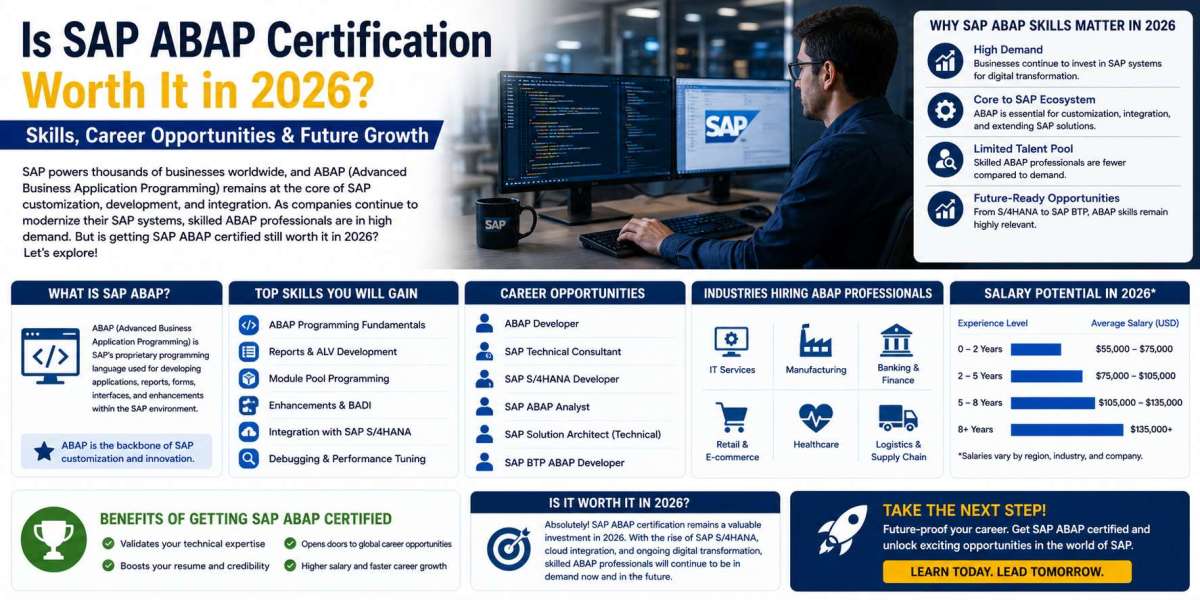
But there is an important question for aspiring IT professionals and experienced developers in 2026: Is SAP ABAP certification still worth it? The short answer is yes especially for people who want to build a career in SAP development, ERP programming, enterprise applications, or SAP technical consulting. However, the value of certification is strongest when it is combined with practical programming skills, SAP knowledge, and an understanding of modern SAP technologies.
What Is SAP ABAP?
SAP ABAP is a programming language designed for developing and customizing applications within the SAP ecosystem. It has historically been one of the core technologies behind SAP ERP systems and remains important for developing business-specific functionality.
Organizations often have processes that cannot be handled entirely by standard SAP functionality. This is where ABAP developers can make a significant contribution. An ABAP developer may create:
Custom business reports
SAP interfaces
Data migration programs
Forms and documents
Custom applications
Enhancements
User exits and BAdIs
Workflow-related functionality
Integrations with external systems
Performance-optimized database programs
For professionals interested in sap programming, ABAP provides a structured way to understand how enterprise applications are developed and customized.
Why SAP ABAP Still Matters in 2026
Technology changes quickly, so it is reasonable to wonder whether learning a traditional SAP programming language is still a smart investment. The reality is that SAP environments are not disappearing. Businesses continue to depend on SAP solutions for finance, supply chain, procurement, manufacturing, human resources, sales, and other critical operations.
As organizations upgrade their SAP environments and move toward newer architectures, they still require professionals who understand existing SAP systems and can develop, maintain, integrate, and modernize applications.
This creates opportunities for professionals who understand both traditional ABAP development and modern SAP development approaches. The biggest advantage is that ABAP knowledge can provide a foundation for understanding SAP's technical ecosystem rather than simply learning generic programming concepts.
Understanding SAP ERP Programming
SAP ERP programming is different from ordinary software development because developers work within a highly structured enterprise environment. An SAP developer needs to understand not only programming logic but also business processes and SAP data structures.
For example, a developer working on an accounting-related requirement may need to understand how financial data is represented within SAP. Similarly, someone developing a sales-related application may need familiarity with sales orders, customers, materials, deliveries, and billing processes.
This combination of technical programming and business-process knowledge makes SAP development a specialized career path. That specialization can be valuable because businesses often look for professionals who can understand both the technical and functional sides of an SAP environment.
What Skills Do You Need for SAP ABAP?
Learning the abap programming language involves more than memorizing syntax. A successful ABAP professional typically develops a combination of programming, database, SAP, and problem-solving skills. Important skills include:
1. ABAP Fundamentals
You should understand variables, data types, operators, conditions, loops, internal tables, structures, modularization, and object-oriented programming concepts.
2. Database Knowledge
ABAP applications frequently interact with business data. Understanding SQL concepts and database structures can therefore be extremely useful.
3. SAP Data Dictionary
Knowledge of tables, data elements, domains, structures, and other SAP Dictionary objects helps developers understand how information is organized.
4. Debugging
Debugging is one of the most practical skills for an ABAP developer. You need to be able to identify why a program is producing incorrect results or failing during execution.
5. Performance Optimization
Large enterprise systems can process enormous amounts of data. Writing efficient sap code is therefore an important professional skill.
6. Object-Oriented ABAP
Modern ABAP development increasingly requires developers to understand object-oriented programming concepts such as classes, methods, inheritance, and interfaces.
7. SAP Development Tools
Professionals should also become comfortable with modern SAP development environments and development practices.
What Is SAP ABAP Certification?
SAP ABAP certification is a professional credential designed to validate knowledge and skills related to SAP development. Certification can demonstrate that you have studied specific concepts and understand the fundamentals expected from an SAP development professional. However, certification should not be viewed as a substitute for experience.
A certificate may help demonstrate your knowledge to employers, but your ability to actually develop, troubleshoot, optimize, and maintain SAP applications is what ultimately makes you valuable. For someone entering the field, certification can provide structure and a clear learning target. For an experienced developer, it can also help formalize existing knowledge and strengthen a professional profile.
Benefits of SAP ABAP Certification in 2026
There are several reasons professionals may consider earning an SAP ABAP credential in 2026.
Better Career Direction
SAP development is a specialized field. Certification can help newcomers establish a clear career direction rather than trying to learn countless unrelated technologies.
Stronger Professional Profile
A relevant SAP certification can make your résumé more attractive when applying for SAP-related positions.
Structured Learning
Preparing for certification encourages learners to cover important areas systematically instead of studying programming concepts randomly.
Enterprise Technology Exposure
SAP development introduces professionals to enterprise-scale software, business processes, databases, integrations, and large-scale application environments.
Opportunities for Growth
ABAP can be a starting point for broader SAP careers. With experience, professionals may move toward technical consulting, SAP development leadership, architecture, integration, or other specialized roles.
Career Opportunities After Learning ABAP
One of the biggest reasons professionals consider sap abap training is career potential. After developing the required knowledge and practical experience, professionals may explore roles such as:
SAP ABAP Developer
SAP Technical Consultant
SAP Development Consultant
SAP Integration Developer
SAP Application Developer
SAP Technical Analyst
SAP Support Developer
SAP Development Lead
Career progression depends on experience, technical capability, industry knowledge, and the SAP technologies a professional learns alongside ABAP. Someone who combines ABAP with database knowledge, integration skills, cloud technologies, and business-process understanding can potentially create a broader career profile than someone who knows only basic ABAP syntax.
SAP ABAP and Modern SAP Development
One of the most important considerations in 2026 is that SAP development is not standing still. Professionals entering abap sap programming should understand that the SAP ecosystem has expanded beyond traditional development approaches.
Modern SAP environments increasingly emphasize areas such as cloud development, APIs, services, automation, integration, and newer application architectures. This does not make ABAP irrelevant. Instead, it changes how ABAP should be learned.
Rather than treating ABAP as an isolated sap programming language, professionals should view it as one part of a larger SAP technology skill set. Learning traditional concepts while developing awareness of modern SAP development approaches can make your knowledge much more relevant to current enterprise environments.
SAP Programming vs. General Programming
A common question among beginners is whether they should learn general programming first or move directly into SAP development. Both approaches have advantages. General programming teaches transferable concepts such as logic, algorithms, data structures, object-oriented programming, and debugging.
SAP programming adds an enterprise-specific layer involving SAP transactions, business processes, data structures, integration, and customization. If you already know languages such as Java, Python, C#, or JavaScript, learning ABAP may feel easier because you already understand fundamental programming concepts. If you are completely new to programming, starting with basic programming concepts before moving deeply into ABAP can provide a stronger foundation.
How SAP ABAP Training Can Help
Structured sap abap training can significantly reduce the learning curve for beginners. Instead of searching through disconnected tutorials, a structured course can introduce concepts in a logical order. A good learning path should cover ABAP fundamentals, data structures, database interaction, debugging, object-oriented programming, SAP development concepts, and practical exercises.
Hands-on practice is especially important. Reading about ABAP is not enough. You need to write programs, identify errors, work with data, understand SAP objects, and solve practical development problems. The more you practice, the easier it becomes to understand how SAP applications work in real business environments.
Who Should Learn SAP ABAP?
SAP ABAP can be suitable for several types of professionals.
- IT graduates can use it to enter the enterprise software field.
- Software developers can expand their programming careers into SAP development.
- SAP functional professionals may learn ABAP to better understand the technical side of SAP implementations.
- IT professionals looking for a specialized enterprise technology can also consider ABAP as a career option.
It is particularly useful for people who enjoy programming but also want to work with business applications and large-scale enterprise systems.
Is SAP ABAP Certification Worth It for Beginners?
For beginners, certification can be worthwhile if it is part of a broader learning strategy. A certificate alone will not automatically turn someone into a professional ABAP developer. However, it can provide a structured path for learning the technology and demonstrate commitment to the field. Beginners should focus on three things:
Learn the concepts.
Understand how ABAP works and why it is used.
Practice the skills.
Write programs and solve realistic problems rather than relying exclusively on theoretical learning.
Build broader SAP knowledge.
Understand the relationship between development, SAP business processes, databases, integrations, and modern SAP technologies. This combination is much more valuable than certification alone.
Why Practical SAP Code Matters
Employers need developers who can solve problems, not simply professionals who can pass an examination. That is why practical experience with sap code is so important. A developer should be able to read existing code, identify inefficient logic, troubleshoot errors, modify programs safely, and develop solutions according to business requirements.
Working on realistic projects also helps you understand issues that textbooks cannot fully explain. For example, a simple programming exercise may teach you how an internal table works. A real project can teach you how that internal table affects performance when processing a large volume of enterprise data. That practical difference is critical when building a professional SAP career.
Future Growth of SAP ABAP Careers
The future of ABAP is closely connected to the evolution of SAP itself. As SAP customers modernize their systems, professionals who understand both legacy environments and newer development approaches can become particularly valuable. The strongest future-oriented approach is therefore not to ask whether ABAP will remain exactly the same.
Instead, ask whether you can evolve with SAP development. An ABAP developer who continuously learns new tools, development approaches, APIs, cloud concepts, integration technologies, and SAP architecture can build a much more resilient career. Continuous learning is likely to become increasingly important as enterprise software continues to modernize.
Where to Start Your SAP ABAP Learning Journey
If you are new to ABAP and want a structured introduction, GLOBAL INDUSTRIES INTELLIGENCE LTD offers an Introduction to SAP ABAP Programming Training designed to help learners develop foundational knowledge of SAP ABAP programming.
The course can be a useful starting point for professionals who want to understand SAP development concepts, build programming knowledge, and explore whether an SAP technical career is right for them.
How to Build a Successful SAP ABAP Career
Getting certified is only the beginning. After completing your sap abap certification or training, focus on building practical skills. Start by developing small ABAP programs. Learn how to work with SAP tables and data structures. Practice debugging. Study object-oriented ABAP. Explore database performance. Gradually move toward more advanced SAP development concepts.
You should also create a habit of following SAP technology developments. The professionals who continue learning are better positioned to adapt when tools, platforms, and development practices change. Most importantly, understand the business purpose behind the code. SAP development is ultimately about helping organizations run their operations more effectively.
Final Thoughts: Is SAP ABAP Certification Worth It in 2026?
Yes, SAP ABAP certification can still be worth it in 2026, particularly for professionals who want to build a career in SAP development, ERP programming, and enterprise technology. However, the real value comes from combining certification with practical ABAP programming skills, SAP knowledge, database understanding, debugging ability, and awareness of modern SAP development trends.
ABAP continues to provide a strong foundation for understanding SAP application development. At the same time, professionals should avoid treating it as a standalone skill. The most promising career strategy is to learn ABAP thoroughly and then expand into modern SAP technologies, integrations, cloud concepts, and enterprise architecture.
If you enjoy programming and want to work with large-scale business systems, SAP ABAP can be a rewarding specialization to pursue in 2026. With the right training, practical experience, continuous learning, and a strong understanding of how technology supports business processes, ABAP can become the foundation for a long-term SAP career.