Introduction
When people think about water conservation, they often picture individual actions like turning off the faucet while brushing their teeth or taking shorter showers. While these habits are important, they are only one part of a much larger picture. During a serious water shortage, no single family or household can solve the problem alone. Clean water depends on infrastructure, planning, transportation, communication, and the willingness of entire communities to work together.
That is why community water conservation is so important. Water is a shared resource, and protecting it requires shared responsibility. Every household, school, business, farmer, utility provider, and local government has a role to play in ensuring that everyone has access to safe, reliable water.
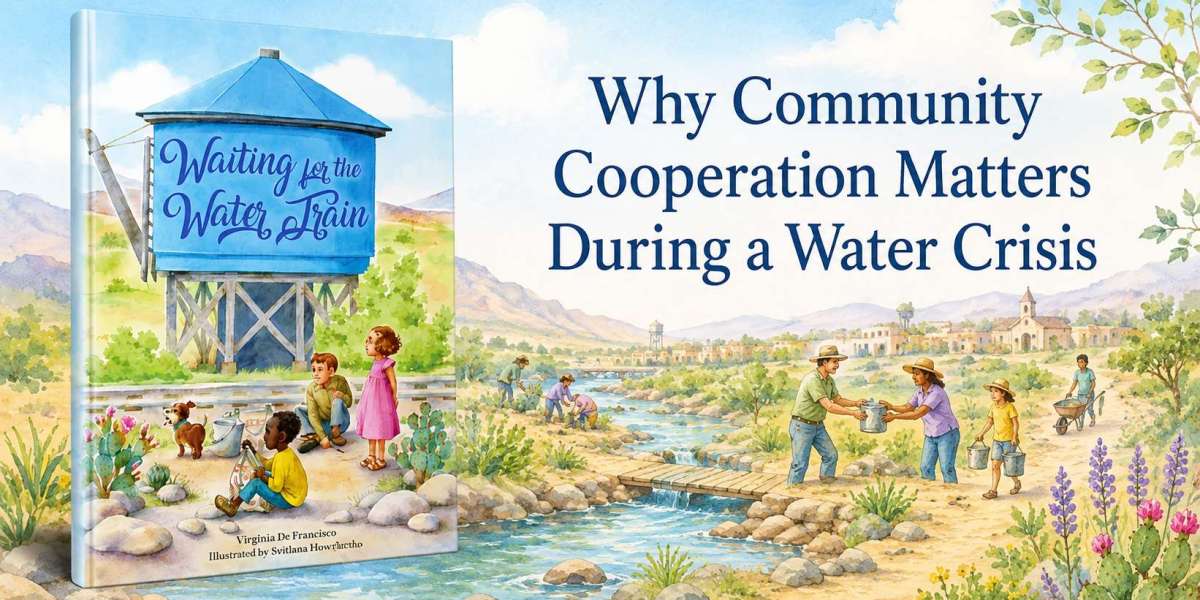
Waiting for the Water Train illustrates this truth through the story of Emma's town. After months of drought, the community's well can no longer provide clean water because the underground aquifer has dropped too low. The town cannot solve the crisis alone. Help arrives from another community near the Colorado River, where a train delivers desperately needed water. Yet even after the train arrives, the work has only begun. Residents of all ages cooperate to unload, transport, and store the water that will sustain the town until the next delivery.
The story reminds readers that water security is never just an individual concern—it is a community effort built on cooperation, preparation, and mutual support.
A Water Crisis Reveals Interdependence
Most communities function so smoothly that people rarely think about how many systems work together to provide clean water.
Every time someone turns on a faucet, countless people and natural resources are involved.
Water may come from:
- Rivers
- Lakes
- Reservoirs
- Underground aquifers
- Municipal wells
It must then be:
- Collected
- Treated
- Stored
- Transported
- Distributed
- Maintained
When drought strikes, these interconnected systems become much more visible.
In Waiting for the Water Train, Emma's town depends entirely on its well.
As the drought continues, the groundwater level falls below the pump, leaving the community without its primary water source.
Fortunately, another town located near the Colorado River offers assistance.
Rail workers transport emergency water across the desert.
Without that neighboring community, the town would have faced an even more serious crisis.
The story demonstrates an important lesson:
Communities survive because they depend on one another.
No town exists in complete isolation.
Sharing resources during emergencies strengthens everyone.
Conservation Extends the Life of a Shared Supply
When emergency water arrives, every gallon becomes precious.
The community knows that the water train will not remain permanently.
The supply must last until the next delivery.
That means conservation becomes everyone's responsibility.
If one household wastes water, fewer resources remain for others.
Children quickly understand this concept because it feels fair.
Everyone depends on the same shared supply.
Community conservation includes everyday actions such as:
- Turning off running faucets.
- Taking shorter showers.
- Repairing leaks immediately.
- Watering plants carefully.
- Using only the water needed for cooking and cleaning.
- Avoiding unnecessary outdoor water use.
These choices may seem small individually.
Together, however, they significantly extend available water supplies.
One of the most valuable lessons in Waiting for the Water Train is that conservation works best when everyone participates.
Rules alone cannot protect water.
People must choose to follow them.
Community success depends on shared commitment.
Infrastructure Alone Is Not Enough
Modern infrastructure plays a vital role during emergencies.
The water train demonstrates impressive engineering and transportation.
It carries thousands of gallons of water across long distances.
But the train alone cannot solve the problem.
Once it reaches the station, people must still work together.
The community needs:
- Storage tanks
- Water towers
- Pumps
- Hoses
- Pipes
- Buckets
- Volunteers
- Organization
Every piece of equipment depends on people who know how to use it effectively.
Technology provides tools.
People provide cooperation.
Without coordination, even the best infrastructure cannot serve the community efficiently.
This lesson extends far beyond the story.
Modern water systems also depend on:
- Engineers
- Utility workers
- Emergency planners
- Public officials
- Maintenance crews
- Environmental scientists
Community water conservation includes supporting the people who keep these essential systems functioning.
The Arrival Scene as a Model of Cooperation
One of the most memorable scenes in Waiting for the Water Train occurs when the long-awaited train finally arrives.
The atmosphere immediately changes.
Instead of fear and uncertainty, the town comes together with purpose.
Everyone has a role.
Adults connect hoses.
Workers guide equipment.
Volunteers pass buckets.
Families assist wherever they can.
Children participate alongside adults.
James even helps Emma carry a heavy bucket of water.
Earlier in the story, James blamed Emma for wasting water.
Now, instead of criticizing her, he works beside her.
His actions demonstrate one of the story's most meaningful themes.
Cooperation replaces blame.
The entire community succeeds because everyone contributes according to their abilities.
This scene shows children that helping others is one of the most important forms of environmental stewardship.
Protecting resources is not simply about using less.
It is also about supporting one another.
Lessons for Modern Communities
Although Waiting for the Water Train is set during a specific drought, its lessons apply to communities everywhere.
Water challenges continue to affect regions around the world.
Communities can prepare by focusing on cooperation before emergencies occur.
Important strategies include:
Prepare Before Shortages Develop
Emergency plans work best when created before they are needed.
Communities can identify alternative water sources, storage systems, and distribution plans in advance.
Protect Groundwater
Healthy aquifers require responsible water use and long-term management.
Conservation today helps protect future supplies.
Maintain Infrastructure
Pipes, pumps, reservoirs, and treatment facilities require regular maintenance to operate efficiently during both normal conditions and emergencies.
Communicate Clearly
Residents should receive accurate, timely information about water conditions, conservation measures, and emergency procedures.
Clear communication reduces confusion and builds public trust.
Support Vulnerable Residents
Older adults, young children, people with disabilities, and families with limited resources may need additional assistance during water shortages.
Strong communities ensure everyone receives the support they need.
Practice Conservation Every Day
One of the story's greatest lessons is that conservation should not begin only after water becomes scarce.
Communities that develop responsible habits during normal times are better prepared when challenges arise.
Building Stronger Communities Through Shared Stewardship
Community water conservation is about much more than reducing water use.
It also strengthens relationships.
When neighbors cooperate during difficult times, they build trust, compassion, and resilience.
Children observing these partnerships learn valuable life lessons.
They discover that:
- Everyone's actions matter.
- Helping others benefits the entire community.
- Fairness encourages cooperation.
- Shared challenges often bring people closer together.
- Environmental stewardship is both a personal and collective responsibility.
Books like Waiting for the Water Train help children understand that water connects every member of a community.
Families, schools, businesses, emergency workers, and neighboring towns all become part of the same story.
That perspective encourages empathy as well as environmental awareness.
Conclusion
Effective community water conservation is about far more than using less water. It requires planning, reliable infrastructure, responsible leadership, clear communication, and, most importantly, cooperation among people who recognize that water is a shared resource.
Waiting for the Water Train captures this message through the unforgettable arrival of the emergency water train. The community survives not because one person solves the crisis, but because neighbors, rail workers, volunteers, children, and adults work together to transport, store, and protect every precious drop. James's willingness to help Emma instead of blaming her further reinforces that collaboration accomplishes far more than criticism.
For families, educators, and young readers, the story offers an enduring lesson: water security depends on all of us. When communities prepare wisely, conserve responsibly, maintain essential infrastructure, and support one another during difficult times, they build resilience that extends far beyond a single drought. By practicing cooperation today, we help ensure that future generations will continue to have access to one of life's most essential resources.