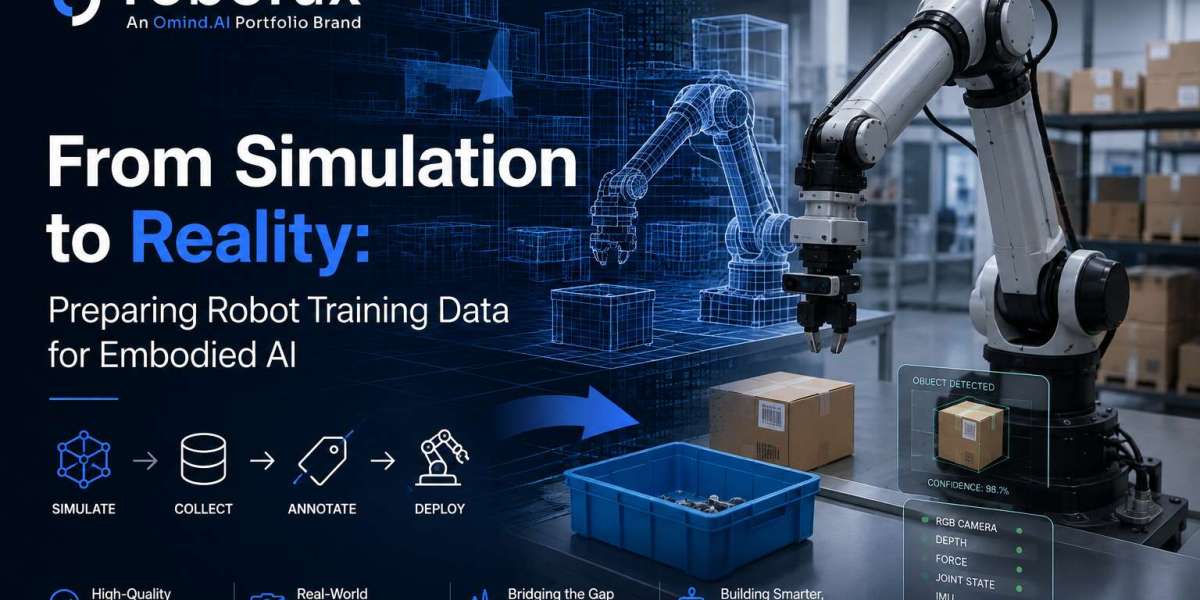
Embodied AI is changing how robots interact with the physical world. Unlike traditional AI systems that operate primarily on digital information, embodied AI must perceive environments, understand context, make decisions, and execute physical actions. This makes the quality of training data especially important. A robot may perform perfectly in a controlled simulation but struggle when exposed to clutter, unpredictable movements, changing lighting, or unfamiliar objects in the real world.
The transition from simulation to physical deployment therefore requires more than simply transferring a trained model. It requires carefully designed robotic training data that connects simulated experiences with real-world behavior. By combining simulation, human demonstrations, sensor data, and robotic data collection, developers can create datasets that help embodied AI systems become more reliable, adaptable, and capable.
Why Simulation Matters for Embodied AI
Training robots entirely in the physical world can be expensive, slow, and potentially unsafe. Every physical experiment requires hardware time, energy, supervision, and maintenance. Simulation provides an alternative environment where robots can experience thousands or millions of scenarios without the same physical constraints.
In a simulated environment, developers can control variables such as object placement, lighting, friction, camera position, obstacles, and robot configuration. They can also generate rare or dangerous situations that would be difficult to reproduce consistently in a physical setting.
For example, a warehouse robot can be trained to navigate around moving objects, misplaced packages, narrow aisles, and unexpected obstacles in simulation before it encounters those situations on a real warehouse floor.
However, simulation has an inherent limitation: it is an approximation of reality.
The Simulation-to-Reality Gap
The difference between simulated environments and physical environments is commonly referred to as the sim-to-real gap. Even highly sophisticated simulations cannot perfectly reproduce every characteristic of the real world.
Real-world robots encounter variations in sensor noise, material properties, lighting, object deformation, mechanical tolerances, latency, friction, and environmental conditions. A simulated object may behave predictably when grasped, while its physical counterpart may slip, deform, or shift unexpectedly.
This means simulated robotic training data should not be treated as a complete substitute for real-world data. Instead, simulation should be used as one component of a broader data strategy.
The goal is to build a feedback loop in which simulated data provides scale and coverage while real-world data provides physical realism.
Building a Strong Robotic Training Data Pipeline
A reliable pipeline typically combines multiple sources of information rather than depending on a single dataset.
1. Generate Diverse Simulation Data
Simulation should expose robots to a wide range of environments and conditions. Developers can vary object sizes, positions, textures, lighting, camera angles, background elements, and environmental layouts.
This process, often called domain randomization, helps models avoid becoming overly dependent on a narrow set of visual or physical conditions.
For embodied AI, diversity is particularly valuable because robots must generalize their learned behaviors to environments they have never encountered before.
2. Capture Real-World Demonstrations
Simulation establishes initial capabilities, but physical demonstrations help models understand how actions behave in reality. Human operators can demonstrate tasks such as grasping, sorting, navigation, assembly, or object manipulation.
These demonstrations can be captured using cameras, depth sensors, motion tracking systems, robot telemetry, and other sensors. High-quality robotic data collection ensures that the resulting dataset captures not only what the robot sees but also what it does and how the environment responds.
3. Combine Multimodal Sensor Data
Embodied AI depends on more than visual perception. Robots may use RGB cameras, depth cameras, LiDAR, force sensors, tactile sensors, microphones, joint encoders, and inertial measurement units.
Combining these modalities creates richer training examples. For instance, a robot attempting to pick up an object can use visual information to identify its location while force and tactile signals help determine whether the object has been successfully grasped.
Effective robotic datasets should therefore preserve the temporal and spatial relationships between sensor streams.
Human Demonstrations Add Critical Context
Human operators can provide information that simulations often fail to capture. A person naturally adapts to changing conditions, corrects mistakes, and selects alternative strategies when an expected action does not work.
Capturing these interactions creates valuable behavioral data for imitation learning and reinforcement learning.
Importantly, demonstrations should include successful actions as well as recovery behaviors. If a robot only learns ideal trajectories, it may struggle when something goes wrong. Data showing how humans respond to failed grasps, blocked paths, unexpected objects, or changing environments can make robotic systems considerably more resilient.
Edge Cases Should Be Part of the Dataset
Real-world deployment rarely follows the “happy path.” Objects may be partially hidden, lighting may change suddenly, people may enter the robot’s workspace, or sensors may produce incomplete information.
These edge cases are particularly important for embodied AI because failures can occur when multiple small uncertainties interact.
A robust robotic data collection strategy should deliberately capture unusual and difficult scenarios. Teams can use simulation to generate rare conditions and then validate important scenarios in physical environments.
This creates a more balanced dataset that represents both common operations and long-tail situations.
Quality Control Is Essential
More data does not automatically produce better robotic intelligence. Poorly synchronized sensor streams, incorrect labels, missing timestamps, inconsistent demonstrations, and noisy measurements can negatively affect model performance.
Quality assurance should therefore be integrated throughout the data lifecycle.
Teams should validate sensor synchronization, remove corrupted recordings, review annotations, check trajectory consistency, and identify duplicate or low-value samples. Dataset metadata should also document environmental conditions, robot configuration, task type, and sensor characteristics.
A structured quality-control process makes robotic training data more reliable and easier to reuse across different models and robotic platforms.
Closing the Loop Between Simulation and Reality
The most effective approach is not simulation versus real-world data. It is simulation plus real-world feedback.
A robot can first learn basic behaviors in simulation. Those behaviors can then be evaluated on physical hardware. Failures and unexpected behaviors are captured through real-world robotic data collection and analyzed to identify weaknesses. Developers can subsequently recreate similar scenarios in simulation, generate additional variations, retrain the model, and test the improved policy again.
This iterative cycle gradually reduces the simulation-to-reality gap.
Preparing Robots for the Physical World
Embodied AI requires robots to operate under uncertainty, adapt to changing environments, and translate perception into precise physical actions. Achieving this level of capability depends heavily on the quality, diversity, and realism of the data used during training.
Simulation provides scale, repeatability, and controlled experimentation. Real-world data provides physical authenticity and exposes the model to unexpected conditions. Human demonstrations add behavioral intelligence, while multimodal sensing provides a richer understanding of the environment.
By combining these elements into a disciplined robotic data collection and validation pipeline, organizations can develop robotic training data that better reflects the complexity of physical environments.
For embodied AI, the journey from simulation to reality is not a single deployment step. It is a continuous learning process—one where every physical interaction can provide new information, improve the dataset, and help robots perform more reliably in the real world.