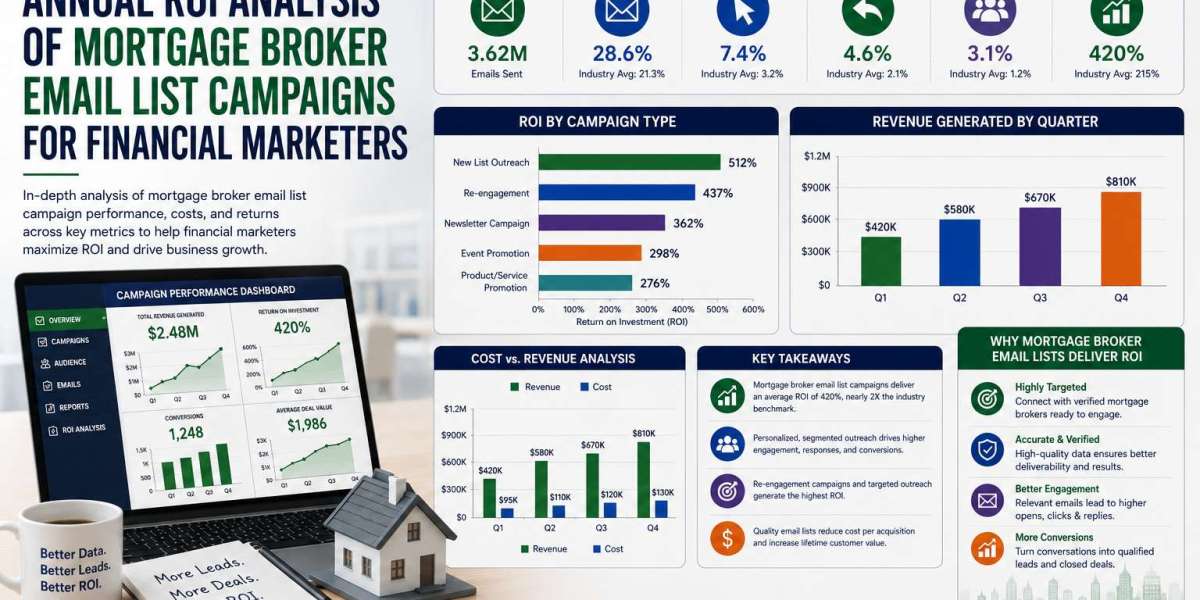
Email remains one of the most measurable B2B marketing channels, but its return depends heavily on audience quality, deliverability, relevance, and conversion tracking. Litmus reports that email generates an average $36 in return for every $1 invested, while its 2025 State of Email research found that 35% of companies reported returns between $10 and $36 per dollar and another 30% reported $36–$50. (Litmus)
For mortgage-focused marketers, the opportunity is significant but increasingly difficult. The U.S. mortgage market remains sensitive to interest rates and affordability: Freddie Mac reported a 6.69% average 30-year fixed mortgage rate on August 6, 2026, while the Mortgage Bankers Association's 2026 forecast anticipates continued mortgage-origination activity despite a challenging market. (Freddie Mac)
This annual ROI analysis examines how a targeted Mortgage Broker Email List can contribute to financial-marketing performance, which metrics matter most, and how marketers can calculate campaign-level returns without relying on inflated engagement assumptions.
Why Does Mortgage Broker Email Marketing Matter in 2026?
Mortgage marketers are operating in a market where every qualified opportunity can matter more because borrowing costs remain elevated.
The Mortgage Bankers Association's October 2025 forecast projected total single-family mortgage originations to increase 8% to $2.2 trillion in 2026, with loan count expected to rise 7.6% to 5.8 million loans from 5.4 million in 2025. (MBA)
However, current conditions are more challenging than that forecast alone might suggest. Freddie Mac's August 2026 data puts the 30-year mortgage rate at 6.69%, compared with 6.63% a year earlier. (Freddie Mac) Recent market reporting also indicates that mortgage activity has cooled, with Zillow revising its 2026 mortgage-market forecast toward a low-to-mid-single-digit decline. (Barron's)
For marketers, this creates a strategic problem: how do you generate more qualified conversations without proportionally increasing acquisition costs?
A carefully segmented Mortgage Broker Email List can help address that problem by giving campaigns a defined professional audience rather than relying exclusively on broad paid acquisition.
What Does the Latest Email ROI Research Tell Mortgage Marketers?
The broader email market continues to demonstrate strong economic potential.
Litmus' 2025 State of Email research found that:
35% of companies reported $10–$36 in return for every $1 spent.
30% reported $36–$50 in return.
5% reported more than $50 in return.
21% of marketing leaders did not measure email ROI. (Litmus)
These figures should not be interpreted as a guaranteed return for a mortgage campaign. They are industry-level findings, not mortgage-broker-specific performance measurements.
The more useful conclusion is methodological: ROI needs to be measured at campaign level.
A financial marketer should calculate:
Email ROI = (Attributed Revenue − Campaign Cost) ÷ Campaign Cost × 100
Campaign cost should include more than the cost of the database. Depending on the program, marketers should account for:
Data acquisition
Email-platform costs
Verification and hygiene
Copy and creative
Marketing automation
Sales follow-up
Landing pages
Analytics
Campaign management
This produces a more defensible ROI figure than simply comparing sales revenue with the purchase price of a list.
How Does Contact Quality Affect Mortgage Broker Campaign ROI?
A database's size is less important than the percentage of contacts that are relevant and reachable.
MailerLite's 2025 benchmark study analyzed more than 3.6 million campaigns from 181,000 approved accounts and found an overall average open rate of 43.46%, click rate of 2.09%, click-to-open rate of 6.81%, and unsubscribe rate of 0.22%. (MailerLite)
These numbers provide broad email-market context, but mortgage prospecting can behave differently from permission-based subscriber marketing. A cold or newly introduced audience should not automatically be expected to perform like an established subscriber base.
That distinction makes list quality particularly important.
A useful Mortgage Broker Email List should ideally allow marketers to segment contacts by characteristics such as:
Mortgage-broker role
Organization type
Geographic market
Seniority
Business specialization
Market served
Company size
Relevant campaign criteria
The objective is to reduce wasted impressions and concentrate campaign resources on contacts that have a plausible business reason to engage.
What Should a Mortgage Broker Mailing List ROI Model Include?
An annual ROI model should move beyond opens and clicks and connect marketing activity to revenue.
Consider a hypothetical campaign—not a reported industry benchmark:
| Metric | Illustrative assumption |
|---|---|
| Contacts targeted | 10,000 |
| Delivered emails | 9,800 |
| Clicks | 196 |
| Qualified inquiries | 20 |
| Sales opportunities | 8 |
| Closed deals | 2 |
| Revenue per closed deal | $4,000 |
| Attributed revenue | $8,000 |
| Total campaign cost | $2,000 |
Under those assumptions:
ROI = ($8,000 − $2,000) ÷ $2,000 × 100 = 300%
That means the campaign generated $4 in revenue for every $1 invested, before considering other costs or attribution complexities.
The numbers above are deliberately illustrative. They should not be presented as the expected performance of a Mortgage Broker Mailing List.
The important lesson is that a campaign can be economically attractive even when only a small percentage of contacts ultimately become customers—provided the average customer value is sufficiently high.
Which Metrics Best Predict Mortgage Email Campaign ROI?
1. Deliverability
First measure whether the message reaches the intended audience.
A high bounce rate can indicate outdated, invalid, or poorly maintained contact data. Mailchimp also warns that open and click metrics can be affected by automated activity and Apple's Mail Privacy Protection, making raw engagement figures imperfect. (Mailchimp)
2. Click-through rate
Clicks provide stronger evidence of active interest than opens because the recipient has taken an additional action.
MailerLite's 2025 cross-industry benchmark reported a 2.09% average click rate. (MailerLite)
Mortgage marketers should compare their own campaigns against a consistent historical baseline rather than treating that figure as a universal target.
3. Qualified response rate
A reply or inquiry becomes much more valuable when it meets defined qualification criteria.
For example, a mortgage-industry campaign might distinguish between:
General information requests
Partnership inquiries
Referral opportunities
Product inquiries
Qualified sales conversations
4. Opportunity-to-close rate
This is where marketing becomes financially meaningful.
If 100 contacts generate 10 qualified opportunities and two become customers, the campaign's value depends on the revenue associated with those two customers—not merely the number of clicks.
5. Revenue per contact
Revenue per contact helps compare campaigns of different sizes.
Revenue per contact = Attributed revenue ÷ Number of targeted contacts
This can reveal whether a smaller, highly relevant segment is producing more economic value than a much larger but less targeted audience.
How Can Segmentation Improve the ROI of a Mortgage Broker Email Database?
Segmentation is one of the most practical ways to improve campaign economics.
A single message sent to every mortgage professional assumes that all recipients have identical needs. That is unlikely to be true.
A better approach is to create audience groups around legitimate business attributes.
Geographic segmentation
Mortgage markets differ substantially by state, metropolitan area, housing costs, and competitive environment.
Geographic segmentation lets marketers adapt offers, content, and examples to the market being addressed.
Role-based segmentation
A mortgage broker, branch manager, loan officer, and executive may have different priorities.
Role-based messaging can therefore focus on the problems most relevant to each audience.
Business-model segmentation
Different organizations may prioritize:
Lead acquisition
Referral partnerships
Technology
Compliance
Customer retention
Operational efficiency
A segmented Mortgage Broker Email Database makes it possible to test these propositions independently.
Why Is Deliverability a Major ROI Variable?
Deliverability is not merely a technical metric; it directly affects campaign economics.
Suppose a marketer spends $2,000 to reach 10,000 contacts. If a significant portion of the database is invalid or messages fail to reach inboxes, the effective cost per reachable prospect increases.
That is why list hygiene should be considered part of campaign ROI.
Marketers should:
Verify addresses before major campaigns.
Suppress hard bounces promptly.
Monitor complaint rates.
Maintain authentication such as SPF, DKIM, and DMARC.
Avoid sending to contacts who have opted out.
Monitor domain reputation.
Keep segmentation and sending volumes under control.
The FTC's CAN-SPAM guidance requires commercial email to use accurate header information, avoid deceptive subject lines, include a physical postal address, and provide recipients with a clear way to opt out. (Federal Trade Commission)
Compliance is therefore part of responsible ROI management: a campaign that produces short-term responses but damages sender reputation or violates applicable requirements can create much larger downstream costs.
How Should Mortgage Marketers Evaluate Annual ROI?
An annual analysis should compare campaign performance across quarters rather than judging one send in isolation.
A useful annual dashboard can include:
| KPI | Why it matters |
|---|---|
| Delivery rate | Measures technical reach |
| Bounce rate | Indicates database quality |
| Click rate | Measures active engagement |
| Qualified response rate | Measures commercial interest |
| Opportunity rate | Connects marketing to pipeline |
| Close rate | Measures sales effectiveness |
| Revenue per campaign | Measures economic output |
| Cost per qualified lead | Measures acquisition efficiency |
| Cost per opportunity | Measures pipeline economics |
| ROI | Measures financial return |
This approach also reveals seasonality.
For example, if one quarter generates fewer clicks but significantly more qualified opportunities, judging that quarter solely by click-through rate would produce the wrong conclusion.
What Does the Mortgage Market Outlook Mean for Email ROI?
The 2026 mortgage environment makes efficiency especially important.
The MBA's June 2026 mortgage-finance forecast provides updated origination estimates, while Freddie Mac's August 2026 data shows the 30-year fixed mortgage rate at 6.69%. (MBA)
Meanwhile, current market reporting indicates that mortgage applications have cooled and that the second half of 2026 may be more difficult for lenders and housing businesses. (Barron's)
This environment favors marketing programs that can:
Identify relevant prospects efficiently.
Keep acquisition costs measurable.
Nurture prospects over time.
Support sales follow-up.
Retarget qualified audiences.
Attribute revenue accurately.
A well-managed Mortgage Broker Email List can therefore serve as one component of a broader demand-generation system rather than functioning as a standalone lead source.
5 Practical Ways to Increase Mortgage Broker Email ROI
1. Measure revenue—not just engagement
Track every campaign through qualified lead, opportunity, and closed-revenue stages where practical.
2. Segment before sending
Separate audiences according to role, geography, business characteristics, and legitimate marketing relevance.
3. Invest in data hygiene
Verification reduces wasted sends and helps protect sender reputation.
4. Test one variable at a time
Test subject lines, offers, calls to action, messaging angles, and send timing while maintaining a control group.
5. Calculate annualized performance
Compare quarterly acquisition costs, response rates, opportunity rates, and revenue to identify which segments consistently produce the best economics.
How Can InfoGlobalData Fit Into a Mortgage Marketing Strategy?
For financial marketers building targeted B2B outreach programs, InfoGlobalData can serve as a data resource for developing a segmented Mortgage Broker Email List.
The strategic value should be evaluated through measurable criteria such as contact relevance, data accuracy, segmentation options, campaign performance, and the resulting cost per qualified opportunity.
Rather than evaluating a database solely by its number of records, marketers should ask a more useful question: How much qualified pipeline can this audience help generate relative to the total cost of activating it?
That shifts the conversation from list size to measurable marketing economics.
Conclusion
The evidence suggests that email remains a potentially high-ROI channel, but mortgage marketers should avoid treating broad industry ROI figures as guaranteed results. Litmus reports an average email ROI of $36 for every $1 invested, while its 2025 research shows substantial variation in returns among organizations. (Litmus)
For mortgage-focused campaigns, the strongest ROI model combines accurate contact data, thoughtful segmentation, strong deliverability, relevant messaging, disciplined testing, and revenue attribution. The current mortgage environment—with the 30-year fixed rate at 6.69% in early August 2026—makes efficient prospecting particularly important. (Freddie Mac)
A Mortgage Broker Email List should therefore be judged by the qualified opportunities and revenue it helps generate, not simply by its size or headline engagement rate. For 2026 and beyond, marketers that connect database quality with complete-funnel measurement will be better positioned to defend and improve email investment.
Frequently Asked Questions
1. What is a Mortgage Broker Email List?
A Mortgage Broker Email List is a targeted database containing professional contact information for mortgage brokers and related mortgage-industry decision-makers. Its marketing value depends on accuracy, relevance, segmentation, and responsible campaign execution.
2. What is a good ROI for mortgage broker email marketing?
There is no single mortgage-specific ROI benchmark that can be applied universally. Litmus reports that email averages approximately $36 in return per $1 invested, but actual results vary according to audience quality, campaign type, industry, attribution model, and customer economics. (Litmus)
3. How do you calculate Mortgage Broker Email List ROI?
Use: (Attributed Revenue − Total Campaign Cost) ÷ Total Campaign Cost × 100. Total campaign cost should include data, verification, email-platform, creative, automation, sales-support, and other relevant expenses.
4. Is email marketing still effective for financial marketers in 2026?
Yes, email remains a major measurable marketing channel, although performance varies considerably by audience and campaign. Litmus' research continues to show strong email ROI, while current benchmark research demonstrates that engagement depends on factors including list quality, relevance, and measurement practices. (Litmus)
5. Why is contact accuracy important for a Mortgage Broker Mailing List?
Invalid or outdated contacts can increase bounces, waste campaign spend, and potentially harm sender reputation. Verification and regular database maintenance help marketers concentrate resources on reachable and relevant business contacts.
6. Should mortgage marketers focus on open rates?
Open rates can be useful for directional analysis, but they should not be the primary measure of ROI. Mailchimp notes that technologies such as Apple Mail Privacy Protection and automated activity can distort open and click measurements, making clicks, qualified responses, opportunities, and revenue more valuable for assessing campaign effectiveness. (Mailchimp)
7. What should marketers look for in a Mortgage Broker Contact List?
Look for relevant professional contacts, accurate and deliverable information, useful segmentation fields, regular data maintenance, and appropriate compliance practices. The objective should be to maximize qualified opportunities rather than simply purchasing the largest possible number of records.