
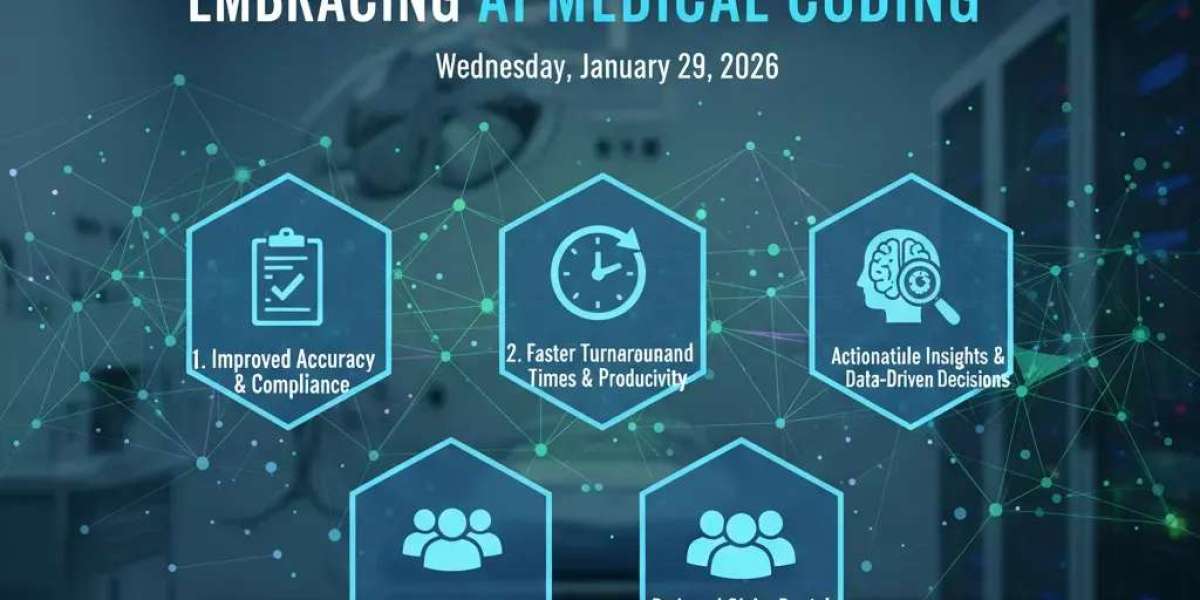
As healthcare systems face rising administrative costs, staffing shortages, and increasing regulatory complexity, many organizations are turning to AI medical coding to modernize their revenue cycle operations. Artificial intelligence is no longer a future concept—it’s actively transforming how medical coding is performed, audited, and optimized across hospitals and large provider networks.
Below are five key reasons health systems are rapidly embracing AI-powered medical coding solutions.
1. Improved Coding Accuracy and Compliance
Accurate coding is critical for proper reimbursement and regulatory compliance. AI medical coding systems use natural language processing (NLP) and machine learning to analyze clinical documentation and assign the most appropriate ICD-10, CPT, and HCPCS codes.
By continuously learning from historical data and payer feedback, AI tools help:
- Reduce human coding errors
- Minimize undercoding and overcoding
- Improve adherence to payer and CMS guidelines
This leads to fewer claim denials and stronger audit readiness.
2. Faster Turnaround Times and Increased Productivity
Manual coding is time-consuming, especially in high-volume hospital settings. AI medical coding dramatically accelerates the coding process by automating routine cases and prioritizing complex encounters for human review.
Health systems benefit from:
- Faster chart-to-bill cycles
- Reduced coding backlogs
- Higher coder productivity without increasing headcount
This speed directly improves cash flow and operational efficiency.
3. Addressing the Medical Coding Workforce Shortage
The healthcare industry continues to face a shortage of certified medical coders, particularly for inpatient and specialty coding. AI helps bridge this gap by acting as a coding assistant rather than a replacement.
- AI-enabled workflows allow:
- Coders to focus on complex and high-risk cases
- New coders to onboard faster with AI guidance
- Teams to manage larger workloads with fewer resources
This hybrid model supports scalability without sacrificing quality.
4. Reduced Claim Denials and Revenue Leakage
Claim denials remain one of the biggest challenges for revenue cycle teams. AI medical coding solutions are trained to identify missing documentation, medical necessity issues, and payer-specific requirements before claims are submitted.
As a result, health systems see:
- Lower initial denial rates
- Fewer rework costs
- Improved first-pass claim acceptance
Over time, this significantly reduces revenue leakage and administrative burden.
5. Actionable Insights and Data-Driven Decision Making
Beyond coding automation, AI provides powerful analytics that help health systems identify trends and performance gaps. These insights support proactive revenue cycle management.
- AI medical coding platforms can reveal:
- Frequent denial root causes
- Documentation improvement opportunities
- Specialty-specific coding risks
- Revenue optimization trends
Leadership teams can use this data to make smarter, evidence-based operational decisions.
The Future of Medical Coding Is AI-Assisted
Health systems are not adopting AI medical coding to eliminate human expertise—but to enhance it. When combined with experienced coding professionals, AI delivers higher accuracy, faster workflows, and stronger financial performance.
As regulatory requirements grow more complex and margins tighten, AI-assisted medical coding is becoming a strategic necessity, not a luxury.
Health systems that invest early in AI-driven coding solutions position themselves for long-term efficiency, compliance, and revenue stability.