
They think about generals, uniforms, battlefields, and military victories.
History books often focus on campaigns, strategies, and the leaders who commanded armies across continents.
Yet behind every army that marched through history was another world entirely.
A world of craftsmen, merchants, families, laborers, entertainers, and ordinary people whose lives moved alongside the soldiers.
They rarely appear in history lessons.
Their names are seldom recorded.
But they were there.
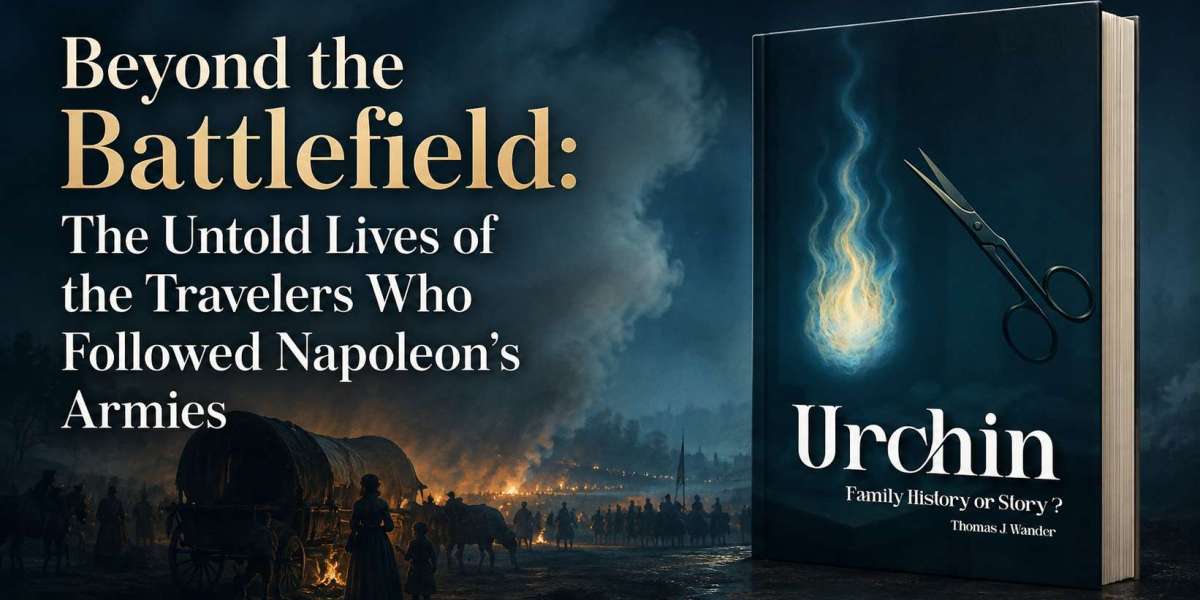
And in Urchin: Family History or Story?, author Thomas J. Wander shines a light on these forgotten lives, offering readers a rare glimpse into one of history’s most overlooked communities.
Set during the turbulent years of Napoleon Bonaparte’s military campaigns, the novel follows a young Dutch apprentice tailor named Johannes, whose life is forever altered when he is taken from his home and drawn into the vast machinery of war.
Yet while armies provide the backdrop, the heart of the story lies elsewhere.
It lies among the people who traveled behind them.
The people history often forgets.
For centuries, armies rarely moved alone.
Alongside soldiers came entire populations of civilians.
Some followed because their livelihoods depended on military movement.
Others traveled because their families were attached to the army.
Many simply had nowhere else to go.
Together, they formed temporary societies that existed on the edges of conflict.
Tailors repaired uniforms.
Cobblers fixed worn boots.
Merchants sold goods.
Laborers loaded wagons.
Families struggled to survive amid uncertainty.
Children grew up in a world where movement was constant and security was never guaranteed.
These were not the heroes celebrated in military histories.
But they were essential to the reality of life during wartime.
This rarely explored perspective is one of the most compelling aspects of Urchin.
Rather than focusing solely on battles and military leaders, Wander directs attention toward the ordinary people who experienced the consequences of those decisions.
The result is a richer and more human understanding of history.
Readers encounter a world that feels alive with complexity.
A world where survival often depends on practical skills rather than military rank.
A world where relationships matter as much as weapons.
A world where every day presents new challenges and unexpected encounters.
For Johannes, entering this environment becomes a profound education.
The life he once knew as an apprentice tailor suddenly expands into something much larger.
He encounters people from different backgrounds, cultures, and circumstances.
Some become allies.
Others become dangers.
Each encounter teaches him something about resilience, trust, and human nature.
As he navigates this unfamiliar world, readers are introduced to the remarkable diversity of individuals who existed within these traveling communities.
What emerges is a portrait of society in motion.
Not the society found in palaces or government buildings.
But the society that exists among ordinary people trying to endure extraordinary circumstances.
This focus gives the novel a distinctive voice within historical fiction.
Many war stories emphasize conflict itself.
Urchin examines what surrounds it.
The communities that form because of it.
The lives disrupted by it.
The people who must adapt to survive within its shadow.
There is something deeply relatable about this perspective.
Most readers are not descendants of generals or rulers.
They are descendants of ordinary people.
Farmers.
Tradesmen.
Mothers.
Laborers.
Craftsmen.
Individuals whose names may never have appeared in official records but whose experiences shaped future generations.
By centering these lives, Wander reminds readers that history belongs to everyone.
Not just those who held power.
Not just those who commanded armies.
But also those who lived through the consequences of decisions made far above them.
The novel also highlights an important reality often overlooked in discussions of war.
Conflict does not affect only those who fight.
Its impact extends outward.
Families are displaced.
Communities are transformed.
Lives are interrupted.
Entire populations must adapt to circumstances beyond their control.
These themes resonate strongly even today.
Although Urchin is set more than two hundred years ago, its exploration of displacement, uncertainty, and resilience feels remarkably contemporary.
The human experience remains recognizable.
People continue to search for stability amid change.
They continue to build communities under difficult circumstances.
They continue to find ways to endure.
That universality is part of what makes the novel so engaging.
It transforms historical events into deeply human experiences.
Readers may come for the historical setting, but they stay for the people.
The forgotten travelers.
The craftsmen.
The families.
The individuals whose stories deserve to be remembered.
Ultimately, Urchin: Family History or Story? invites readers to look beyond the battlefield and consider a broader view of history.
It asks us to remember those who traveled alongside great events without ever controlling them.
Those who survived through skill, determination, and adaptability.
Those who carried their lives forward despite uncertainty.
And those whose stories, though often absent from history books, remain every bit as important as the battles themselves.
For more information about Urchin: Family History or Story? or to schedule an interview with Thomas J. Wander, please contact:
Media Contact:
Name: Thomas Wander
Amazon: Urchin: Family History or Story?
About Thomas J. Wander:
Thomas J. Wander is an author whose work explores family history, overlooked historical experiences, and the resilience of ordinary people navigating extraordinary events. Drawing inspiration from stories passed down through generations, he brings forgotten perspectives to life through rich historical storytelling and compelling human narratives.