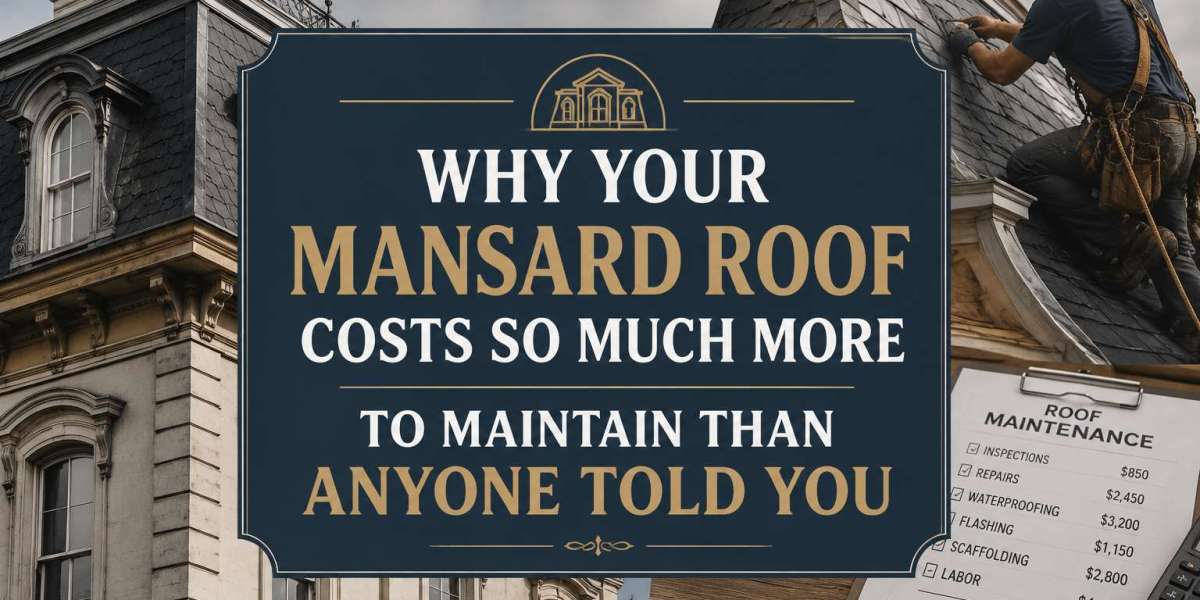
There's a specific moment in many Second Empire home ownership stories when reality catches up with romance. The roof that looked so distinctive and elegant from the street finally reaches a point where it needs attention, and the contractor's bid arrives with a number that's roughly double what would be quoted for a standard pitched roof on any neighboring house.
This isn't contractor overcharging, it's the practical reality of maintaining a complex architectural form that was designed when labor and materials were cheap, maintenance frequency was higher and shorter-lived, and the whole calculation of what cost justified which design choice was completely different from how we think about it now.
The mansard roof problem nobody mentions until they own one
A mansard roof, the defining feature of Second Empire architecture, is elegant precisely because it's complicated. It has two slopes on each side, the lower steep and the upper gentle, creating the distinctive profile that made these buildings iconic symbols of 19th-century urban success. That shape, which looks beautiful, requires multiple unique angles, multiple flashing points, dormer windows breaking through the lower slope, and details that have to be handled individually rather than as part of a standard repeating pattern.
A standard gable or hip roof gets installed with a rhythm: the same angle, the same materials, the same process repeating across the whole surface. Maintenance is straightforward because the surface is straightforward. A mansard breaks that pattern. Every valley, every transition, every dormer window is a place where water can pool or find a seam. The complexity that gave the building its presence is the same thing that makes it expensive to maintain.
The dormer window tradeoff
Those dormer windows that punctuate the lower mansard slope aren't just decoration, they're functional elements that brought light and living space into what would otherwise be attic storage. The tradeoff was that every dormer window creates a complex flashing situation where roof meets wall. One dormer, fine. Five dormer windows across a long mansard facade, and you've got five different flashing situations that can leak, five areas where ice dams can form differently, five spots where maintenance costs are concentrated.
Original Second Empire homes were often built for owners wealthy enough to maintain them actively, with regular roof inspections, regular repairs, and labor costs that didn't stop them from being proactive. A modern owner carrying a mortgage doesn't have that same economics. Deferred maintenance on a simple roof is an annoyance. Deferred maintenance on a mansard becomes expensive very quickly.
Material authenticity versus practical replacement
The original materials on a Second Empire roof were often slate, sometimes tile, sometimes standing seam metal, materials that last longer than modern asphalt shingles but require skilled, expensive labor to install. Modern replacement options exist, including high-quality architectural shingles designed to approximate the appearance of slate or tile. The aesthetic tradeoff is real, but the cost and maintenance difference is also real.
A restoration architect or a purist wants to see authentic materials. A practical homeowner wants the roof to not leak and to be maintainable by any roofer without requiring specialist knowledge. These aren't always compatible goals, and the cost difference between them is significant enough that it often drives decisions about other parts of the building.
The ornament maintenance problem
Beyond the roof, the decorative elements that define Second Empire style, the ornate iron cresting, the elaborate cornices, the detailed window surrounds, are expensive to maintain because they're hard to maintain. Ornate ironwork needs paint maintenance, or it rusts. Detailed plasterwork and moldings are vulnerable to water damage and require careful repair or replacement. Decorative tile work cracks and chips.
A simple, unadorned building is cheaper to maintain because there's less surface area, less detail, less to go wrong. A building where decoration is part of the structural integrity, where every element is visible and matters to the overall composition, is more expensive to maintain because every element needs to be kept in reasonable condition or the whole effect degrades.
Why they stopped building this way
Second Empire fell out of favor not primarily for style reasons but for practical ones. By 1880, architectural preferences were shifting toward simpler forms, flatter roofs, less ornamentation, designs that were cheaper to build and cheaper to maintain. The shift wasn't entirely about taste, it was about cost-benefit analysis. A building that required constant maintenance and specialized skill wasn't as economically sensible once labor got more expensive and material standardization made simpler designs cheaper.
If you actually own one of these buildings
The reality is that maintaining a Second Empire home authentically is expensive, and that's not changing. The question is usually how much authenticity to preserve versus how much practical compromise to make. Some owners decide to maintain the exterior character completely while making the interior thoroughly modern and efficient. Others gradually update elements as they fail, choosing practical replacements over authentic ones. A few have the resources and commitment to maintain everything to original standards.
Understanding what actually defines Second Empire architecture, which elements are genuinely essential to the style and which are just products of the era, helps inform those decisions. There's a comprehensive guide to Second Empire architecture and its key features that covers which elements are truly defining and which could, in principle, be updated without losing the essential character.
The honest conversation before buying
If you're considering a Second Empire property, the beautiful exterior should come with a realistic conversation about what that actually costs to maintain. The building's distinction is also its maintenance burden. Some people accept that tradeoff happily. Some discover halfway through ownership that they didn't fully calculate what they were signing up for. The ones who are satisfied are usually the ones who made that decision consciously, knowing what they were committing to rather than discovering it later when a major system starts failing.
The buildings that have lasted as Second Empire properties are usually the ones where someone made the economics work, either by having genuine resources to maintain them well, or by making strategic compromises that kept them livable and distinctive without trying to preserve every original detail at all costs.