Rising Importance of Waste-to-Energy in Southeast Asia
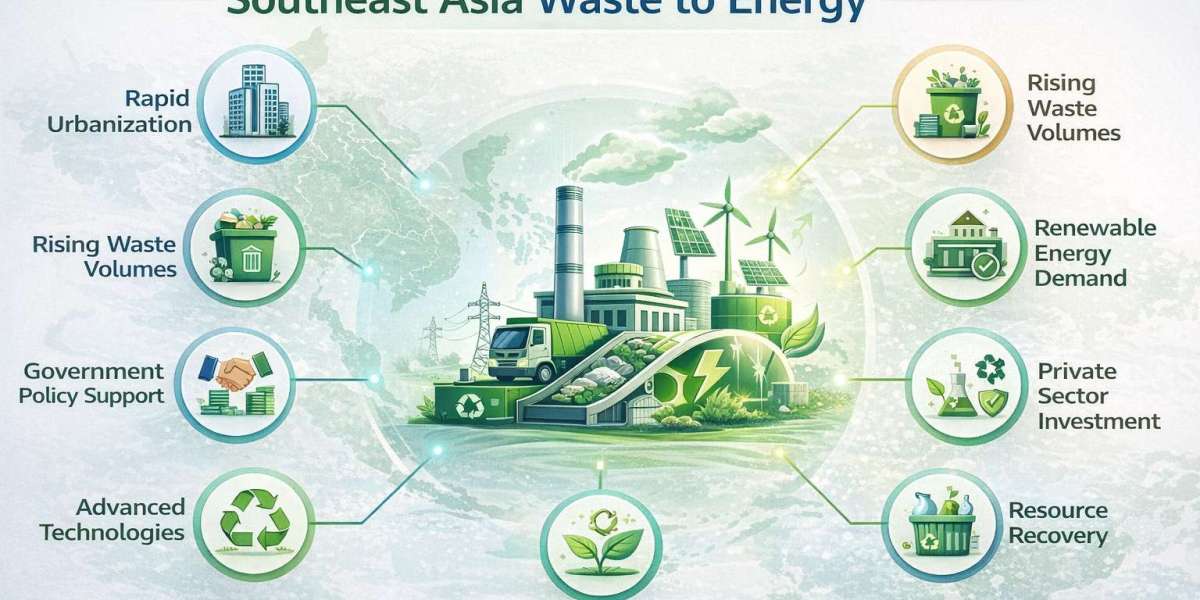
The southeastern part of Asia is presently undergoing fast urbanization, population increase, and industrialization. All these contribute to the pressure mounting on the existing municipal waste management infrastructure. The conventional landfilled waste disposal technology has been rendered increasingly inefficient owing to lack of land, associated dangers, and increasing operation costs. It is in this setting that waste-to-energy technology is being increasingly sought after.
Unlike traditional waste treatment, WtE makes it possible for cities to produce energy from the normally unrecyclable waste that will end up in landfills. With the change in policies towards aligning waste policies with the need to combat climate change, WtE is no longer a supplementary approach but a foundational one.
Market Outlook and Growth Trajectory
The Southeast Asia waste-to-energy sector has entered a decisive growth phase supported by policy clarity and project execution. The market was valued at approximately USD 1.9 billion in 2025 and is forecast to reach nearly USD 3.88 billion by 2032. This expansion represents a compound annual growth rate (CAGR) of around 10.9% during 2026–2032, reflecting both rising waste volumes and improved bankability of projects.
Major cities all across Indonesia, Vietnam, Thailand, Malaysia, and the Philippines are generating a quantity of trash beyond the landfill capacity, which serves as a steady source of biomass materials for any Waste to Energy facility. On the other hand, improved regulations, such as auction systems, feed-in tariffs, or power development plans, are lowering investors' uncertainty.
In current developments, the Southeast Asia Waste to Energy Market is being driven by long-term municipal concessions, public-private partnerships, and the transition towards larger plants to function as base-load power plants instead of intermittent power plants.
Urban Waste Pressure and Policy Alignment
Urbanization in particular is the major factor in the adoption of WtE technology in the SEA market. Large urban areas in the region, such as Jakarta, Manila, Bangkok, Hanoi, and Ho Chi Minh City, produce thousands of tons of waste per day. This does not only put pressure on waste collection infrastructure, but in some instances, open dump sites and landfills pose threats to the environment and public health.
Policy harmonization is further accentuating this trend. Nations in the region are incorporating WtE solutions within their overall waste and energy policies, ensuring easier approvals and economically favorable conditions. Green energy tenders, development plans for the electricity sector, and waste supply obligations are helping to enhance prospects.
From the municipal point of view, what they need is predictable waste management, and from the utility point of view, they require despatchable renewables, including solar, and wind. The increasing alignment of waste management and energy planning is leading to widespread adoption.
Technology Evolution and Digital Integration
Thermal technologies—particularly modern incineration and gasification—continue to dominate WtE deployment due to their ability to handle mixed, moisture-rich municipal waste at scale. These systems offer high volume reduction, stable energy output, and proven operational performance in dense urban settings.
At the same time, digitalization is reshaping how WtE facilities operate. Advanced control systems, artificial intelligence, and real-time monitoring are improving combustion efficiency, emissions management, and maintenance planning. Predictive analytics allow operators to optimize calorific value inputs and detect anomalies before they escalate into operational disruptions.
Smart waste-collection platforms are also strengthening feedstock reliability. Digital tracking of waste streams, sensor-enabled bins, and data-driven routing are reducing contamination and improving consistency of input materials. These improvements lower operating risks and enhance overall plant performance.
Following these developments, the Southeast Asia Waste to Energy Market is evolving toward more efficient, transparent, and technology-driven operations that align with broader smart-city initiatives.
Financial Barriers and Structural Challenges
Despite strong fundamentals, high capital intensity remains a major barrier to WtE expansion. Large-scale plants require significant upfront investment for civil works, advanced flue-gas treatment, grid interconnection, and land acquisition. For many municipalities, such projects exceed available budgets without external financing support.
Financing challenges are compounded by revenue risks linked to electricity tariffs, waste-supply guarantees, and long concession tenures. Inconsistent pricing mechanisms and delays in approvals can weaken project bankability, especially for first-time developments in emerging cities.
While multilateral institutions and development banks are increasingly supporting WtE initiatives, wider adoption will depend on standardized procurement frameworks, predictable tariffs, and stronger risk-sharing mechanisms between public and private stakeholders.
Segmentation Insights: Feedstock and Technology
Municipal solid waste (MSW) represents the dominant feedstock segment due to its volume, concentration in urban areas, and structured collection systems. Residential and commercial waste streams provide steady, predictable input that supports continuous plant operation. Unlike agricultural or industrial waste, MSW is less seasonal and easier to aggregate at scale.
From a technology perspective, thermal solutions account for the largest share of installed capacity. Incineration and gasification systems are favored for their robustness, ability to handle heterogeneous waste, and compatibility with emissions standards. These plants often generate multiple revenue streams through electricity sales, steam supply, and refuse-derived fuel.
Biological and physical technologies play a complementary role, particularly for organic waste treatment and pre-processing, but they remain secondary in large urban deployments.
Key Companies and Competitive Landscape
The market in Southeast Asia is characterized by the presence of global engineering majors along with regional specialists. These players competing in the market are based on reliability factors such as technology, emissions, integration, and complex project execution on concessions.
Major players operating in the market include Mitsubishi Heavy Industries, Keppel Corporation, PT Yokogawa Indonesia, Veolia Environment, SUEZ Group, CNIM Group, Babcock & Wilcox Enterprises, and Global Green Power, among others. The key players in the industry possess expertise in thermal treatment, automation, as well as environmental compliance.
Their participation has contributed to improving technology standards in this region and has assisted in promoting knowledge transfer and operational best practices.
Regional Leadership and Long-Term Outlook
Singapore remains the regional benchmark for waste-to-energy deployment, driven by land scarcity, strict environmental regulation, and integrated national planning. Its experience demonstrates how WtE can function as critical urban infrastructure rather than a standalone waste solution.
Looking ahead, the Waste-to-Energy industry in Southeast Asia is poised for positive growth as more waste is generated and with scarce land for disposal in landfills. To this end, more alignment with existing regulations and technology innovations should shape future adoption rates for developing cities.
Strategic market intelligence offered by institutions like MarkNtleAdvisors plays an important role in helping market participants overcome statutory complexity, explore valid project formats, and align their investment strategies with the prevailing regional trend patterns.
In a rather comprehensive analysis, waste-to-energy technology, as a whole, appears to have a significant prospective part to play in this transformation of Southeast Asia's cities through 2032.