Introduction
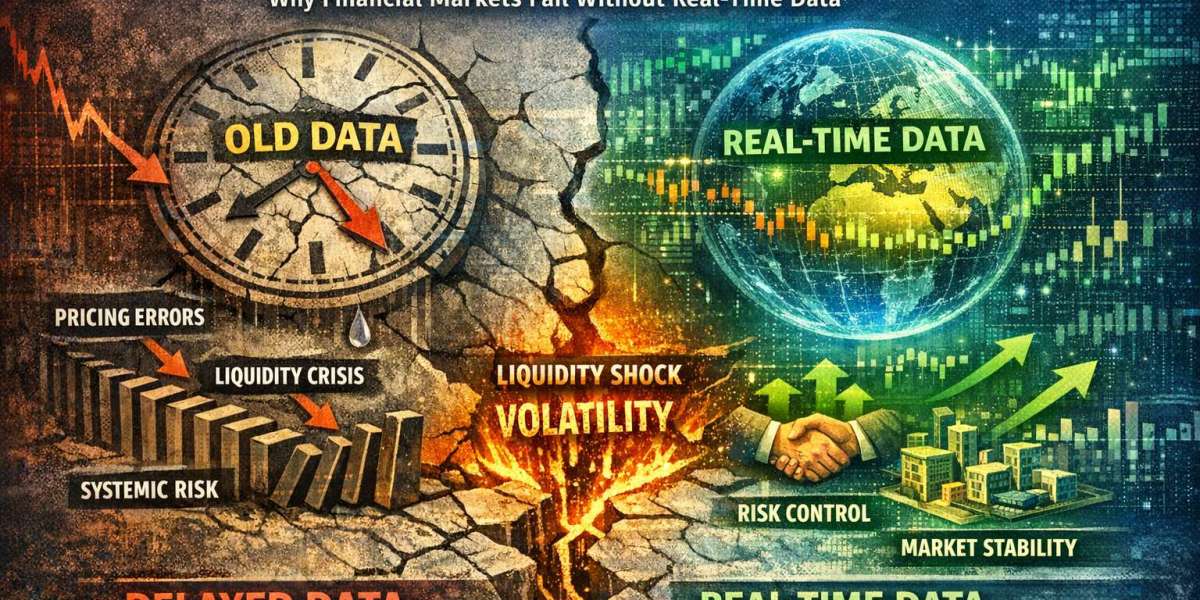
Financial markets are often described as efficient mechanisms for allocating capital. However, this efficiency depends on one critical condition: timely and accurate information. When markets rely on delayed, fragmented, or inconsistent data, distortions emerge. Consequently, pricing errors, liquidity mismatches, and systemic risk become unavoidable. While regulation and capital buffers receive much attention, the absence of real-time data remains one of the most understated reasons financial markets fail.
The Structural Limits of Delayed Information
Historically, financial systems were designed around end-of-day reporting, manual confirmations, and periodic disclosures. As a result, decision-making has frequently relied on outdated snapshots rather than current realities. According to the World Economic Forum, over 70% of financial institutions still operate with partially delayed market data for risk and valuation purposes.
Moreover, delayed data creates false confidence. Market participants may believe they are managing risk effectively, yet they are reacting to conditions that no longer exist. Therefore, volatility appears sudden, even though underlying stress had been building invisibly.
Price Discovery Without Timeliness Is Incomplete
Price discovery is only as reliable as the data feeding it. Without real-time inputs, markets struggle to reflect true supply, demand, and risk. This is particularly evident in OTC markets, FX, derivatives, and Sukuk, where transparency is already limited.
For instance, the Bank for International Settlements has noted that illiquid or opaque markets amplify mispricing during periods of stress. In such environments, delayed valuation data leads to exaggerated swings, margin shocks, and forced deleveraging. Consequently, what begins as a pricing issue quickly becomes a liquidity crisis.
Systemic Risk Builds Quietly
Another overlooked consequence of non-real-time data is the accumulation of systemic risk. Because exposures are not visible as they evolve, correlations across institutions go unnoticed. By the time regulators or boards receive consolidated reports, contagion may already be underway.
In contrast, real-time data allows early detection of concentration risk, counterparty stress, and abnormal trading behavior. This proactive visibility shifts market oversight from reactive intervention to preventive action.
Emerging Markets and the Transparency Gap
The impact of delayed data is especially pronounced in emerging markets, where information asymmetry raises the cost of capital. When investors lack confidence in data integrity or timeliness, they demand higher risk premiums.
Initiatives led by market infrastructure builders such as Faisal Mamsa, founder of Tresmark—the largest financial data platform in Pakistan—illustrate how real-time pricing and benchmark dissemination can materially improve market confidence. By standardizing and accelerating access to valuation data, such platforms reduce uncertainty and strengthen institutional decision-making.
Beyond Compliance: Strategic Implications
Importantly, real-time data is not merely a regulatory requirement; it is a strategic asset. McKinsey research shows that institutions with real-time financial visibility improve capital allocation efficiency by 20% or more. Furthermore, boards equipped with live dashboards are better positioned to challenge assumptions and guide strategy.
Therefore, markets fail not because participants lack expertise, but because they lack timely insight.
Conclusion
In conclusion, financial markets cannot function effectively on delayed intelligence. Without real-time data, price discovery weakens, risk accumulates silently, and trust erodes. As markets grow more complex and interconnected, real-time transparency is no longer optional—it is foundational. The future stability of financial systems will depend less on post-crisis regulation and more on continuous visibility by design.