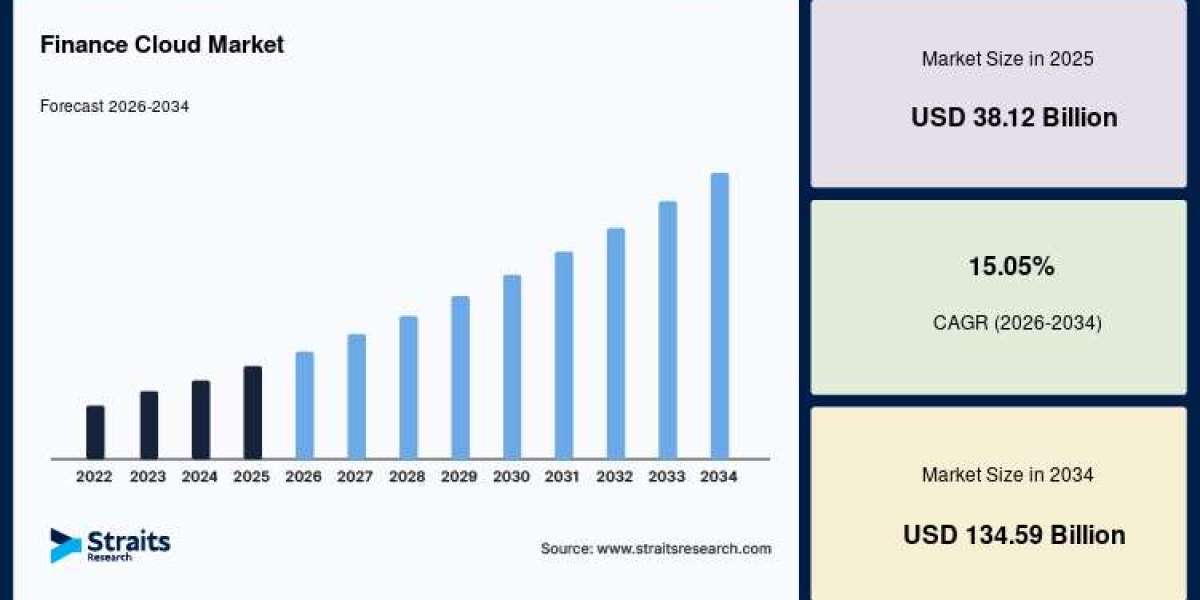
The global finance cloud market is witnessing rapid growth due to increasing digital transformation across financial institutions, rising adoption of cloud-based banking solutions, growing demand for scalable IT infrastructure, and stringent regulatory requirements for secure financial data management. The global finance cloud market size was valued at USD 38.12 billion in 2025 and is projected to grow from USD 43.86 billion in 2026 to USD 134.59 billion by 2034, registering a CAGR of 15.05% during the forecast period (2026–2034).
Finance cloud refers to cloud computing platforms and services specifically designed for banks, insurance companies, investment firms, fintech companies, and other financial institutions. These platforms support core banking operations, payment processing, fraud detection, customer relationship management, regulatory compliance, financial analytics, and risk management while providing enhanced scalability, security, and operational efficiency.
The increasing adoption of artificial intelligence, big data analytics, open banking, and digital financial services continues to drive the expansion of the global finance cloud market.
Market Drivers
Growing Digital Transformation in Financial Services
Banks and financial institutions are rapidly modernizing legacy systems by migrating to cloud-based platforms. Cloud technologies enable faster deployment of financial services, improved operational efficiency, and greater business agility.
Digital transformation initiatives are encouraging financial organizations to invest in cloud-native applications, automated workflows, and integrated digital banking platforms.
Rising Adoption of Cloud-Based Banking Solutions
Financial institutions are increasingly utilizing cloud platforms for core banking, loan management, customer onboarding, payment processing, and digital banking services.
Cloud infrastructure provides scalability, flexibility, and cost efficiency while enabling organizations to respond quickly to changing customer expectations.
Increasing Demand for Data Analytics
Financial organizations generate vast amounts of transactional and customer data that require advanced analytics for decision-making.
Cloud platforms provide artificial intelligence, machine learning, and big data capabilities that help institutions improve customer insights, detect fraud, optimize lending decisions, and enhance operational performance.
Expansion of Fintech Ecosystems
The rapid growth of fintech companies is driving demand for cloud-based financial infrastructure.
Cloud platforms enable fintech organizations to launch innovative payment solutions, digital wallets, lending platforms, wealth management applications, and embedded finance services with reduced infrastructure costs.
Regulatory Compliance and Security
Financial institutions must comply with evolving regulatory frameworks governing data privacy, cybersecurity, and operational resilience.
Modern finance cloud platforms incorporate encryption, identity management, disaster recovery, compliance monitoring, and advanced cybersecurity capabilities to support regulatory requirements.
For Detailed Insights, Visit:
https://straitsresearch.com/report/finance-cloud-market
Market Challenges
Cybersecurity Risks
Financial institutions remain attractive targets for cyberattacks due to the highly sensitive nature of financial information.
Maintaining secure cloud environments requires continuous investment in cybersecurity technologies, threat monitoring, and identity management.
Data Privacy Regulations
Organizations operating across multiple countries must comply with diverse financial regulations and data protection laws, increasing implementation complexity.
Legacy System Integration
Many banks continue to operate legacy IT infrastructure, making cloud migration technically complex and resource-intensive.
Vendor Lock-In Concerns
Financial institutions may face challenges when migrating between cloud providers due to proprietary technologies, data migration complexity, and contractual limitations.
Market Segmentation
The finance cloud market is segmented based on deployment model, service type, organization size, application, and region.
By Deployment Model
The market is categorized into:
Public Cloud
Private Cloud
Hybrid Cloud
Hybrid cloud accounts for the largest market share due to its ability to combine security, flexibility, regulatory compliance, and operational efficiency.
By Service Type
The market includes:
Infrastructure as a Service (IaaS)
Platform as a Service (PaaS)
Software as a Service (SaaS)
Software as a Service dominates the market owing to increasing adoption of cloud-based financial management, customer relationship management, and enterprise resource planning solutions.
By Organization Size
The market is segmented into:
Large Enterprises
Small and Medium Enterprises
Large enterprises account for the largest market share because of extensive digital transformation initiatives and large-scale cloud migration projects.
By Application
The market includes:
Core Banking
Financial Analytics
Risk and Compliance Management
Customer Relationship Management
Fraud Detection and Prevention
Payment Processing
Wealth Management
Others
Core banking applications represent a significant market segment due to increasing modernization of banking infrastructure and digital banking services.
By Region
The market is analyzed across:
North America
Europe
Asia-Pacific
Latin America
Middle East & Africa
Regional Insights
North America
North America holds a significant share of the finance cloud market due to advanced digital banking infrastructure, widespread cloud adoption, strong fintech ecosystems, and the presence of leading cloud service providers.
Financial institutions across the United States and Canada continue to invest in artificial intelligence, cloud-native banking platforms, and cybersecurity technologies.
Europe
Europe represents a major market supported by open banking regulations, increasing digital payment adoption, expanding fintech innovation, and stringent data protection standards.
Countries such as the United Kingdom, Germany, France, and the Netherlands continue to modernize financial infrastructure through cloud-based technologies.
Asia-Pacific
Asia-Pacific is expected to witness the fastest growth owing to rapid digital banking expansion, increasing smartphone penetration, growing fintech investments, and government-led digital finance initiatives.
China, India, Japan, Singapore, South Korea, and Southeast Asian countries are significantly investing in cloud infrastructure to support digital payments, online banking, and financial inclusion.
Latin America
Latin America is experiencing steady market growth driven by increasing adoption of digital financial services, expanding mobile banking, and rising fintech investments.
Middle East & Africa
The Middle East & Africa market is gradually expanding due to banking sector modernization, smart government initiatives, increasing cloud adoption, and growing digital payment ecosystems.
Technology Trends and Market Opportunities
The finance cloud market is evolving through innovations in artificial intelligence, machine learning, blockchain, edge computing, cloud-native banking platforms, robotic process automation, and generative AI.
Artificial intelligence is transforming financial operations by enabling predictive analytics, automated credit scoring, fraud detection, customer service automation, and intelligent financial planning.
Blockchain technology is increasingly being integrated with finance cloud platforms to improve transaction transparency, digital identity verification, cross-border payments, and smart contract execution.
Generative AI is emerging as a powerful tool for automating financial reporting, compliance documentation, customer engagement, and personalized financial advisory services.
Cloud-native banking platforms are enabling financial institutions to rapidly deploy new digital products, integrate with fintech partners through APIs, and support open banking initiatives.
Growing investments in digital banking, embedded finance, decentralized finance (DeFi), cybersecurity, regulatory technology (RegTech), and artificial intelligence-driven financial services are expected to create substantial opportunities for market participants during the forecast period.
Key Players Analysis
The global finance cloud market is highly competitive, with leading cloud service providers and enterprise software companies focusing on artificial intelligence, cloud-native financial platforms, cybersecurity, and regulatory compliance solutions.
Major companies operating in the market include:
Amazon Web Services, Inc.
Microsoft Corporation
Google Cloud
Oracle Corporation
IBM Corporation
SAP SE
Salesforce, Inc.
VMware, Inc.
Alibaba Cloud
Temenos AG
These companies continue to invest in cloud infrastructure, AI-powered financial solutions, cybersecurity platforms, open banking technologies, and strategic partnerships with financial institutions. Continuous product innovation and expansion of cloud service capabilities are strengthening their positions in the global finance cloud market.
Conclusion
The global finance cloud market is expected to experience significant growth through 2034, driven by increasing digital transformation, expanding cloud adoption across financial institutions, rising demand for data analytics, and growing fintech innovation.
Advancements in artificial intelligence, blockchain, cloud-native banking, generative AI, and cybersecurity technologies are transforming financial services worldwide. As financial institutions continue to modernize operations, improve customer experiences, and strengthen regulatory compliance, demand for finance cloud solutions is expected to grow substantially throughout the forecast period.
Related Report
Cloud Computing Market
https://straitsresearch.com/report/cloud-computing-market
About Us
Straits Research is a leading market research and intelligence organization specializing in analytics, advisory services, and comprehensive market research reports across multiple industries.
Contact Us
Email: [email protected]
U.S. Tel: +1 646 905 0080
U.K. Tel: +44 203 695 0070