
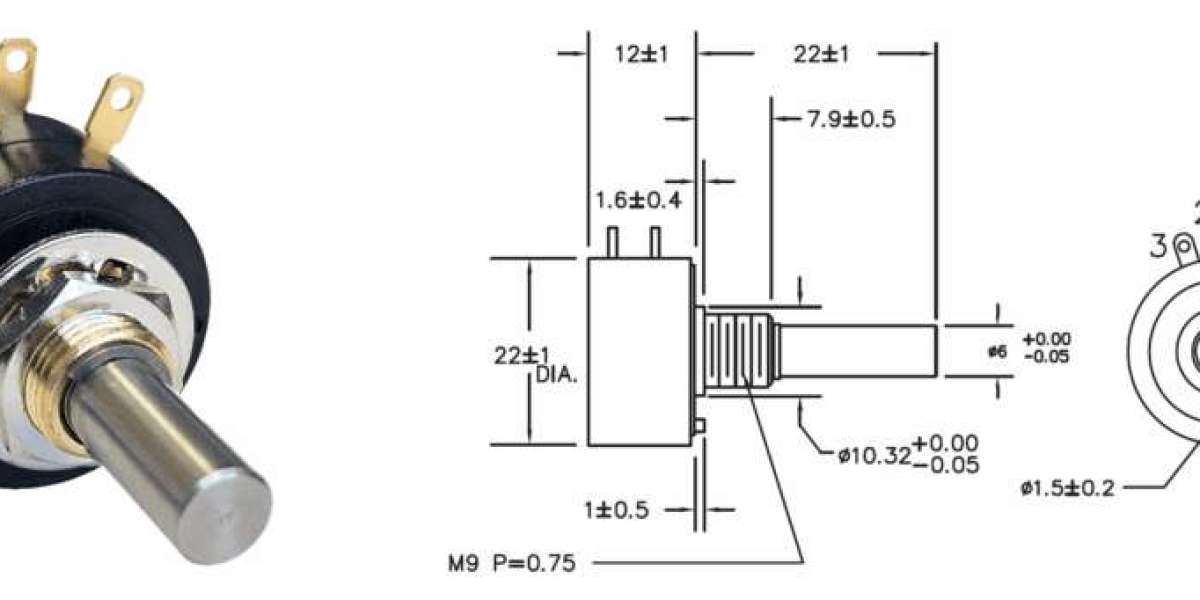
The decision between a Single-Turn Potentiometer and a Multi-Turn Potentiometer reduces to a single trade-off: how finely the output must be set against how quickly and simply it must be adjusted. A single-turn unit covers its full range in one rotation, which makes adjustment fast and the part inexpensive while limiting resolution. A multi-turn unit spreads that same range over several rotations, delivering far finer resolution at the cost of more rotations, greater complexity, and a higher price. Picking correctly means defining what the application demands of resolution, adjustment, space, and budget before reaching for either.
Single-Turn vs Multi-Turn Potentiometer: The Resolution Trade-Off
Both parts share the same resistive divider principle and can use identical elements. What differs is how the range maps to rotation, and that mapping drives the entire decision. In a Single-Turn Potentiometer, the full electrical range sits within roughly three hundred degrees of one turn, so each degree of shaft movement produces a relatively large change in output. In a Multi-Turn Potentiometer, the same range is distributed across several turns, so each degree of movement changes the output far less, yielding proportionally finer control. A ten-turn unit resolves a setting about ten times more finely than a single-turn unit over the same range. Every other factor in the choice follows from this relationship.
When to Use a Single-Turn Potentiometer
A Single-Turn Potentiometer is the better choice wherever speed and simplicity of adjustment outweigh fine resolution. It suits panel controls, an operator sets by feel, single-axis joystick sensing, volume and tone adjustment, and rotary position feedback over a limited angle. Its single rotation moves an operator from one extreme to the other in one motion, which is valuable where adjustments are frequent or time-sensitive. It also costs less, uses a simpler mechanism, and integrates with minimal effort. Where the process tolerates the coarser resolution that one turn imposes, paying for anything more refined adds cost without return.
When to Use a Multi-Turn Potentiometer
A Multi-Turn Potentiometer is the right choice wherever a fine, repeatable setting is the priority. Calibration, trimming, precision setpoints, and position feedback on shafts that turn through multiple revolutions all depend on the finer resolution that spreading the range across many turns provides. Paired with a turns-counting dial, it lets an operator return to an exact value and read the setting directly. The trade is clear: it costs more, adds mechanical complexity, and requires more rotation to traverse the range, so it suits considered, infrequent adjustment far better than rapid operator control. Where precision is the deciding requirement, that trade is worth making.
Key Factors for Choosing Between Single-Turn and Multi-Turn Potentiometers
Four factors govern the decision, and each can be quantified before any part is specified.
Resolution Requirements
Resolution is the dominant factor. If the application must set or read a value to a fine increment, multi-turn is the natural answer; if coarse positioning suffices, single-turn covers it at lower cost. Quantifying the smallest meaningful adjustment the process needs settles this question quickly.
Adjustment Speed and Frequency
How often the control moves, and how fast, weighs heavily. Frequent, rapid changes favor the single rotation of a single-turn part, while occasional, deliberate calibration favors the controlled fineness of a multi-turn part. An interface that must sweep its full range many times a shift is poorly served by a unit that needs ten turns to do so.
Panel Space and Mounting Depth
A multi-turn unit and its counting dial occupy more depth and demand a mounting that tolerates extended rotation, while a single-turn unit fits tighter panels and simpler couplings. The mechanical envelope sometimes decides the choice on its own, independent of the electrical requirement.
Cost and Production Volume
A single-turn part costs less to buy and integrate, which is significant across high unit volumes. A multi-turn part justifies its higher price only where its resolution is genuinely used. Specifying a multi-turn unit for an application that never exploits the fine adjustment wastes both cost and panel space.
How to Choose Between a Single-Turn and Multi-Turn Potentiometer
A short sequence settles the choice in order of importance:
- Define the finest adjustment the application genuinely requires.
- Estimate how frequently and how quickly the control will be adjusted.
- Confirm the panel space and mounting depth available.
- Weigh the unit cost against the production volume.
Where fine resolution and exact, repeatable settings dominate, a Multi-Turn Potentiometer is the answer. Where quick, broad adjustment, tight space, and low cost dominate, a Single-Turn Potentiometer is the better fit. In most designs, these factors point clearly in one direction once the required resolution is quantified.
Common Mistakes in Single-Turn and Multi-Turn Potentiometer Selection
Two errors recur. The first is over-specifying, fitting a multi-turn unit and its dial, where coarse adjustment was all the process needed, which adds cost, bulk, and slower operation for no gain. The second is under-specifying, choosing a single-turn unit for a calibration or setpoint task that demands fine resolution, then fighting its coarseness with awkward gearing or extra operator effort. Both stem from selecting the component before quantifying the resolution and adjusting the application requirements. Defining those two needs first prevents either mistake.
Sourcing the Right Single-Turn or Multi-Turn Potentiometer
Once the resolution and adjustment needs are fixed, the task that remains is sourcing a part that meets them across temperature, life, and load. ETI Systems, a control-product manufacturer since 1958, offers both single-turn and multi-turn precision potentiometers, with conductive plastic, wirewound, and hybrid elements, a range of resistance values and linearity grades, and turns-counting dials for multi-turn setpoint work. Matching the defined requirement to a specific part, single-turn or multi-turn, is where the catalog and custom options earn their keep.
Frequently Asked Questions
How do I decide between a single-turn and a multi-turn potentiometer?
Start with the finest adjustment the application requires. If it needs precise, repeatable settings, choose multi-turn; if coarse adjustment is enough, choose single-turn. Then, weigh adjustment speed, panel space, and cost, which usually confirm the choice the resolution requirement points to.
Is a multi-turn potentiometer always more accurate?
It offers finer resolution because the range is spread over several turns, but accuracy in the sense of linearity and tolerance depends on the element and grade, not the turn count. A high-grade single-turn part can be very accurate within its coarser resolution. Multi-turn wins specifically where fine setting resolution is needed.
When is a single-turn potentiometer the better choice?
When adjustment must be quick, panel space is tight, cost is high across volume, and the process tolerates coarser resolution. Panel controls, operator setpoints, volume adjustment, and limited-angle position feedback are typical cases where a single-turn part is the sensible fit.
Why would I pay more for a multi-turn potentiometer?
The higher price buys finer resolution and the ability to return to an exact setting, which calibration, trimming, and precision setpoints require. It is justified only where that resolution is genuinely used; for coarse adjustment, it adds cost without benefit.
Can a single-turn potentiometer be used for calibration?
It can for coarse trimming, but its full range sits in one rotation, so fine calibration is difficult and imprecise. Tasks that demand setting a value to a small, repeatable increment are far better served by a multi-turn part, often with a counting dial.
Does turn count affect how the potentiometer is wired?
No. Both single-turn and multi-turn potentiometers wire the same way, as a three-terminal divider or a two-terminal rheostat. The turn count changes only how much shaft rotation covers the range, not the electrical connection.
What is a turns-counting dial, and why pair it with a multi-turn potentiometer?
A turns-counting dial displays shaft position across multiple rotations, letting an operator read and return to an exact setting. Paired with a multi-turn potentiometer, it makes the fine resolution usable in practice by giving a precise, repeatable reference for each value.