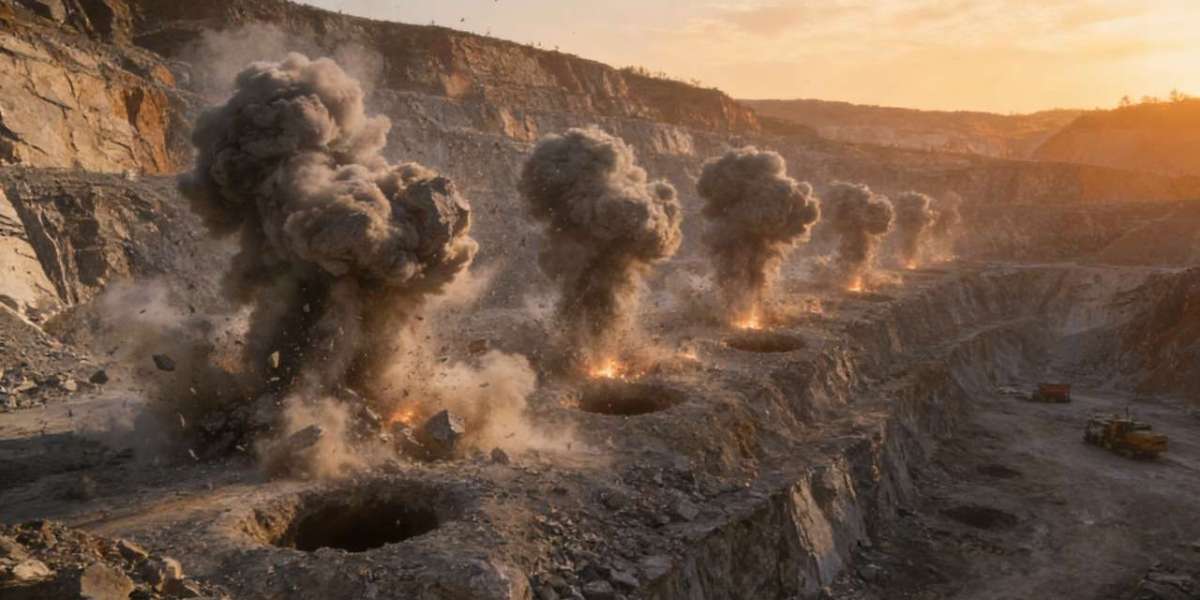
Achieving optimal rock fragmentation is the "holy grail" of mining and quarrying. In hard rock formations, poor fragmentation leads to a domino effect of costs: increased wear on crushers, higher fuel consumption for loaders, and the expensive necessity of secondary blasting.
To solve this, industry experts are increasingly moving away from traditional dry agents in favor of high-performance emulsion explosive solutions. Here is how you can optimize your blast results by leveraging the unique properties of emulsions.
1. Leverage High Velocity of Detonation (VOD)
Hard rock requires high crystalline energy to snap the geological bonds. Unlike ANFO, which has a variable and often lower VOD, a high-quality emulsion explosive provides a consistently high Velocity of Detonation.
Why it matters: High VOD generates a powerful shock wave that creates a dense network of micro-fractures before the gas expansion phase. In hard granite or basalt, this initial shock is what determines the final fragment size.
2. Optimize Energy Coupling in the Borehole
One of the most overlooked factors in fragmentation is "coupling"—the contact between the explosive and the rock wall.
The Emulsion Advantage: When using bulk emulsion explosive systems, like those provided by Handar Blasting, the liquid-phase explosive fills the borehole, regardless of irregularities.
Result: 100% energy transfer. This minimizes energy loss and ensures that the maximum pressure is exerted directly into the hard rock, reducing the occurrence of large, unbroken blocks at the perimeter.
3. Adjust Powder Factor with Precision
In hard rock, the "one size fits all" approach to powder factor fails. Because emulsion explosives are more energy-dense, you can fine-tune your powder factor to match the Rock Quality Designation (RQD).
Expert Tip: Use a tiered loading approach. By increasing the density of the emulsion at the bottom of the hole (the "toe"), you ensure the hardest part of the bench is successfully lifted and broken, preventing "floor toes" that slow down excavation.
4. Addressing Geology: Stemming and Timing
Even the best emulsion explosive needs the right confinement.
Stemming: Use crushed angular stone instead of drill fines to ensure the high-pressure gases from the emulsion stay in the hole longer.
Electronic Timing: Pair your emulsion with electronic detonators. Precision timing (in milliseconds) allows for "inter-hole collision," where shockwaves from adjacent holes meet to further pulverize the rock between them.
5. Environmental Resilience
Hard rock mining often involves deep pits or groundwater. Traditional explosives lose their potency or fail when damp. The inherent water resistance of emulsion explosive ensures that your energy output remains 100% consistent, even in the wettest conditions, preventing "half-shots" that result in poor fragmentation.
Optimizing fragmentation in hard rock is a science of energy management. By switching to a high-VOD emulsion explosive, you aren't just buying a product; you are investing in a more efficient downstream process. Better fragmentation means faster loading, lower crushing costs, and a safer work environment.
Looking to crush your production targets? At Handar Blasting, we specialize in providing high-stability emulsion explosive solutions and technical consulting to help you master the toughest geological challenges.