Over the past three years, Artificial Intelligence has evolved from a promising technology into a boardroom mandate. Every executive discussion seems to include AI. Every technology roadmap includes AI. Every software vendor claims to be AI-powered. Organizations across industries are launching pilots, experimenting with Generative AI, deploying copilots, and exploring automation opportunities at an unprecedented pace.
Ready to Move Beyond AI Pilots and Create Enterprise-Wide Transformation?
Discover how QKS Group helps organizations align AI initiatives with business strategy, operating models, governance, workforce readiness, and measurable outcomes.
Explore our AI Transformation services: AI Transformation Advisory Platform by QKS Group
For more information : https://qksgroup.com/ai-transformation
Yet despite the enthusiasm, a critical question remains unanswered -
Are organizations truly transforming, or are they simply deploying new technology?
The distinction matters. History is filled with examples of enterprises that invested heavily in emerging technologies without fundamentally changing how they operated. They digitized existing processes, modernized applications, and automated workflows, yet failed to create sustainable competitive advantage.
AI presents a similar risk. Many organizations are approaching AI as another technology implementation initiative. The most successful organizations, however, recognize something fundamentally different. AI is not simply a technology shift. It is a business transformation imperative.
The enterprises that thrive over the next decade will not be those that deploy the most AI tools. They will be those that successfully redesign strategy, operating models, talent, governance, and decision-making around intelligence. The future belongs to organizations that understand AI transformation is ultimately about business reinvention.
The Evolution of Enterprise Transformation
Every major technology wave has reshaped business. Mainframe computing enabled scale. Enterprise applications improved process standardization. The internet transformed customer engagement. Cloud computing accelerated agility. Digital transformation connected organizations.
Artificial Intelligence represents the next phase of this evolution. What makes AI different is its ability to influence decisions rather than merely automate transactions. Traditional technologies improved efficiency. AI improves intelligence. This distinction is profound.
When organizations can predict outcomes, automate knowledge work, personalize customer experiences, optimize decisions, and continuously learn from data, they are no longer simply improving operations.
They are changing how value is created. This is why AI transformation should not be viewed as an extension of digital transformation. It represents an entirely new transformation agenda.
Why Most AI Initiatives Fail to Deliver Enterprise Value
Despite significant investments, many organizations struggle to move beyond isolated AI successes. The reasons are surprisingly consistent.
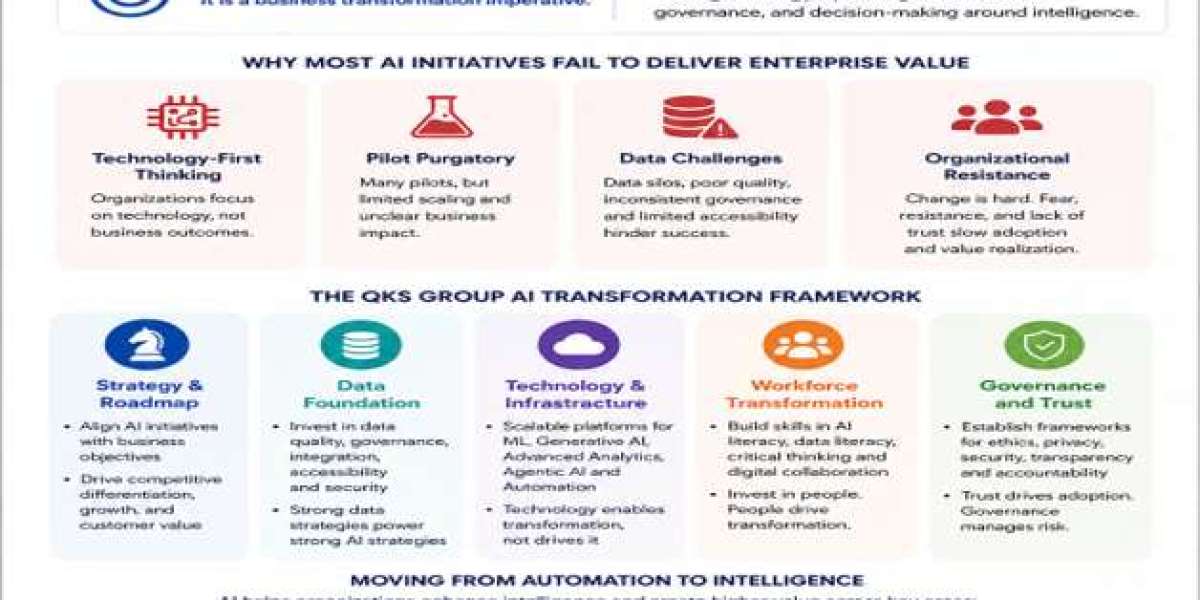
Technology-First Thinking: Many organizations begin with the technology. They ask: Which AI platform should we deploy? Which model should we use? Which use cases should we pilot? Very few begin with a more important question: What business outcomes are we trying to achieve? Technology without strategic alignment rarely creates transformational value.
Pilot Purgatory: Organizations launch dozens of pilots but struggle to scale them. Proofs of concept generate excitement. Enterprise adoption remains limited. Business impact remains unclear. This phenomenon, often called “pilot purgatory,” is one of the biggest barriers to AI transformation.
Data Challenges: AI is only as effective as the data that supports it. Many enterprises continue to struggle with - Data silos, Poor data quality, Inconsistent governance, Limited accessibility. With out a strong data foundation, AI initiatives often fail to achieve expected outcomes.
Organizational Resistance: Technology adoption is relatively easy. Behavioral change is difficult. Employees may fear displacement. Managers may resist new ways of working. Leaders may struggle to trust AI-generated recommendations. The result is slower adoption and unrealized value.
At QKS Group, we believe successful AI transformation requires a balanced focus across interconnected dimensions.
Strategy & Roadmap: AI initiatives must align with strategic business objectives. Organizations should identify where AI can create competitive differentiation, revenue growth, operational excellence, or customer value. The objective is not to implement AI. The objective is to improve business outcomes.
Data Foundation: Data remains the fuel that powers AI. Organizations must invest in - Data quality, Governance, Integration, Accessibility, Security. The strongest AI strategies are often built on the strongest data strategies.
Technology & Infrastructure: Technology platforms remain important. Organizations require scalable architectures capable of supporting - Machine learning, Generative AI, Advanced analytics, Agentic AI, Intelligent automation. Technology should enable transformation, not drive it.
Workforce Transformation: AI transformation is fundamentally a people transformation. Employees require new skills - AI literacy, Data literacy, Critical thinking, Digital collaboration, Change adaptability. Organizations that invest in workforce readiness consistently outperform those focused solely on technology deployment.
Governance and Trust: Trust is becoming one of the most important success factors in AI adoption. Organizations require governance frameworks that address: Ethics, Privacy, Security, Transparency, Accountability. Without trust, adoption remains limited. Without governance, risk increases.
Moving From Automation to Intelligence: Many organizations initially pursue AI to improve efficiency. While valuable, efficiency represents only the beginning of the opportunity. The real value emerges when organizations leverage AI to enhance intelligence.
A few relevant examples include:
Customer Intelligence: AI enables organizations to understand customer behavior, preferences, and intent at unprecedented levels. Personalization becomes scalable. Engagement becomes proactive. Customer experiences improve dramatically.
Decision Intelligence: AI can analyze vast amounts of information and identify patterns beyond human capability. Organizations gain: Faster insights, better forecasts, Improved risk management, Enhanced strategic planning
Operational Intelligence: Supply chains become more resilient. Manufacturing becomes more adaptive. Service operations become more responsive. Organizations move beyond efficiency toward optimization. This shift from automation to intelligence is where true transformation occurs.
Across industries, leading organizations are already demonstrating what successful AI transformation looks like.
Banking and Financial Services: Financial institutions are leveraging AI to transform fraud detection, customer service, credit risk management, and personalized financial advisory services. The focus is shifting from process automation to intelligent customer engagement and decision-making.
Consumer Goods: Consumer goods companies are using AI to improve demand forecasting, trade promotion optimization, pricing strategies, and supply chain resilience. AI is enabling faster responses to changing market conditions.
Manufacturing: Manufacturers are deploying AI for predictive maintenance, quality management, production optimization, and workforce productivity. The result is improved efficiency, reduced downtime, and enhanced operational resilience.
Healthcare: Healthcare providers are leveraging AI to support diagnostics, patient engagement, clinical decision-making, and operational optimization. The goal is improved outcomes alongside improved efficiency. Across industries, the pattern is clear. Organizations creating the greatest value are integrating AI into business strategy rather than treating it as a standalone technology initiative.
And finally, the most important aspect is the Leadership Imperative. AI transformation cannot be delegated entirely to technology teams. It requires executive leadership. The most successful organizations share several characteristics. Their leaders view AI as a business initiative, align investments with strategic outcomes, promote experimentation and innovation, invest in workforce readiness, establish governance frameworks, Foster a culture of continuous learning
Perhaps most importantly, they recognize that transformation is not a one-time event. It is an ongoing journey. As AI capabilities evolve, organizations must continuously adapt. Leadership therefore becomes one of the most important determinants of success.
The Future of AI Transformation is interesting. The next decade will see AI become deeply embedded across every aspect of enterprise operations. Several trends such as Agentic AI Hyper-Personalization, Autonomous Operations & Decision-Centric Organizations are already emerging. Autonomous agents capable of planning and executing tasks will become increasingly common. Organizations will begin managing hybrid workforces consisting of humans and digital workers.
Customer experiences will become more adaptive, contextual, and individualized. Supply chains, manufacturing environments, and service operations will become increasingly self-optimizing. Competitive advantage will increasingly be determined by the speed and quality of decision-making. Organizations that embrace these trends early will be better positioned for long-term success.
There is a real opportunity with AI. The greatest misconception about AI is that it is primarily a technology story. It is not. It is a business transformation story. Technology enables change. Transformation creates value. The organizations that focus exclusively on tools, models, and platforms may achieve incremental improvements.
The organizations that redesign strategy, operations, talent, governance, and leadership around intelligence will achieve something much more significant. They will redefine how business is conducted. That is the true promise of AI transformation. And it is why the conversation must move beyond hype toward meaningful enterprise reinvention.
Partner with QKS Group to accelerate your AI transformation journey. Access Your AI Maturity in 4 minutes: SPARK Plus by QKS Group
Author: Devendra Pagnis, AVP and Principal Advisor at QKs Group