
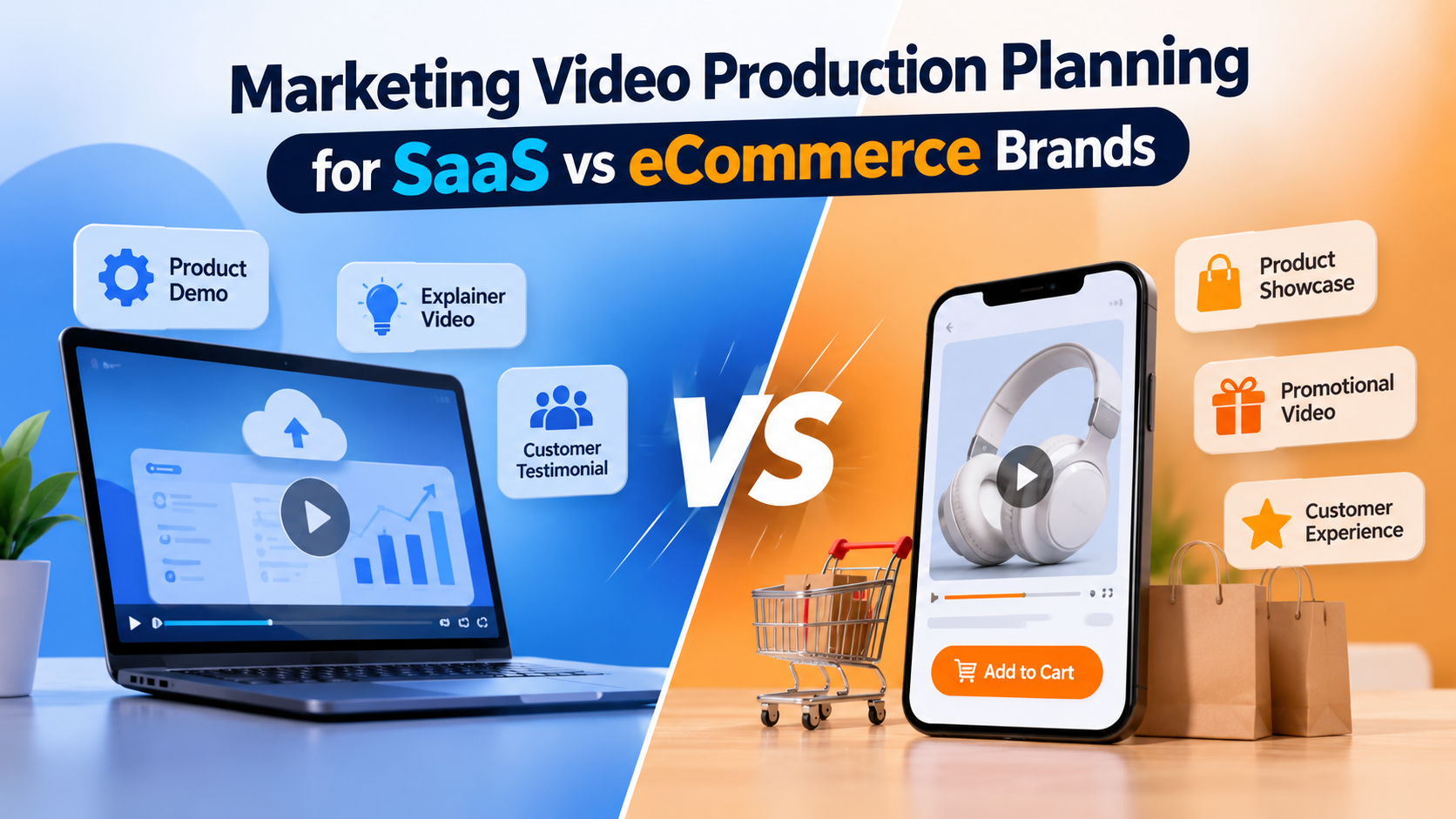
Marketing Video Production Planning for SaaS vs eCommerce Brands: Key Differences and Strategies

Video has become an important part of how businesses introduce products, explain services, and connect with potential customers. However, not every business needs the same type of video content. A software company trying to explain a complex platform has very different marketing requirements from an online store promoting clothing, electronics, or lifestyle products.
This is why marketing video production planning for SaaS vs eCommerce brands requires two different approaches. SaaS businesses generally need to communicate functionality, demonstrate solutions, and build trust in a product that customers may not fully understand at first. eCommerce brands, on the other hand, often focus on product presentation, visual appeal, customer experience, and purchase decisions.
Understanding these differences helps businesses develop video strategies that match their audience, marketing goals, and sales process.
Understanding Video Marketing Needs for SaaS Businesses
Software-as-a-Service (SaaS) companies sell digital products that customers access through the internet, usually through subscriptions. Since customers cannot physically examine a software platform before purchasing, businesses need effective ways to demonstrate its value.
A potential customer may want to know how the software works, which problems it solves, and whether it is worth paying for. Video content can answer these questions through demonstrations, animations, and practical examples.
Common video formats for SaaS brands include:
-
Product Demonstration Videos: Show how the platform works and highlight its most useful features.
-
Explainer Videos: Break down complex software concepts into simple, understandable information.
-
Tutorial Videos: Guide users through specific tasks and help them become familiar with the platform.
-
Customer Testimonial Videos: Share genuine customer experiences and demonstrate practical value.
-
Feature Announcement Videos: Introduce new tools, updates, and improvements to existing users.
The main objective is to make the software easier to understand while helping potential customers feel confident about trying it.
Understanding Video Marketing Needs for eCommerce Brands
eCommerce businesses face a different challenge. Customers cannot physically touch, inspect, or try products before ordering online. As a result, brands need visual content that helps shoppers understand what they are buying and feel confident about their purchase.
A product photograph may show what an item looks like, but a video can demonstrate its size, movement, texture, functionality, and practical use.
Popular formats for online retailers include:
-
Product Showcase Videos: Present products from different angles and highlight important details.
-
Lifestyle Videos: Show products being used in everyday situations to help customers imagine owning them.
-
Unboxing Videos: Present packaging, product presentation, and the overall buying experience.
-
Promotional Videos: Introduce discounts, seasonal offers, and new product collections.
-
Customer Experience Videos: Share customer feedback and real product experiences.
For eCommerce brands, the main objective is to make products visually appealing while answering the questions customers might have before purchasing.
SaaS vs eCommerce: The Main Differences in Video Production
Although both business models benefit from professional video content, their production priorities are quite different.
|
Production Element |
SaaS Brands |
eCommerce Brands |
|
Main Objective |
Explain software functionality |
Showcase physical products |
|
Audience Focus |
Understanding and trust |
Interest and purchase confidence |
|
Visual Approach |
UI animation, motion graphics, screen demonstrations |
Product photography, 3D visuals, lifestyle footage |
|
Storytelling |
Problem, solution, product benefits |
Product appeal, features, usage, benefits |
|
Common Formats |
Explainer and demo videos |
Product showcases and promotional videos |
|
Key Goal |
Trials, demos, and subscriptions |
Product sales and conversions |
These differences should influence every production decision, including the script, visual direction, animation style, editing pace, and final video format.
Planning a Marketing Video Production Strategy for SaaS Brands
A successful SaaS video starts with understanding the problems potential customers want to solve.
Before developing a concept, businesses should identify their target users, the challenges they face, and the features that make their software useful.
1. Identify the Main Customer Problem
Start by asking what makes your software relevant to its intended audience.
For example, a project management platform might help businesses organize tasks, manage deadlines, and improve team communication.
Instead of introducing every feature immediately, the video should first establish the problem and then demonstrate how the platform provides a solution.
2. Choose the Appropriate Visual Style
SaaS products often benefit from animation because it allows creative teams to explain digital processes without relying entirely on screen recordings.
Motion graphics can highlight important information, while animated user interfaces can demonstrate how different features work.
For more technical products, 2D or 3D animation can make complicated workflows easier to understand.
3. Develop a Focused Script
A SaaS video should not feel like a lengthy software manual.
The script should communicate one central message, explain the most relevant benefits, and guide viewers towards an appropriate next step.
For example, a homepage explainer might encourage visitors to explore the platform, while a product demonstration could invite them to schedule a free trial or request a demo.
4. Consider Future Software Updates
Software products change frequently. New features, interface updates, and improvements can make older videos less relevant.
During production planning, businesses should consider creating reusable visual assets and modular animation sequences. This makes future updates easier without requiring an entirely new production.
Planning Video Content for eCommerce Brands
For online retailers, production planning begins with understanding the product and the reasons customers might want to purchase it.
The video should make the product look appealing while providing enough information to support purchasing decisions.
1. Understand the Product's Selling Points
Every product has features that make it useful or different from competing options.
For example, a clothing brand might focus on fabric quality, stitching, fit, and styling possibilities. An electronics retailer may need to highlight functionality, design, compatibility, and ease of use.
Identifying these selling points helps determine which details deserve the most attention.
2. Select the Right Production Technique
Different products require different visual treatments.
Traditional filming works well when customers need to see real-life product usage. Studio photography and controlled lighting can help highlight material quality and design.
3D animation is another useful option when products have complex internal components or when businesses want to demonstrate features that are difficult to capture through conventional filming.
3. Create Content for Different Platforms
An eCommerce campaign may require several versions of the same video.
For example:
-
A longer product presentation for the website.
-
Short promotional clips for Instagram and Facebook.
-
Vertical videos for TikTok and Instagram Reels.
-
Product-focused advertisements for paid campaigns.
Planning these formats before production helps maintain visual consistency and reduces the need to recreate content for every platform.
4. Focus on Customer Confidence
Online shoppers often have questions about product quality, dimensions, functionality, and appearance.
A useful video should address these concerns rather than relying only on attractive visuals.
Showing a product from multiple angles, demonstrating its practical use, and highlighting important details can help customers make more informed decisions.
Choosing Between 2D Animation, 3D Animation, and Live-Action Video
The production style can influence how audiences understand and respond to a marketing video. There is no single format that works best for every business.
Live-action videos use real people, physical products, and actual environments. They are useful for lifestyle campaigns, customer testimonials, brand introductions, and product demonstrations.
The right approach depends on the message, available budget, production timeline, and intended audience. In some campaigns, combining animation with live-action footage can deliver an effective result.
Budget and Timeline Considerations for Both Business Models
Budget planning is another important difference between SaaS and eCommerce video campaigns.
SaaS production may require script development, interface design, custom animation, voiceovers, and multiple revisions. The complexity often depends on how much of the software needs to be explained.
eCommerce production costs can vary depending on the number of products, filming locations, lighting requirements, product styling, and animation complexity.
Businesses should consider the following before approving a production budget:
-
The number of videos required.
-
The complexity of the creative concept.
-
Whether filming or animation is needed.
-
Scriptwriting and storyboard requirements.
-
Voiceover, music, and sound design.
-
Editing and revision requirements.
-
Different aspect ratios and platform versions.
It is also worth considering how the finished content can be reused. A carefully planned production can provide material for website pages, social media campaigns, advertisements, and email marketing.
Measuring the Performance of Your Video Campaign
Once the video is published, businesses need to evaluate whether it is supporting their marketing objectives.
However, SaaS and eCommerce companies should not necessarily measure success in the same way.
For SaaS businesses, useful performance indicators include:
-
Website visitors who request product demonstrations.
-
Free trial registrations.
-
Video engagement and audience retention.
-
Product page interactions.
-
Subscription conversions.
For eCommerce brands, important measurements include:
-
Product page engagement.
-
Add-to-cart activity.
-
Sales generated through video campaigns.
-
Advertisement click-through rates.
-
Customer interaction with product videos.
Looking at these results helps businesses understand which creative approaches are effective and where future campaigns could improve.
How Hatch Studios Helps Brands Develop Effective Video Content
Whether a company sells software subscriptions or physical products, professional video content requires a clear creative direction and an understanding of the audience.
From concept development and storyboarding to animation and final production, each stage should support the purpose of the campaign.
Hatch Studios works with brands to develop engaging visual content through creative storytelling, animation, and professional video production.
For SaaS businesses, this can involve explaining complex digital products through clear visuals and animated demonstrations. For eCommerce brands, product-focused animation and visual presentations can help highlight features and communicate product value.
Choosing the right production approach allows businesses to create content that reflects their brand identity while addressing the needs of their customers.
Final Thoughts
SaaS and eCommerce businesses may both rely on video marketing, but their audiences expect different experiences.
Software companies need to make complex products easier to understand, demonstrate practical value, and build confidence in their platforms. Online retailers need to present physical products clearly, highlight their most important features, and help customers feel comfortable purchasing without seeing the item in person.
The most effective production strategy begins with understanding these differences. When the creative concept, storytelling, visual style, and distribution plan are aligned with business objectives, video becomes more than promotional content. It becomes a useful communication tool that supports customer relationships and business growth.


