
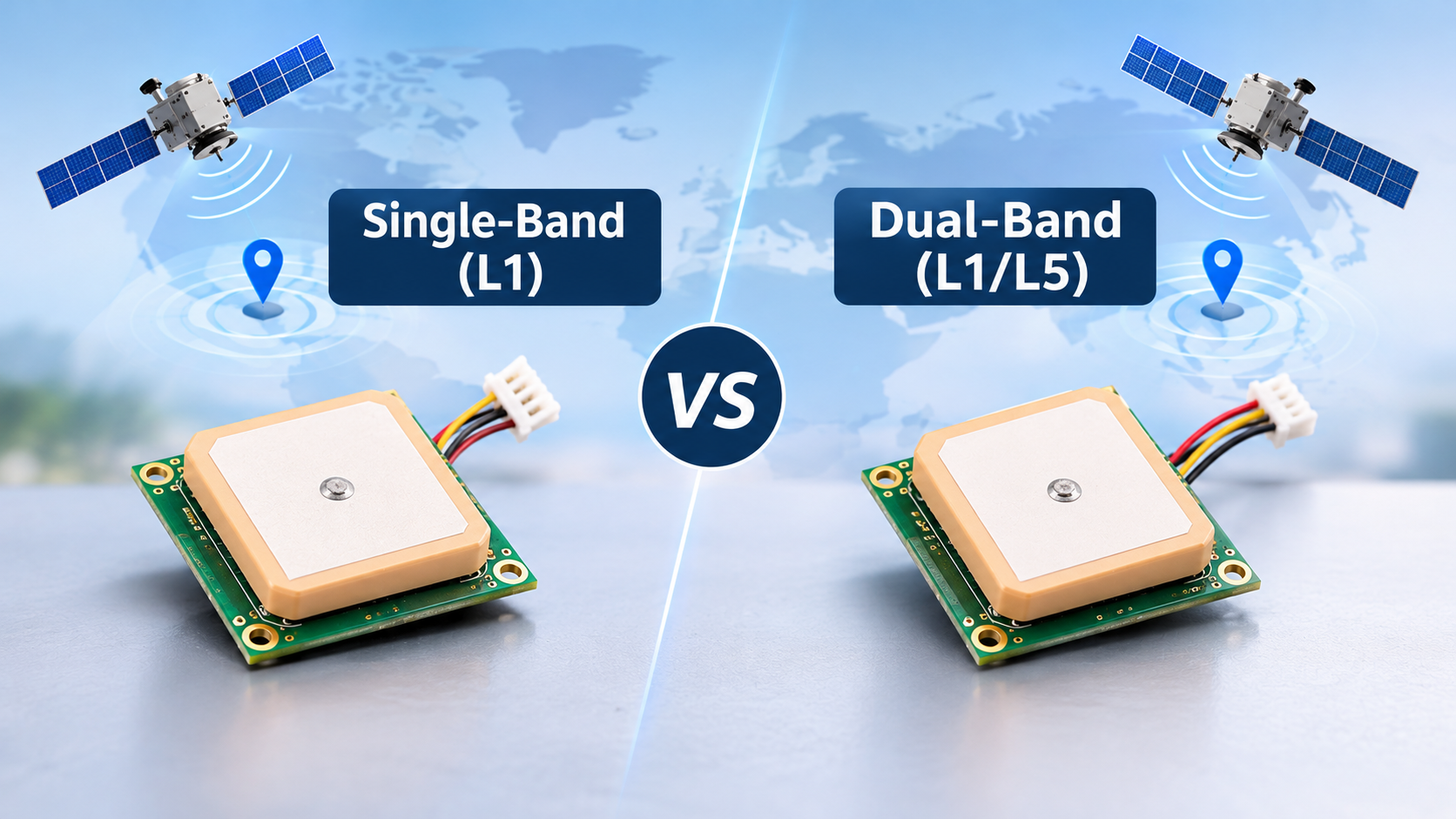

A few years ago, choosing a GNSS module was simple: almost everything on the market received the L1 band, and the main question was price. In 2026, that has changed. Dual-band L1/L5 modules are now available in tiny packages for trackers and IoT devices. In March 2026, for example, Telit Cinterion launched a dual-band module in the same 7 × 7 mm footprint as its single-band version.
So should every new design use dual-band? Not necessarily. This article explains the difference and helps you choose the right GPS module with antenna for your project.
What L1 and L5 actually mean
Satellite navigation systems transmit on several frequency bands. Two of them matter most for commercial modules:
- L1 (about 1575 MHz): the classic band, used by GPS, Galileo, GLONASS and BeiDou. Practically every GNSS module supports it.
- L5 (about 1176 MHz): the newer band, shared by GPS L5, Galileo E5a and BeiDou B2a.
A single-band module listens only to L1. A dual-band module receives L1 and L5 at the same time.
The second band brings two advantages. First, L5 signals use a faster code and more power, so the receiver can better separate direct signals from reflections. Second, with two frequencies the receiver can calculate and remove the delay caused by the ionosphere, one of the largest error sources in satellite positioning.
One detail is often overlooked: GPS L5 is still officially "pre-operational" in 2026. Today's dual-band modules therefore rely mainly on Galileo and BeiDou signals in the L5 band.
Where the difference shows
Under open sky, the gap is small. Manufacturer datasheets typically list around 1.5 to 2.5 metres (CEP50) for single-band modules and around 1 metre for dual-band modules. Both are good enough to show a truck on a map or log the position of a buoy.
In cities, the picture changes. Signals bounce off glass and concrete before they reach the antenna. In a drive test published by u-blox, an L1-only receiver showed errors of up to 30 metres in a deep urban area, while the L1/L5 receiver stayed within about 4 metres.
A simple decision guide
Single-band is usually enough for:
- vehicle and fleet tracking on roads and in rural areas
- asset tracking of containers, trailers and machines
- time synchronisation with a 1PPS output
- marine, agricultural and outdoor telemetry
Dual-band is worth it for:
- tracking in dense city centres
- e-scooters, delivery robots and drones
- lane-level navigation and precision machinery, often combined with RTK correction data
If your device mostly works under open sky, a single-band module saves cost and design effort. If it moves between buildings or needs sub-metre accuracy, plan for dual-band from the start.
Don't forget the antenna
The antenna has as much influence on performance as the chip. That is why many developers choose a GPS module with antenna already integrated. It removes RF design work, avoids layout mistakes and shortens time to market, which is especially useful for prototypes, small series and retrofits.
For dual-band designs, the antenna must cover both bands. Such antennas tend to be larger and more expensive, and they often need a bigger ground plane. A dual-band module paired with an L1-only antenna simply behaves like a single-band module.
For compact L1 designs, a ready-made GPS module with antenna is often the fastest route. Typical examples combine a built-in active antenna, GPS and GLONASS reception, NMEA output and a 1PPS pin on a board just a few centimetres wide.
Other points to check
Before you decide, compare these details in the datasheet:
- supported satellite systems (GPS plus GLONASS, Galileo or BeiDou)
- interface and signal level (UART at TTL or RS-232 level, USB, I²C)
- protocol (NMEA for standard software, binary for full configuration)
- update rate (1 Hz for trackers, up to 10 Hz for fast vehicles)
- current consumption in tracking mode
- temperature range and EMI shielding near cellular modems
Conclusion
Dual-band is the future of precise positioning, especially in urban areas. But for many tracking, telemetry and timing applications, a proven single-band module still offers the best value in 2026. Define where your device works and how accurate it must be, then choose the module. That order saves money and avoids redesigns.
Frequently asked questions
Is a dual-band GPS module always more accurate? Under open sky, the difference is often only about a metre. The real advantage appears in cities, where reflections cause large errors for L1-only receivers.
Can I use GPS L5 signals today? GPS L5 is still pre-operational. Dual-band modules mainly use Galileo E5a and BeiDou B2a, which share the same frequency.
Does a dual-band module need a special antenna? Yes. The antenna must receive both around 1176 MHz and 1575 MHz. With an L1-only antenna, you lose the dual-band benefit.
Why choose a module with an integrated antenna? It saves RF design work and development time. It is ideal for compact devices, prototypes and small production runs.
What accuracy can I expect from a single-band module? Under open sky, typically 1.5 to 2.5 metres according to manufacturer datasheets. Near tall buildings or under dense trees, errors can grow much larger.
Does dual-band use more power? Not necessarily. Power consumption depends strongly on the chip generation, so always compare the tracking current in the datasheets.
Read More: https://tecsysproductguides.blogspot.com/2026/11/l1-or-l1l5-how-to-choose-right-gps.html


