
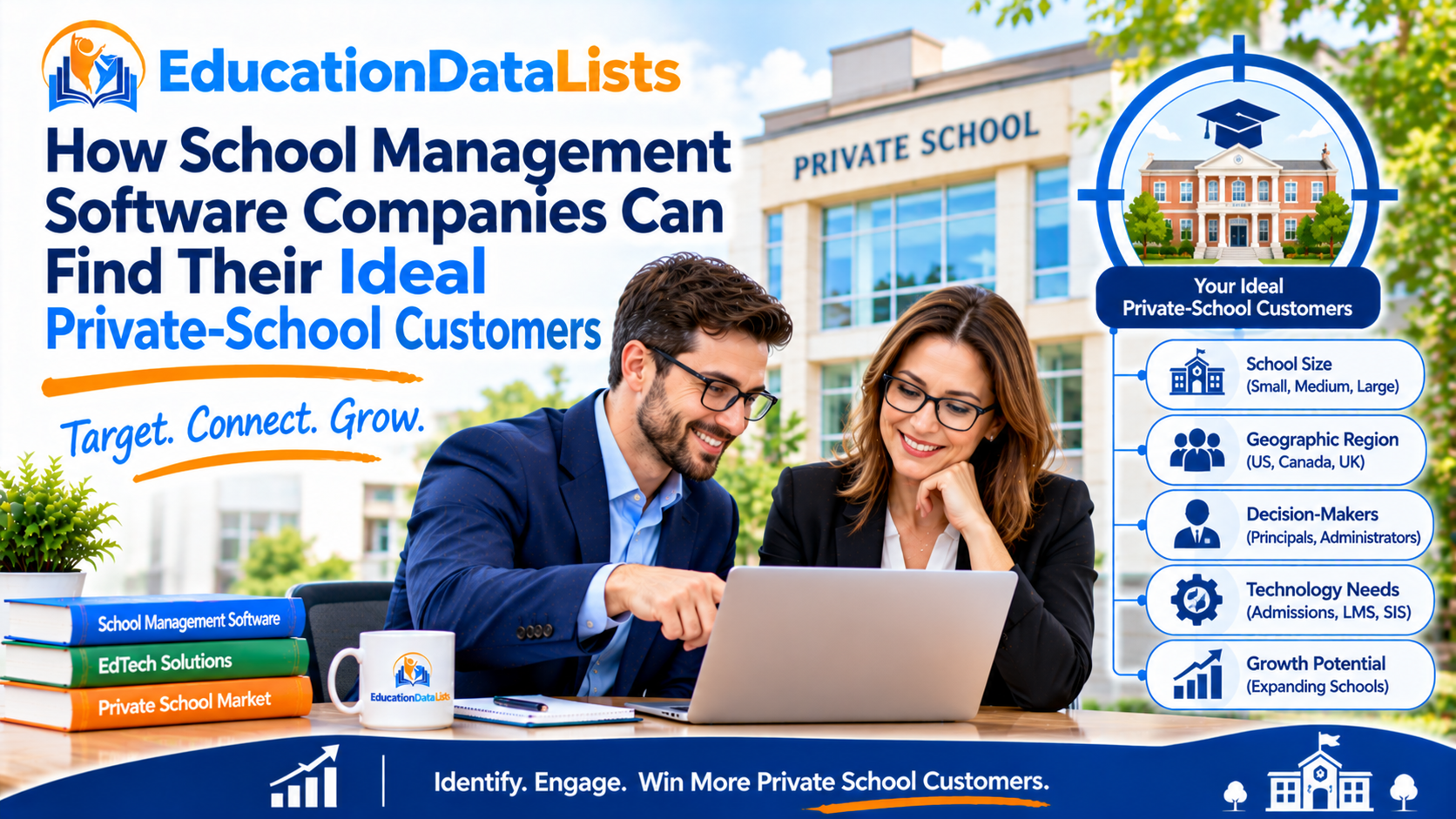
How School Management Software Companies Can Find Their Ideal Private-School Customers | EducationDataLists

Private schools are not a single, uniform software market. Their enrolment, educational models, technology requirements, budgets, and administrative structures vary considerably. The latest National Center for Education Statistics (NCES) Private School Universe Survey, published in May 2026, counted 30,553 private K–12 schools serving approximately 5.1 million students in the 2023–24 school year. It also found that about 39% of private schools enrolled fewer than 50 students.
For school management software companies, these differences matter: a small independent school may need straightforward attendance and fee administration, while a larger institution may require integrated admissions, finance, learning, and reporting systems. Finding the right prospects means researching each school's operating model before using a Private School Email List to begin outreach.
1. Segment Private Schools by Size and Operational Complexity
The first step is to identify which types of schools are most likely to benefit from the software. A small independent school and a large multi-campus institution may both need student information systems, but their requirements and purchasing capacity can be very different.
NCES reported an average private-school enrolment of 167 students in 2023–24. Approximately 39% of private schools enrolled fewer than 50 students, while average enrolment was 113 students for elementary and middle schools and 252 for secondary and high schools. NCES, 2026
These figures have direct implications for software positioning. Smaller schools may prioritize:
-
Affordable subscription plans
-
Simple student records and attendance management
-
Fee collection and parent communication
-
Easy onboarding without dedicated IT staff
-
Straightforward reporting and administration
Larger schools may need more advanced capabilities, including multi-campus administration, admissions workflows, financial reporting, staff management, integrations, and customizable permissions.
Software companies should therefore segment prospects by enrolment, number of campuses, school level, and administrative complexity. A Private School Mailing List becomes more valuable when it supports this kind of segmentation rather than treating every institution as an identical prospect.
2. Understand the School's Educational Model and Affiliation
Private schools operate under different educational philosophies, religious affiliations, and program structures. These differences can influence the software features that matter most to school administrators.
The 2023–24 NCES survey found that 67% of private schools had a religious orientation or purpose, accounting for 76% of private-school students. Approximately 71% of schools emphasized a regular elementary or secondary program, while 8% emphasized early childhood education. NCES, 2026
This diversity means software vendors should research the institution's educational model before developing a sales pitch.
For example:
-
Faith-based schools: May need communication and administration features that accommodate religious education, community activities, and institution-specific reporting.
-
Montessori schools: May value flexible student progress records and tools that accommodate individualized learning approaches.
-
Special education schools: May need configurable student support records, accessibility features, and carefully controlled information access.
-
Traditional independent schools: May prioritize admissions, tuition management, academic reporting, and parent communication.
-
Early childhood-focused schools: May need attendance tracking, family communication, scheduling, and child-specific administrative records.
A generic demonstration may fail to show how a platform fits a school's actual operations. Vendors should use the school's published curriculum, program descriptions, and educational philosophy to make product demonstrations more relevant.
3. Identify the Software Problems Schools Are Trying to Solve
School management software can cover several different operational areas. Some schools want to replace disconnected spreadsheets and manual records, while others are looking to integrate existing systems or improve specific workflows.
The NCES 2023–24 survey recorded 517,780 full-time-equivalent private-school teachers and an average pupil-to-teacher ratio of 9.8. The ratio varied by school level, reaching 10.4 in secondary and high schools. NCES, 2026
These figures describe the scale and variation of private-school operations, but they do not establish which software systems individual schools currently use. Vendors should investigate that separately.
Useful research areas include:
-
Student information management: Student profiles, enrolment records, attendance, and academic histories.
-
Admissions management: Applications, enquiries, assessments, enrolment decisions, and document collection.
-
Finance and fee administration: Tuition billing, payment tracking, invoices, and financial reporting.
-
Parent communication: Announcements, messages, notifications, and access to student information.
-
Staff administration: Employee records, schedules, permissions, and internal communication.
-
Academic management: Timetables, grades, assessments, report cards, and progress tracking.
The important question is not simply whether a school needs management software. It is which administrative problem is creating enough friction to justify a purchase or system change.
A vendor offering an integrated platform should identify disconnected processes that its product can realistically improve. A specialist admissions platform, meanwhile, should focus on application management and enrolment workflows rather than promoting unrelated features.
4. Research Technology Readiness, Integrations, and AI Policies
A school may be interested in new software but reluctant to replace systems that already work. Compatibility with existing technology, data migration, user training, and implementation time can all influence purchasing decisions.
The National Association of Independent Schools (NAIS) published its 2026 AI in Independent Schools Report in October 2026. The research examines AI adoption across independent schools, including differences in adoption by role, the development of school policies, training, and educators' perceptions. It reflects a sector in which school leaders are actively considering how emerging technology should fit into teaching and administration. NAIS, 2026
For school management software companies, this makes technology-readiness research increasingly important. Prospects may differ in their willingness to adopt cloud-based platforms, automated workflows, AI-enabled features, or integrations with other educational systems.
Before approaching a school, investigate:
-
Whether it already uses a student information system or school management platform
-
Whether its systems are cloud-based, locally hosted, or a combination
-
Which accounting, learning management, admissions, and communication tools it uses
-
Whether it has a technology coordinator or dedicated IT team
-
Whether it has published policies for AI use and student data
-
Whether it is planning a technology upgrade or system replacement
Vendors should also be prepared to explain data migration, integration options, support arrangements, and the limits of any AI-powered features. Avoid claiming that a platform will integrate seamlessly with existing systems unless the compatibility has been verified.
5. Evaluate Data Security and Student Privacy Requirements
School management systems can store sensitive information, including student records, family contact details, attendance, academic performance, and financial information. Security and privacy are therefore central considerations in software evaluation.
The 2025 CIS/MS-ISAC K–12 Cybersecurity Report analyzed more than 5,000 K–12 organizations between July 2023 and December 2024. It reported that 82% of reporting schools experienced cyber-threat impacts during the period, alongside approximately 14,000 security events and 8,100 confirmed cybersecurity incidents. The report covers K–12 organizations broadly and should not be interpreted as a private-school-only measurement. Center for Internet Security, 2025
For software vendors, the findings reinforce the importance of making security capabilities clear during the sales process.
School leaders may want information about:
-
Data encryption and secure authentication
-
Role-based access controls
-
Backup and recovery procedures
-
Audit logs and account monitoring
-
Data retention and deletion policies
-
Incident response and breach notification processes
-
Third-party integrations and data-sharing practices
Vendors serving U.S. schools should also understand the relevant privacy framework. FERPA applies to educational agencies and institutions receiving funds under applicable U.S. Department of Education programs, while COPPA can apply to online services collecting personal information from children under 13. The exact obligations depend on the service, data practices, and legal relationship with the school.
A software demonstration should therefore include more than user-interface features. Clear documentation about security, privacy, permissions, and data handling can help establish credibility with school administrators.
6. Find the Actual Software Decision-Makers
A school principal or head of school may be an important contact, but software purchasing often involves several people. The buying group depends on the platform's purpose, cost, technical complexity, and the school's organizational structure.
Potential contacts include:
| Contact role | Likely area of interest |
|---|---|
| Head of School / Principal | Strategic value and school-wide operations |
| School Business Manager | Finance, tuition, billing, and reporting |
| Admissions Director | Applications, enquiries, and enrolment workflows |
| IT Director / Technology Coordinator | Security, integrations, migration, and technical support |
| Registrar | Student records and academic administration |
| Academic Dean / Curriculum Director | Timetables, grades, and academic reporting |
| Operations Manager | Scheduling, facilities, and administrative efficiency |
In a smaller institution, one administrator may manage several of these responsibilities. Larger schools may have separate teams for admissions, finance, technology, and academic operations.
The latest NAIS 2025–2026 State of the Independent School Sector report, published in April 2026, examines admissions, enrolment, tuition, financial aid, advancement, employee information, and financial operations. These areas illustrate the range of responsibilities that school leaders must consider when evaluating operational systems. NAIS, 2026
Software companies should map the likely buying group before launching outreach. A finance platform should prioritize business managers and finance leaders, while a student information system may require conversations with school leadership, registrars, and technology staff.
A Private School Email Database that includes relevant job titles, school names, locations, and institutional characteristics can help sales teams identify these contacts. However, contact records should be checked against current school websites and other reliable sources before use.
7. Use School-Specific Research to Personalize Outreach
Once a target segment and decision-making group have been identified, vendors should tailor their messaging to the school's likely priorities.
A school with multiple campuses may be interested in consolidated reporting and centralized administration. A smaller independent school may care more about affordability and ease of use. A school planning an admissions expansion may be more receptive to an enrolment-management solution than a general-purpose software pitch.
Useful sources for prospect research include:
-
School websites and published staff directories
-
Admissions pages and enrolment information
-
Job advertisements for technology or administrative roles
-
Public announcements about new campuses or programs
-
Published technology and privacy policies
-
School association directories and institutional profiles
Personalization should be based on verifiable information. For example, if a school publicly advertises a new campus, a vendor may discuss multi-campus administration. It should not assume the school has a specific software problem unless there is evidence to support that conclusion.
EducationDataLists provides education-sector contact-data resources that can help software companies identify private-school audiences. A Private School Email List can support initial prospect identification, while institution-level research and role-based segmentation help make the resulting outreach more relevant.
Practical Takeaways for School Management Software Companies
Before launching a private-school prospecting campaign, sales and marketing teams should:
-
Segment schools by size and structure: Separate small independent schools, larger institutions, and multi-campus organizations.
-
Research educational models: Identify religious affiliation, Montessori programs, special education, and other relevant institutional characteristics.
-
Identify operational needs: Match the software's capabilities to admissions, attendance, finance, academic records, or communication challenges.
-
Map the buying group: Include school leadership, business managers, IT contacts, admissions teams, and registrars as appropriate.
-
Prioritize security and integration: Prepare clear information about data protection, compatibility, implementation, and ongoing support.
Conclusion
Finding ideal private-school customers requires more than building a large prospect database. The NCES 2023–24 survey shows that private schools differ substantially in enrolment, educational level, and institutional characteristics. NAIS research also highlights the importance of financial operations and changing technology considerations across the independent-school sector.
For school management software companies, the strongest prospecting strategy combines institution-level research, accurate decision-maker information, and a clear understanding of operational needs. A carefully segmented Private School Mailing List can help identify potential customers, but meaningful conversations depend on showing how the software fits each school's structure, budget, technology environment, and priorities. The goal should be to establish a practical business case—not simply secure a product demonstration.
Frequently Asked Questions
1. How can school management software companies identify ideal private-school customers?
They should segment schools by enrolment, educational model, number of campuses, administrative structure, and technology requirements. This helps identify institutions whose operational needs match the software's capabilities and pricing.
2. Who should software vendors contact at private schools?
Relevant contacts may include the head of school, principal, business manager, admissions director, IT director, registrar, or operations manager. The best contact depends on whether the product focuses on finance, admissions, student records, technology, or general administration.
3. How should companies segment a Private School Email List?
Useful segmentation fields include school size, grade levels, religious or nonsectarian orientation, location, number of campuses, and job title. Vendors can then create separate campaigns for small independent schools, larger institutions, and specialist schools.
4. What features do private schools look for in school management software?
Common requirements include student information management, attendance, admissions, tuition billing, academic reporting, parent communication, and staff administration. The priority features vary according to the school's size, educational model, and existing technology.
5. Why is data security important for private-school management software?
School platforms may process sensitive student, parent, staff, and financial information. Vendors should be ready to explain access controls, encryption, backups, privacy practices, and applicable legal obligations, including FERPA or COPPA where relevant.
6. What is the difference between a Private School Mailing List and a Private School Email Database?
A Private School Mailing List generally refers to a collection of private-school contacts for outreach. A Private School Email Database may include additional information such as school size, location, affiliation, job titles, and other segmentation fields. The exact coverage depends on the data provider.
7. How can software vendors improve outreach to private-school administrators?
They should research each school's structure, identify the relevant decision-makers, and connect the product to a specific operational requirement. Messages supported by relevant examples, clear implementation information, and transparent security details are more useful than generic software promotions.


